

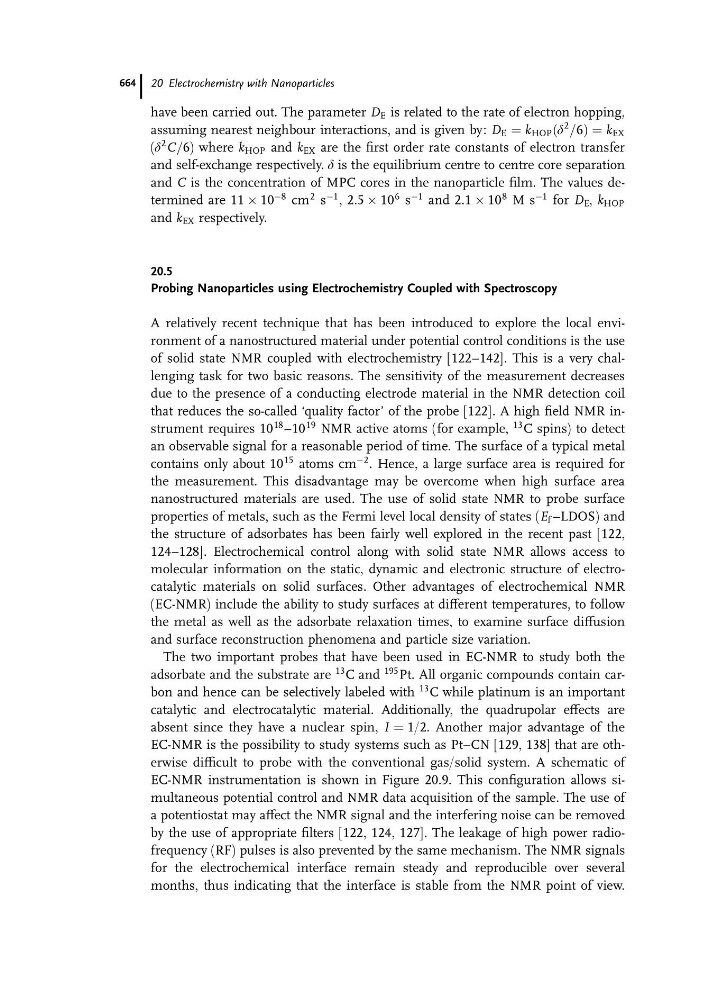
have been carried out. The parameter D E is related to the rate of electron hopping,
assuming nearest neighbour interactions, and is given by: D E ¼ k HOP ðd
2 =6Þ ¼ k EX
(d
2 C=6) where k HOP and k EX are the first order rate constants of electron transfer
and self-exchange respectively. d is the equilibrium centre to centre core separation
and C is the concentration of MPC cores in the nanoparticle film. The values determined are 11 Â 10
À8 cm
2 s
À1 , 2.5 Â 10
6 s
À1 and 2.1 Â 10
8 M s
À1 for D E , k HOP
and k EX respectively.
20.5
Probing Nanoparticles using Electrochemistry Coupled with Spectroscopy
A relatively recent technique that has been introduced to explore the local environment of a nanostructured material under potential control conditions is the use
of solid state NMR coupled with electrochemistry [122–142]. This is a very challenging task for two basic reasons. The sensitivity of the measurement decreases
due to the presence of a conducting electrode material in the NMR detection coil
that reduces the so-called ‘quality factor’ of the probe [122]. A high field NMR instrument requires 10
18 –10
19 NMR active atoms (for example,
13 C spins) to detect
an observable signal for a reasonable period of time. The surface of a typical metal
contains only about 10
15 atoms cm
À2 . Hence, a large surface area is required for
the measurement. This disadvantage may be overcome when high surface area
nanostructured materials are used. The use of solid state NMR to probe surface
properties of metals, such as the Fermi level local density of states (E f –LDOS) and
the structure of adsorbates has been fairly well explored in the recent past [122,
124–128]. Electrochemical control along with solid state NMR allows access to
molecular information on the static, dynamic and electronic structure of electrocatalytic materials on solid surfaces. Other advantages of electrochemical NMR
(EC-NMR) include the ability to study surfaces at different temperatures, to follow
the metal as well as the adsorbate relaxation times, to examine surface diffusion
and surface reconstruction phenomena and particle size variation.
The two important probes that have been used in EC-NMR to study both the
adsorbate and the substrate are
13 C and
195 Pt. All organic compounds contain carbon and hence can be selectively labeled with
13 C while platinum is an important
catalytic and electrocatalytic material. Additionally, the quadrupolar effects are
absent since they have a nuclear spin, I ¼ 1/2. Another major advantage of the
EC-NMR is the possibility to study systems such as PtaCN [129, 138] that are otherwise difficult to probe with the conventional gas/solid system. A schematic of
EC-NMR instrumentation is shown in Figure 20.9. This configuration allows simultaneous potential control and NMR data acquisition of the sample. The use of
a potentiostat may affect the NMR signal and the interfering noise can be removed
by the use of appropriate filters [122, 124, 127]. The leakage of high power radiofrequency (RF) pulses is also prevented by the same mechanism. The NMR signals
for the electrochemical interface remain steady and reproducible over several
months, thus indicating that the interface is stable from the NMR point of view.
20 Electrochemistry with Nanoparticles
664