

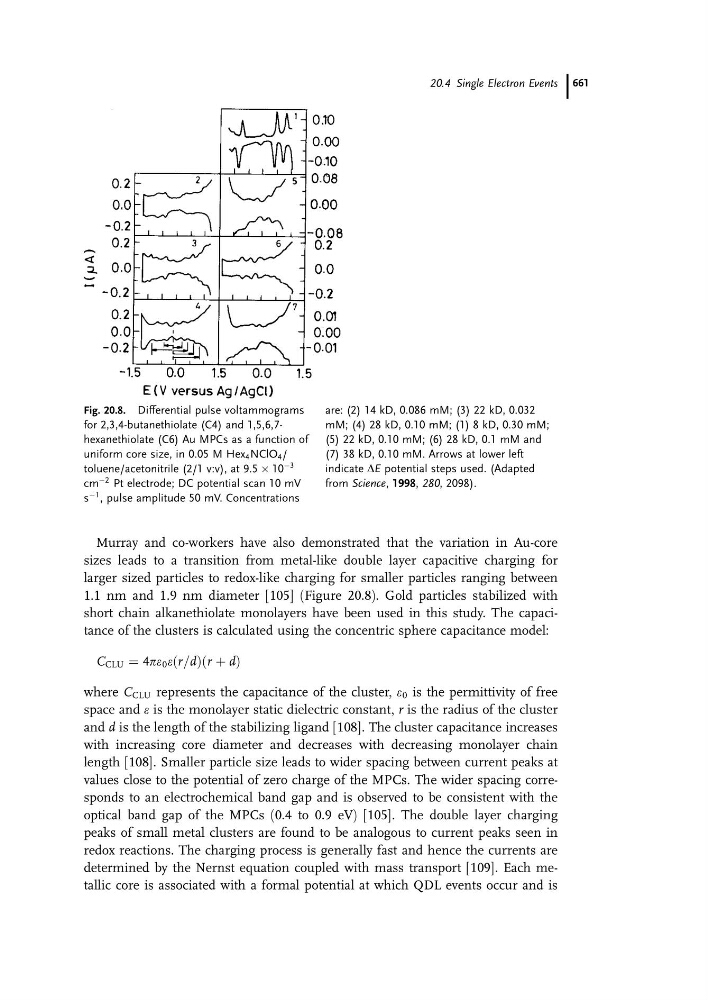
Murray and co-workers have also demonstrated that the variation in Au-core
sizes leads to a transition from metal-like double layer capacitive charging for
larger sized particles to redox-like charging for smaller particles ranging between
1.1 nm and 1.9 nm diameter [105] (Figure 20.8). Gold particles stabilized with
short chain alkanethiolate monolayers have been used in this study. The capacitance of the clusters is calculated using the concentric sphere capacitance model:
C CLU ¼ 4pe 0 eðr=dÞðr þ dÞ
where C CLU represents the capacitance of the cluster, e 0 is the permittivity of free
space and e is the monolayer static dielectric constant, r is the radius of the cluster
and d is the length of the stabilizing ligand [108]. The cluster capacitance increases
with increasing core diameter and decreases with decreasing monolayer chain
length [108]. Smaller particle size leads to wider spacing between current peaks at
values close to the potential of zero charge of the MPCs. The wider spacing corresponds to an electrochemical band gap and is observed to be consistent with the
optical band gap of the MPCs (0.4 to 0.9 eV) [105]. The double layer charging
peaks of small metal clusters are found to be analogous to current peaks seen in
redox reactions. The charging process is generally fast and hence the currents are
determined by the Nernst equation coupled with mass transport [109]. Each metallic core is associated with a formal potential at which QDL events occur and is
Fig. 20.8. Differential pulse voltammograms
for 2,3,4-butanethiolate (C4) and 1,5,6,7hexanethiolate (C6) Au MPCs as a function of
uniform core size, in 0.05 M Hex 4 NClO 4 /
toluene/acetonitrile (2/1 v:v), at 9.5 Â 10
À3
cm
À2 Pt electrode; DC potential scan 10 mV
s
À1 , pulse amplitude 50 mV. Concentrations
are: (2) 14 kD, 0.086 mM; (3) 22 kD, 0.032
mM; (4) 28 kD, 0.10 mM; (1) 8 kD, 0.30 mM;
(5) 22 kD, 0.10 mM; (6) 28 kD, 0.1 mM and
(7) 38 kD, 0.10 mM. Arrows at lower left
indicate DE potential steps used. (Adapted
from Science, 1998, 280, 2098).
20.4 Single Electron Events 661