

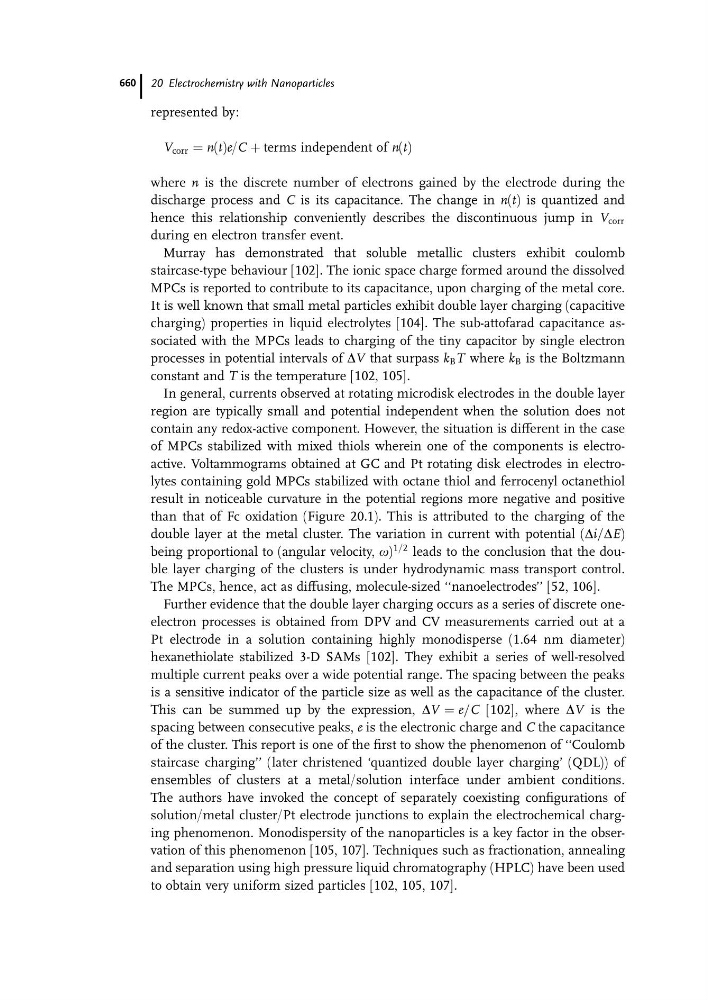
represented by:
V corr ¼ n(t)e/C þ terms independent of n(t)
where n is the discrete number of electrons gained by the electrode during the
discharge process and C is its capacitance. The change in n(t) is quantized and
hence this relationship conveniently describes the discontinuous jump in V corr
during en electron transfer event.
Murray has demonstrated that soluble metallic clusters exhibit coulomb
staircase-type behaviour [102]. The ionic space charge formed around the dissolved
MPCs is reported to contribute to its capacitance, upon charging of the metal core.
It is well known that small metal particles exhibit double layer charging (capacitive
charging) properties in liquid electrolytes [104]. The sub-attofarad capacitance associated with the MPCs leads to charging of the tiny capacitor by single electron
processes in potential intervals of DV that surpass k B T where k B is the Boltzmann
constant and T is the temperature [102, 105].
In general, currents observed at rotating microdisk electrodes in the double layer
region are typically small and potential independent when the solution does not
contain any redox-active component. However, the situation is different in the case
of MPCs stabilized with mixed thiols wherein one of the components is electroactive. Voltammograms obtained at GC and Pt rotating disk electrodes in electrolytes containing gold MPCs stabilized with octane thiol and ferrocenyl octanethiol
result in noticeable curvature in the potential regions more negative and positive
than that of Fc oxidation (Figure 20.1). This is attributed to the charging of the
double layer at the metal cluster. The variation in current with potential (Di=DE)
being proportional to (angular velocity, o)
1=2 leads to the conclusion that the double layer charging of the clusters is under hydrodynamic mass transport control.
The MPCs, hence, act as diffusing, molecule-sized ‘‘nanoelectrodes’’ [52, 106].
Further evidence that the double layer charging occurs as a series of discrete oneelectron processes is obtained from DPV and CV measurements carried out at a
Pt electrode in a solution containing highly monodisperse (1.64 nm diameter)
hexanethiolate stabilized 3-D SAMs [102]. They exhibit a series of well-resolved
multiple current peaks over a wide potential range. The spacing between the peaks
is a sensitive indicator of the particle size as well as the capacitance of the cluster.
This can be summed up by the expression, DV ¼ e=C [102], where DV is the
spacing between consecutive peaks, e is the electronic charge and C the capacitance
of the cluster. This report is one of the first to show the phenomenon of ‘‘Coulomb
staircase charging’’ (later christened ‘quantized double layer charging’ (QDL)) of
ensembles of clusters at a metal/solution interface under ambient conditions.
The authors have invoked the concept of separately coexisting configurations of
solution/metal cluster/Pt electrode junctions to explain the electrochemical charging phenomenon. Monodispersity of the nanoparticles is a key factor in the observation of this phenomenon [105, 107]. Techniques such as fractionation, annealing
and separation using high pressure liquid chromatography (HPLC) have been used
to obtain very uniform sized particles [102, 105, 107].
20 Electrochemistry with Nanoparticles
660