

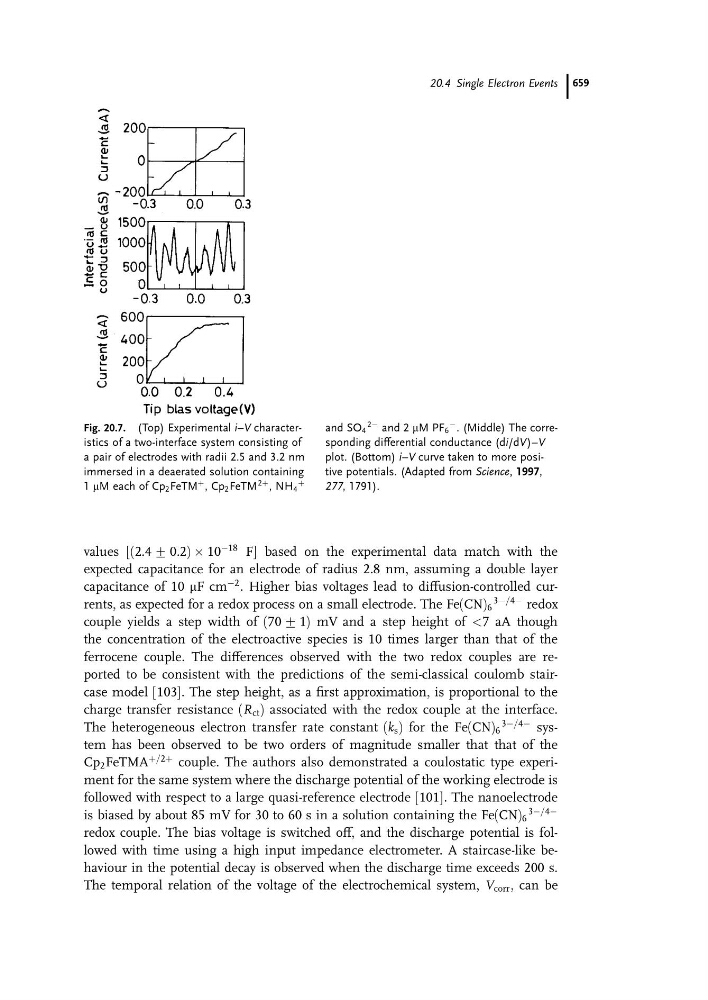
values [(2.4 G 0.2) Â 10
À18 F] based on the experimental data match with the
expected capacitance for an electrode of radius 2.8 nm, assuming a double layer
capacitance of 10 mF cm
À2 . Higher bias voltages lead to diffusion-controlled currents, as expected for a redox process on a small electrode. The Fe(CN) 6
3À=4À redox
couple yields a step width of (70 G 1) mV and a step height of <7 aA though
the concentration of the electroactive species is 10 times larger than that of the
ferrocene couple. The differences observed with the two redox couples are reported to be consistent with the predictions of the semi-classical coulomb staircase model [103]. The step height, as a first approximation, is proportional to the
charge transfer resistance (R ct ) associated with the redox couple at the interface.
The heterogeneous electron transfer rate constant (k s ) for the Fe(CN) 6
3À=4À system has been observed to be two orders of magnitude smaller that that of the
Cp 2 FeTMA
þ=2þ couple. The authors also demonstrated a coulostatic type experiment for the same system where the discharge potential of the working electrode is
followed with respect to a large quasi-reference electrode [101]. The nanoelectrode
is biased by about 85 mV for 30 to 60 s in a solution containing the Fe(CN) 6
3À=4À
redox couple. The bias voltage is switched off, and the discharge potential is followed with time using a high input impedance electrometer. A staircase-like behaviour in the potential decay is observed when the discharge time exceeds 200 s.
The temporal relation of the voltage of the electrochemical system, V corr , can be
Fig. 20.7. (Top) Experimental i–V characteristics of a two-interface system consisting of
a pair of electrodes with radii 2.5 and 3.2 nm
immersed in a deaerated solution containing
1 mM each of Cp 2 FeTM
þ , Cp 2 FeTM
2þ , NH 4
þ
and SO 4
2À and 2 mM PF 6
À . (Middle) The corresponding differential conductance (di/dV)–V
plot. (Bottom) i–V curve taken to more positive potentials. (Adapted from Science, 1997,
277, 1791).
20.4 Single Electron Events 659