

properties of nanoparticles through the use of scanning tunneling microscopy
(STM). Weaver and Gao have reported the sequential electron transfer kinetics for
solution phase Pt-carbonyl clusters and correlated this phenomenon to the bulk
metal/vacuum interface [100]. The use of electrochemistry to follow the discrete
charging events that occur at a metal/solution interface is of recent origin [101,
102].
Fan and Bard described the observation of single electron processes with
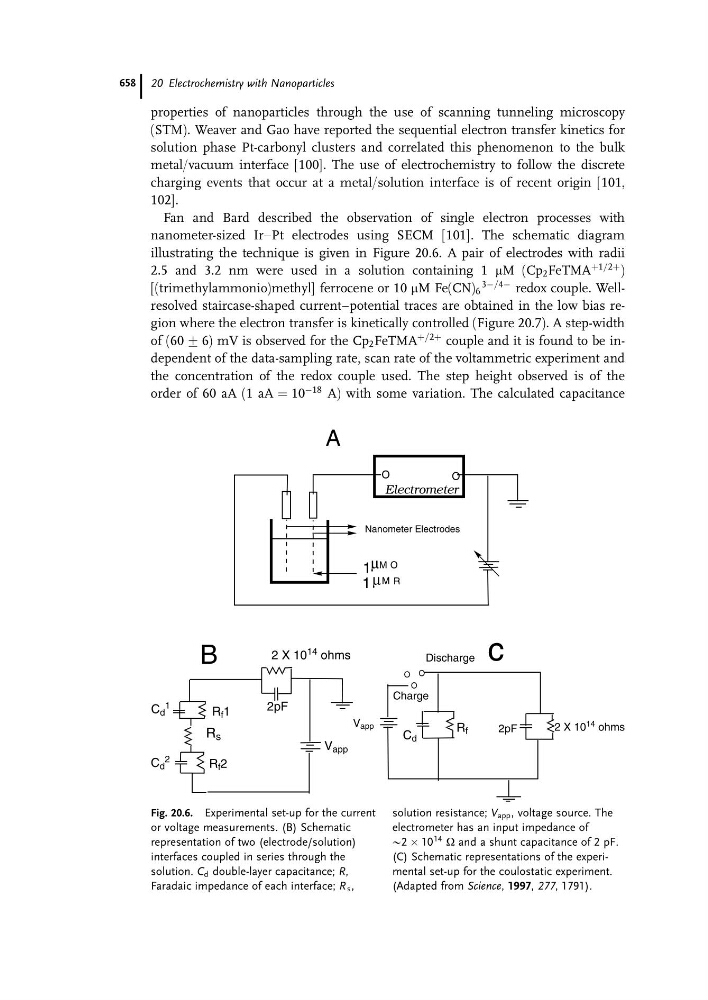
nanometer-sized IraPt electrodes using SECM [101]. The schematic diagram
illustrating the technique is given in Figure 20.6. A pair of electrodes with radii
2.5 and 3.2 nm were used in a solution containing 1 mM (Cp 2 FeTMA
þ1=2þ )
[(trimethylammonio)methyl] ferrocene or 10 mM Fe(CN) 6
3À=4À redox couple. Wellresolved staircase-shaped current–potential traces are obtained in the low bias region where the electron transfer is kinetically controlled (Figure 20.7). A step-width
of (60 G 6) mV is observed for the Cp 2 FeTMA
þ=2þ couple and it is found to be independent of the data-sampling rate, scan rate of the voltammetric experiment and
the concentration of the redox couple used. The step height observed is of the
order of 60 aA (1 aA ¼ 10
À18 A) with some variation. The calculated capacitance
O
O
A
Electrometer
Nanometer Electrodes
µ
1 µ
1
O
O
O
B
Discharge
Charge
V app
2 X 10 14 ohms
2pF
2 X 10
14 ohms
R f 1
R s
R f 2
C d
1
V app
C d
2
2pF
c
M
M R
O
C d
R f
Fig. 20.6. Experimental set-up for the current
or voltage measurements. (B) Schematic
representation of two (electrode/solution)
interfaces coupled in series through the
solution. C d double-layer capacitance; R,
Faradaic impedance of each interface; R s ,
solution resistance; V app , voltage source. The
electrometer has an input impedance of
@2 Â 10
14 W and a shunt capacitance of 2 pF.
(C) Schematic representations of the experimental set-up for the coulostatic experiment.
(Adapted from Science, 1997, 277, 1791).
20 Electrochemistry with Nanoparticles
658