

[75]. One side is filled with 1 mM KCl while the other side is filled with either 0.5
mM solution of a cationic dye, methylene blue or 1 mM of KMnO 4 solution. In the
former case, the transport is observed from one half of the cell to the other while
the latter does not penetrate through the membrane. This is clear evidence to show
that the membranes transport a large cation while a small anion does not pass
through. This cation permselectivity or charge based selectivity is further explored
by potentiometry [75]. The authors go on to demonstrate that the selectivity towards cations or anions can be controlled by the potential applied to the membrane [75].
The size-based selective separation has been in use in the form of dialysis for a
long time. The nanofiltration membranes demonstrated here combine both size
and chemical transport selectivity and are selective for the particular separation
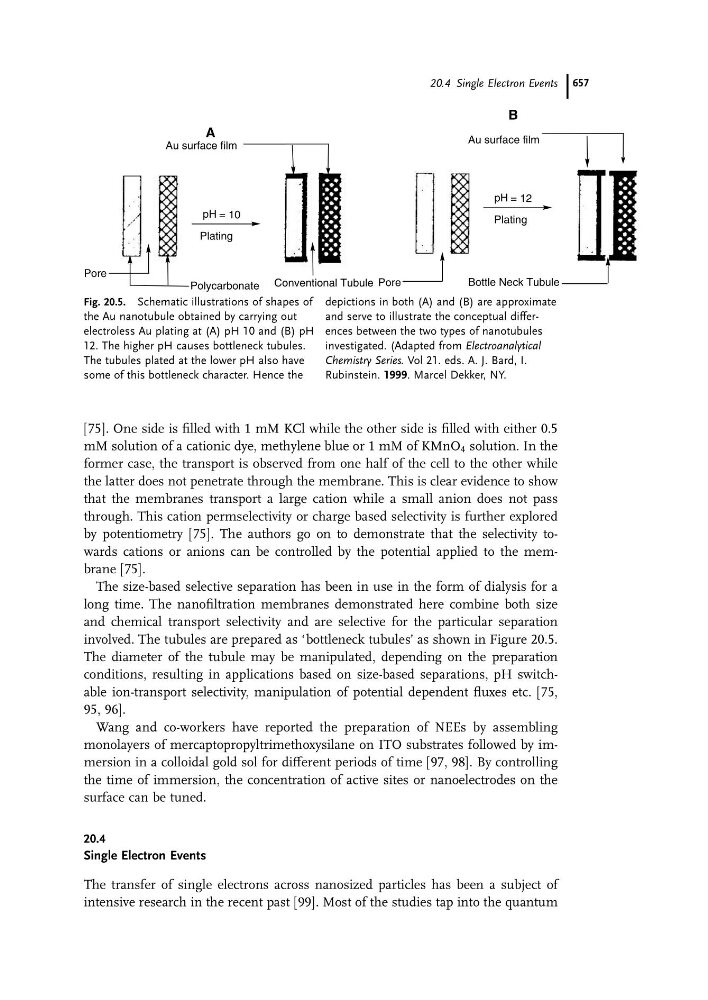
involved. The tubules are prepared as ‘bottleneck tubules’ as shown in Figure 20.5.
The diameter of the tubule may be manipulated, depending on the preparation
conditions, resulting in applications based on size-based separations, pH switchable ion-transport selectivity, manipulation of potential dependent fluxes etc. [75,
95, 96].
Wang and co-workers have reported the preparation of NEEs by assembling
monolayers of mercaptopropyltrimethoxysilane on ITO substrates followed by immersion in a colloidal gold sol for different periods of time [97, 98]. By controlling
the time of immersion, the concentration of active sites or nanoelectrodes on the
surface can be tuned.
20.4
Single Electron Events
The transfer of single electrons across nanosized particles has been a subject of
intensive research in the recent past [99]. Most of the studies tap into the quantum
Pore
Au surface film
Pore
Bottle Neck Tubule
Plating
pH = 12
Au surface film
Plating
pH = 10
Polycarbonate Conventional Tubule
B
A
Fig. 20.5. Schematic illustrations of shapes of
the Au nanotubule obtained by carrying out
electroless Au plating at (A) pH 10 and (B) pH
12. The higher pH causes bottleneck tubules.
The tubules plated at the lower pH also have
some of this bottleneck character. Hence the
depictions in both (A) and (B) are approximate
and serve to illustrate the conceptual differences between the two types of nanotubules
investigated. (Adapted from Electroanalytical
Chemistry Series. Vol 21. eds. A. J. Bard, I.
Rubinstein. 1999. Marcel Dekker, NY.
20.4 Single Electron Events 657