

electrochemically switchable ion exchangers. The authors refer to these materials,
based on their property to separate molecules as a function of size, as ‘molecular
filters’ [93, 94].
The selective ion transport phenomenon using NEEs is exemplified in a simple
experiment where a membrane separates two different solutions in a U–tube cell
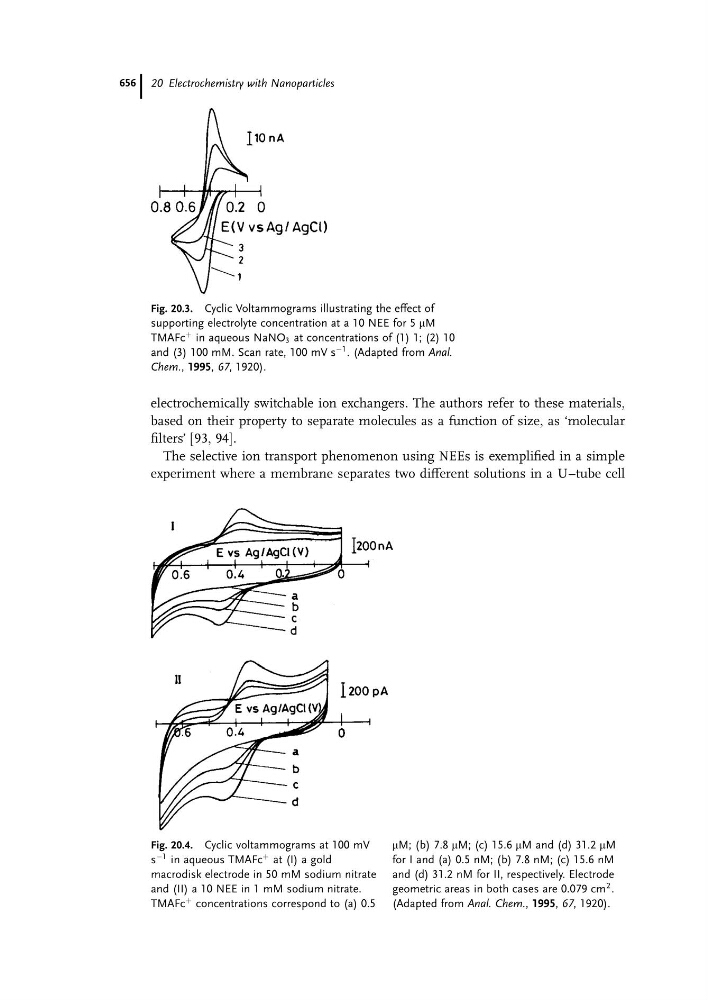
Fig. 20.3. Cyclic Voltammograms illustrating the effect of
supporting electrolyte concentration at a 10 NEE for 5 mM
TMAFc
þ in aqueous NaNO 3 at concentrations of (1) 1; (2) 10
and (3) 100 mM. Scan rate, 100 mV s
À1 . (Adapted from Anal.
Chem., 1995, 67, 1920).
Fig. 20.4. Cyclic voltammograms at 100 mV
s
À1 in aqueous TMAFc
þ at (I) a gold
macrodisk electrode in 50 mM sodium nitrate
and (II) a 10 NEE in 1 mM sodium nitrate.
TMAFc
þ concentrations correspond to (a) 0.5
mM; (b) 7.8 mM; (c) 15.6 mM and (d) 31.2 mM
for I and (a) 0.5 nM; (b) 7.8 nM; (c) 15.6 nM
and (d) 31.2 nM for II, respectively. Electrode
geometric areas in both cases are 0.079 cm
2 .
(Adapted from Anal. Chem., 1995, 67, 1920).
20 Electrochemistry with Nanoparticles
656