

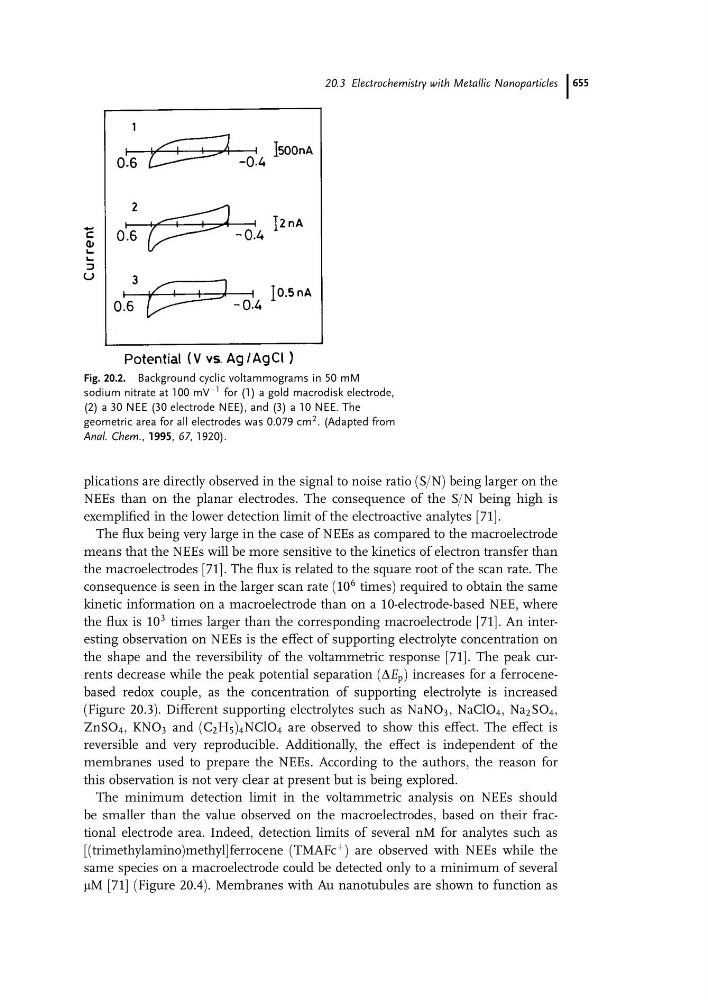
plications are directly observed in the signal to noise ratio (S/N) being larger on the
NEEs than on the planar electrodes. The consequence of the S/N being high is
exemplified in the lower detection limit of the electroactive analytes [71].
The flux being very large in the case of NEEs as compared to the macroelectrode
means that the NEEs will be more sensitive to the kinetics of electron transfer than
the macroelectrodes [71]. The flux is related to the square root of the scan rate. The
consequence is seen in the larger scan rate (10
6 times) required to obtain the same
kinetic information on a macroelectrode than on a 10-electrode-based NEE, where
the flux is 10
3 times larger than the corresponding macroelectrode [71]. An interesting observation on NEEs is the effect of supporting electrolyte concentration on
the shape and the reversibility of the voltammetric response [71]. The peak currents decrease while the peak potential separation (DE p ) increases for a ferrocenebased redox couple, as the concentration of supporting electrolyte is increased
(Figure 20.3). Different supporting electrolytes such as NaNO 3 , NaClO 4 , Na 2 SO 4 ,
ZnSO 4 , KNO 3 and (C 2 H 5 ) 4 NClO 4 are observed to show this effect. The effect is
reversible and very reproducible. Additionally, the effect is independent of the
membranes used to prepare the NEEs. According to the authors, the reason for
this observation is not very clear at present but is being explored.
The minimum detection limit in the voltammetric analysis on NEEs should
be smaller than the value observed on the macroelectrodes, based on their fractional electrode area. Indeed, detection limits of several nM for analytes such as
[(trimethylamino)methyl]ferrocene (TMAFc
þ ) are observed with NEEs while the
same species on a macroelectrode could be detected only to a minimum of several
mM [71] (Figure 20.4). Membranes with Au nanotubules are shown to function as
Fig. 20.2. Background cyclic voltammograms in 50 mM
sodium nitrate at 100 mV
À1 for (1) a gold macrodisk electrode,
(2) a 30 NEE (30 electrode NEE), and (3) a 10 NEE. The
geometric area for all electrodes was 0.079 cm
2 . (Adapted from
Anal. Chem., 1995, 67, 1920).
20.3 Electrochemistry with Metallic Nanoparticles 655