

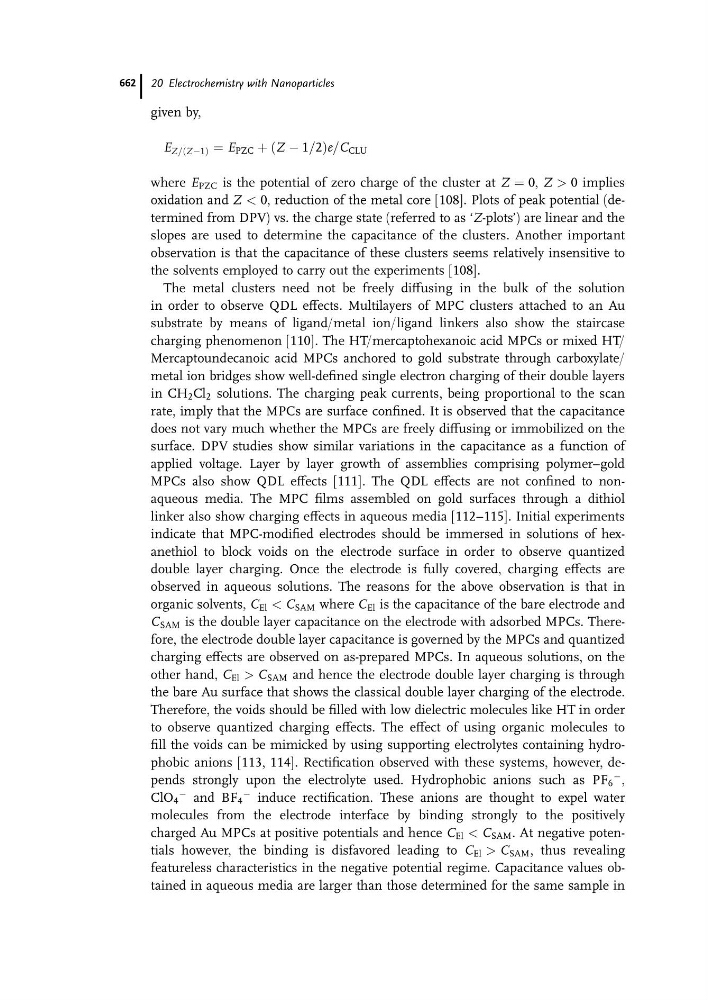
given by,
E Z=ðZÀ1Þ ¼ E PZC þ ðZ À 1=2Þe=C CLU
where E PZC is the potential of zero charge of the cluster at Z ¼ 0, Z > 0 implies
oxidation and Z < 0, reduction of the metal core [108]. Plots of peak potential (determined from DPV) vs. the charge state (referred to as ‘Z-plots’) are linear and the
slopes are used to determine the capacitance of the clusters. Another important
observation is that the capacitance of these clusters seems relatively insensitive to
the solvents employed to carry out the experiments [108].
The metal clusters need not be freely diffusing in the bulk of the solution
in order to observe QDL effects. Multilayers of MPC clusters attached to an Au
substrate by means of ligand/metal ion/ligand linkers also show the staircase
charging phenomenon [110]. The HT/mercaptohexanoic acid MPCs or mixed HT/
Mercaptoundecanoic acid MPCs anchored to gold substrate through carboxylate/
metal ion bridges show well-defined single electron charging of their double layers
in CH 2 Cl 2 solutions. The charging peak currents, being proportional to the scan
rate, imply that the MPCs are surface confined. It is observed that the capacitance
does not vary much whether the MPCs are freely diffusing or immobilized on the
surface. DPV studies show similar variations in the capacitance as a function of
applied voltage. Layer by layer growth of assemblies comprising polymer–gold
MPCs also show QDL effects [111]. The QDL effects are not confined to nonaqueous media. The MPC films assembled on gold surfaces through a dithiol
linker also show charging effects in aqueous media [112–115]. Initial experiments
indicate that MPC-modified electrodes should be immersed in solutions of hexanethiol to block voids on the electrode surface in order to observe quantized
double layer charging. Once the electrode is fully covered, charging effects are
observed in aqueous solutions. The reasons for the above observation is that in
organic solvents, C El < C SAM where C El is the capacitance of the bare electrode and
C SAM is the double layer capacitance on the electrode with adsorbed MPCs. Therefore, the electrode double layer capacitance is governed by the MPCs and quantized
charging effects are observed on as-prepared MPCs. In aqueous solutions, on the
other hand, C El > C SAM and hence the electrode double layer charging is through
the bare Au surface that shows the classical double layer charging of the electrode.
Therefore, the voids should be filled with low dielectric molecules like HT in order
to observe quantized charging effects. The effect of using organic molecules to
fill the voids can be mimicked by using supporting electrolytes containing hydrophobic anions [113, 114]. Rectification observed with these systems, however, depends strongly upon the electrolyte used. Hydrophobic anions such as PF 6
À ,
ClO 4
À and BF 4
À induce rectification. These anions are thought to expel water
molecules from the electrode interface by binding strongly to the positively
charged Au MPCs at positive potentials and hence C El < C SAM . At negative potentials however, the binding is disfavored leading to C El > C SAM , thus revealing
featureless characteristics in the negative potential regime. Capacitance values obtained in aqueous media are larger than those determined for the same sample in
20 Electrochemistry with Nanoparticles
662