

19.4
Electrochemistry of Semiconductor Nanostructures
19.4.1
Nanostructured Metal Oxide Films
Semiconductor nanoparticles exhibit an interesting property of storing electrons
and holes at trap sites. This redox property opens the way to modulate charging of
these particles using an electrochemical bias. Efforts have been made in the past
to investigate electrochemically induced chromic effects in WO 3 nanoparticle suspensions [137] and films [138–144]. Nanoparticles of SnO 2 , TiO 2 , and WO 3 are
readily assembled as three-dimensional arrays on conducting glass electrodes.
These highly porous nanostructured thin films undergo color changes under applied potential.
The presence of alkali metal ions is crucial for the stabilization of excess charge
trapped within the nanoparticles. Intercalation of metal ions within the nanoparticle thus becomes a limiting factor as the rate of transport of these ions becomes slower in thicker metal oxide films. This in turn controls the rate of coloration and recovery of the electrochromic effects. Limited efforts have also been
made to employ mixed TiO 2 /WO 3 [145], WO 3 /V 2 O 5 [146], and WO 3 /MoO 3 [147]
systems to enhance the efficiency of electrochromic effects. The beneficial aspect
of these nanostructured semiconductor films in electrochromic devices is yet to be
explored in a systematic way.
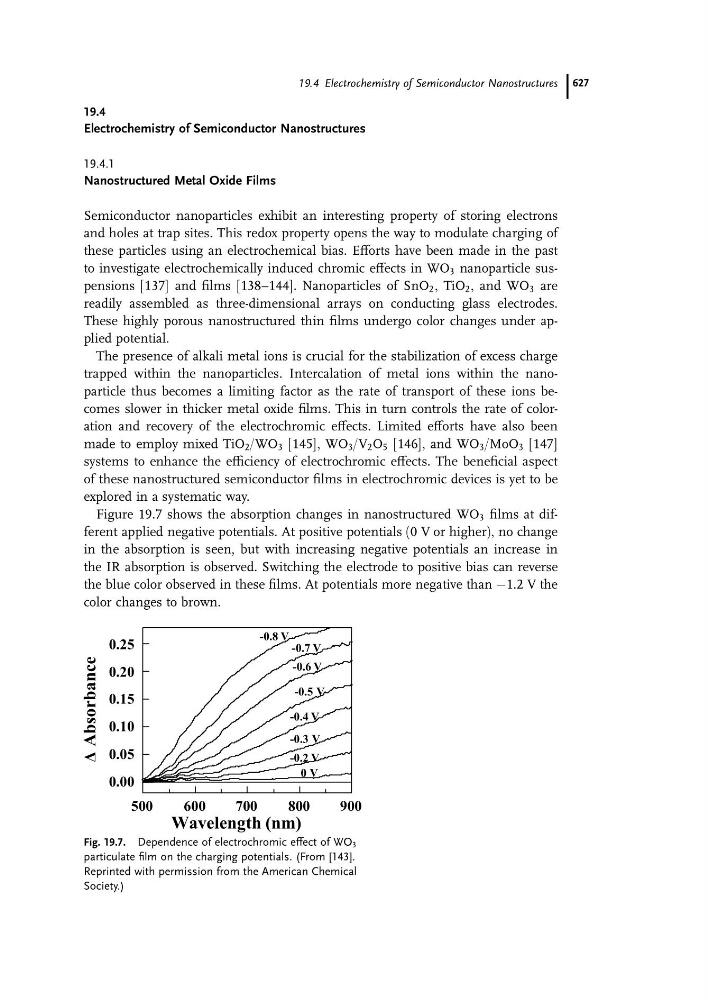
Figure 19.7 shows the absorption changes in nanostructured WO 3 films at different applied negative potentials. At positive potentials (0 V or higher), no change
in the absorption is seen, but with increasing negative potentials an increase in
the IR absorption is observed. Switching the electrode to positive bias can reverse
the blue color observed in these films. At potentials more negative than À1.2 V the
color changes to brown.
500
600
700
800
900
0.00
0.05
0.10
0.15
0.20
0.25
0 V
-0.2 V
-0.3 V
-0.4 V
-0.5 V
-0.6 V
-0.7 V
Wavelength (nm)
-0.8 V
D Absorbance
Fig. 19.7. Dependence of electrochromic effect of WO 3
particulate film on the charging potentials. (From [143].
Reprinted with permission from the American Chemical
Society.)
19.4 Electrochemistry of Semiconductor Nanostructures 627