

and photochemical [113–118] properties. In order to meet the practical challenges
that lie ahead we need to understand surface interactions at the molecular level
and develop strategies for refining properties of nanoparticle superstructures.
Photoinduced electron transfer and energy transfer in a number of donor–
acceptor systems have been extensively studied with an aim to mimic natural photosynthesis, by converting the charge-separated state into chemical or electrical
energy [119, 120]. By suitably assembling these systems on a metal surface one can
find ways to utilize the separated charge in such molecular assemblies. Demonstration of such a concept is made using self assembled monolayers (SAMs) of
photoactive molecules on gold electrodes [108, 114, 118, 121–130]. Direct binding
of a fluorophore to the metal surface often results in the quenching of excited
states [49, 91, 128, 131]. Both energy-transfer and electron-transfer processes are
considered to be major deactivation pathways for excited fluorophores on metal
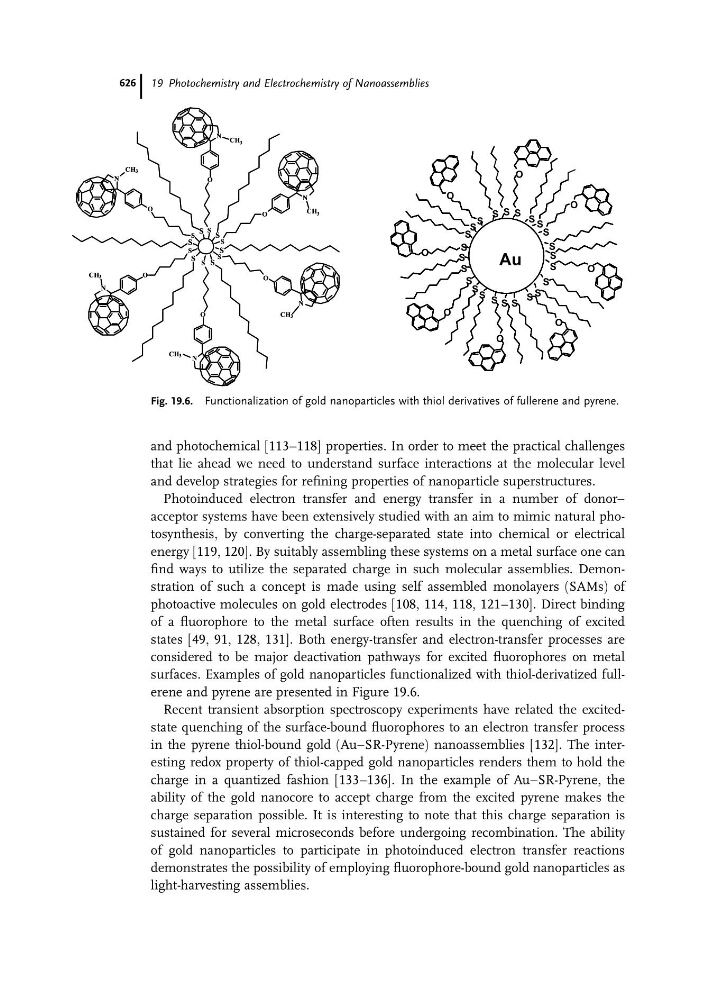
surfaces. Examples of gold nanoparticles functionalized with thiol-derivatized fullerene and pyrene are presented in Figure 19.6.
Recent transient absorption spectroscopy experiments have related the excitedstate quenching of the surface-bound fluorophores to an electron transfer process
in the pyrene thiol-bound gold (AuaSR-Pyrene) nanoassemblies [132]. The interesting redox property of thiol-capped gold nanoparticles renders them to hold the
charge in a quantized fashion [133–136]. In the example of AuaSR-Pyrene, the
ability of the gold nanocore to accept charge from the excited pyrene makes the
charge separation possible. It is interesting to note that this charge separation is
sustained for several microseconds before undergoing recombination. The ability
of gold nanoparticles to participate in photoinduced electron transfer reactions
demonstrates the possibility of employing fluorophore-bound gold nanoparticles as
light-harvesting assemblies.
S
S
O
S
S
S
O
S
S S
O
S
S
S
O
S
S
S
O
S
S
S
O
S
S
S
O
S
S
S
O
S
Au
N CH 3
O
S
N
CH 3
O
S
N
CH3
O
S
N
CH3
O
S
N
CH3
O
S
N
CH3
O
S
S
S
S
S
S
S
N CH 3
O
S
N
CH 3
O
S
N
CH3
O
S
N
CH3
O
S
N
CH3
O
S
N
CH3
O
S
S
S
S
S
S
S
Fig. 19.6. Functionalization of gold nanoparticles with thiol derivatives of fullerene and pyrene.
19 Photochemistry and Electrochemistry of Nanoassemblies
626