

The photofusion phenomenon occurs as a result of the melting of gold nanoparticle aggregates to form larger spherical particles during laser irradiation. As the
gold particles are repeatedly bombarded with laser pulse, the temperature of these
particles increases leading to melting. Theoretical calculations have predicted a rise
in temperature up to 2500 K during laser excitation [84]. Similar laser induced fusion is not seen in uncapped gold colloids because the individual particles are well
separated and the heat gained from laser excitation is quickly dumped into the
surrounding aqueous medium (< 200 ps) [72, 85, 86].
19.3.3
Photoinduced Energy and Electron Transfer Process between Excited Sensitizer and
Metal Nanocore
Researchers have often used functional groups such as thiols, amines, or silanes
to attach electroactive or photoactive molecules to the gold surface [87–91]. The
ability of gold surfaces to bind with specific functional groups makes them potentially useful in the development of biological probes [92–95], photonic materials
[96], and chemical sensors [18, 97]. An inorganic–organic hybrid probe also offers
the possibility of using complementary sensing via fluorescence spectroscopy and
electron microscopy. Since fluorescence spectroscopy is a very sensitive technique,
fluorophore bound gold nanoparticles are useful probes for biomolecular labeling
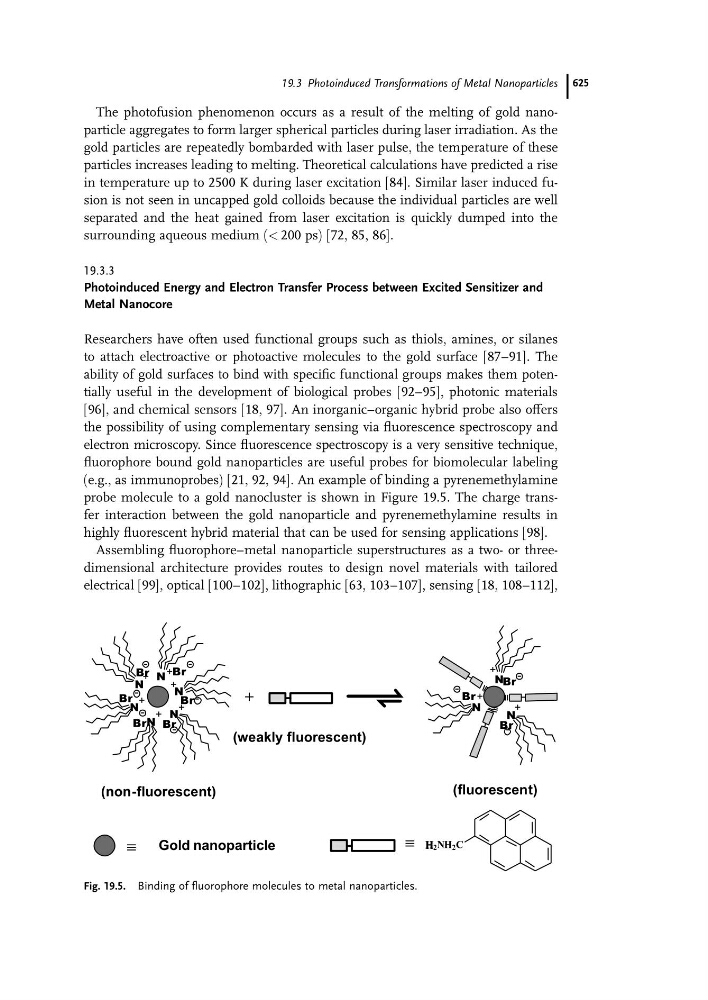
(e.g., as immunoprobes) [21, 92, 94]. An example of binding a pyrenemethylamine
probe molecule to a gold nanocluster is shown in Figure 19.5. The charge transfer interaction between the gold nanoparticle and pyrenemethylamine results in
highly fluorescent hybrid material that can be used for sensing applications [98].
Assembling fluorophore–metal nanoparticle superstructures as a two- or threedimensional architecture provides routes to design novel materials with tailored
electrical [99], optical [100–102], lithographic [63, 103–107], sensing [18, 108–112],
+
(weakly fluorescent)
≡ Gold nanoparticle
(non-fluorescent)
N
+
-
Br
N
+
N
+ N +
-
Br
N
+
-
Br
N
+
-
Br
-
Br
-
Br
(fluorescent)
N
+
N
+
-
Br
N
+
- Br
-
Br
≡ H 2 NH 2 C
H
Fig. 19.5. Binding of fluorophore molecules to metal nanoparticles.
19.3 Photoinduced Transformations of Metal Nanoparticles 625