

ing, in spite of the fact that the International Zeolite Association has assigned a
three letter code to each structure type, since many materials are more commonly
known by acronyms chosen by the laboratory in which they were discovered. Pore
sizes range from about 0.2 nm in the case of sodalites (SOD), in which the largest
channel has rings containing 6 Si/Al sites (i.e. 6-rings), to about 1 nm in so-called
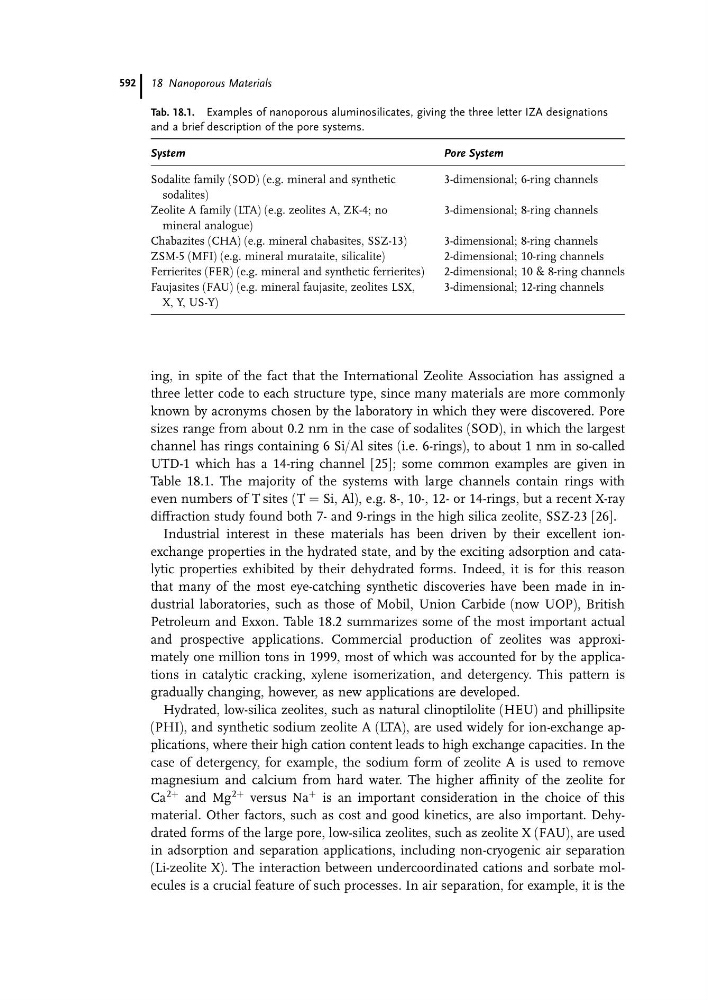
UTD-1 which has a 14-ring channel [25]; some common examples are given in
Table 18.1. The majority of the systems with large channels contain rings with
even numbers of T sites (T ¼ Si, Al), e.g. 8-, 10-, 12- or 14-rings, but a recent X-ray
diffraction study found both 7- and 9-rings in the high silica zeolite, SSZ-23 [26].
Industrial interest in these materials has been driven by their excellent ionexchange properties in the hydrated state, and by the exciting adsorption and catalytic properties exhibited by their dehydrated forms. Indeed, it is for this reason
that many of the most eye-catching synthetic discoveries have been made in industrial laboratories, such as those of Mobil, Union Carbide (now UOP), British
Petroleum and Exxon. Table 18.2 summarizes some of the most important actual
and prospective applications. Commercial production of zeolites was approximately one million tons in 1999, most of which was accounted for by the applications in catalytic cracking, xylene isomerization, and detergency. This pattern is
gradually changing, however, as new applications are developed.
Hydrated, low-silica zeolites, such as natural clinoptilolite (HEU) and phillipsite
(PHI), and synthetic sodium zeolite A (LTA), are used widely for ion-exchange applications, where their high cation content leads to high exchange capacities. In the
case of detergency, for example, the sodium form of zeolite A is used to remove
magnesium and calcium from hard water. The higher affinity of the zeolite for
Ca
2þ and Mg
2þ versus Na
þ is an important consideration in the choice of this
material. Other factors, such as cost and good kinetics, are also important. Dehydrated forms of the large pore, low-silica zeolites, such as zeolite X (FAU), are used
in adsorption and separation applications, including non-cryogenic air separation
(Li-zeolite X). The interaction between undercoordinated cations and sorbate molecules is a crucial feature of such processes. In air separation, for example, it is the
Tab. 18.1. Examples of nanoporous aluminosilicates, giving the three letter IZA designations
and a brief description of the pore systems.
System
Pore System
Sodalite family (SOD) (e.g. mineral and synthetic
sodalites)
3-dimensional; 6-ring channels
Zeolite A family (LTA) (e.g. zeolites A, ZK-4; no
mineral analogue)
3-dimensional; 8-ring channels
Chabazites (CHA) (e.g. mineral chabasites, SSZ-13)
3-dimensional; 8-ring channels
ZSM-5 (MFI) (e.g. mineral murataite, silicalite)
2-dimensional; 10-ring channels
Ferrierites (FER) (e.g. mineral and synthetic ferrierites)
2-dimensional; 10 & 8-ring channels
Faujasites (FAU) (e.g. mineral faujasite, zeolites LSX,
X, Y, US-Y)
3-dimensional; 12-ring channels
18 Nanoporous Materials
592