

and even fewer have found applications in processes that require porosity. These
exceptions include SAPO-34, an aluminum phosphate with the chabazite structure
that is being exploited for the conversion of methanol to olefins [17] and the titanosilicate, TS-1, which is very effective for selective oxidations using hydrogen
peroxide [18]. Attempts to make nanoporous transition metal phosphates, for example, have led to the discovery of many new open-frameworks, e.g. VaPaO [19],
FeaPaO [20], and CoaPaO [21], but, as is the case with most non-silicate materials, the poor thermal stability of these systems leads, in most cases, to the collapse
of the pore structures on activation. The nickel phosphates, which are stable to
around 500
C, represent a notable exception and exhibit a wide range of interesting properties [22].
18.3
Aluminosilicate Zeolites
The aluminosilicate zeolites, of general formula A x=n [Si 1Àx Al x O 2 ]ÁnH 2 O where A is
typically a cation of valence n, or a protonated or quaternary organic amine, was
the first class of nanoporous materials to be recognized. They occur quite extensively in nature, and synthetic examples were made as early as the mid-19th century [23]. Such has been the rate of development in this area during the second
half of the 20th century that as many as 133 different architectures are now known
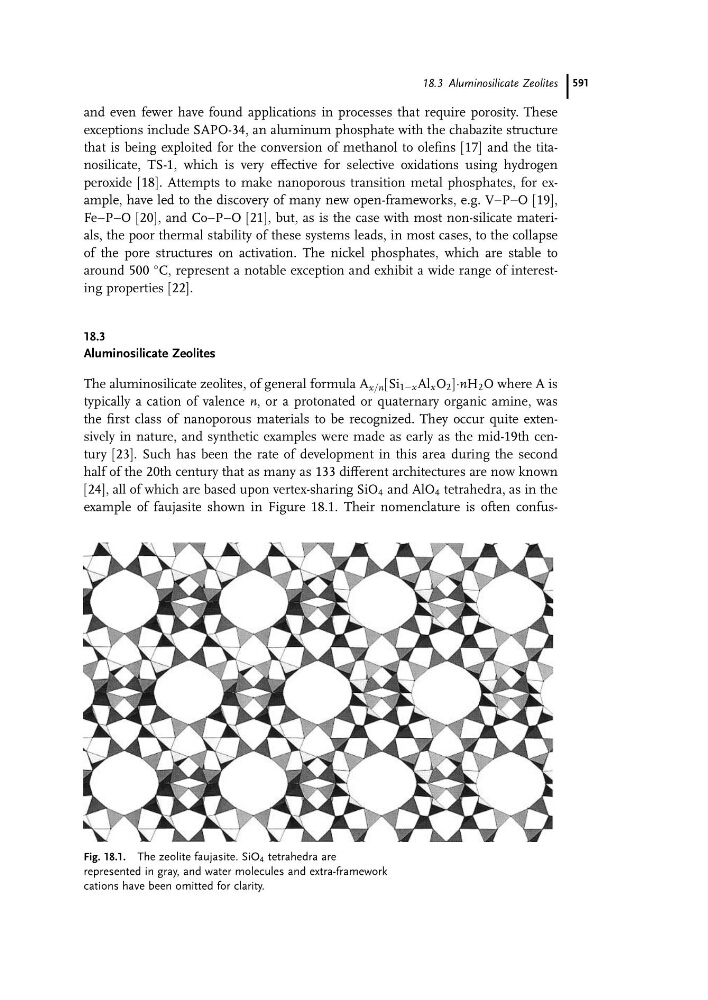
[24], all of which are based upon vertex-sharing SiO 4 and AlO 4 tetrahedra, as in the
example of faujasite shown in Figure 18.1. Their nomenclature is often confusFig. 18.1. The zeolite faujasite. SiO 4 tetrahedra are
represented in gray, and water molecules and extra-framework
cations have been omitted for clarity.
18.3 Aluminosilicate Zeolites 591