

affinity of the lithium for the dinitrogen molecule, which has a quadrupolar moment that is three times bigger than that of dioxygen, that provides the basis for
the separation [27]. The low-silica materials are relatively unstable at high temperatures, so materials with high Si/Al ratios are preferred for catalytic applications.
These include high-silica FAUs, such as ultrastabilized Y, and ZSM-5. Most of the
catalytic processes are based upon acid catalyzed reactions in which the exchangeable cation of the zeolite is replaced by a proton that provides Brønsted acidity. In
addition, the shape and size of the zeolite cavities leads to selectivity in the reaction, hence the term ‘‘shape-selective catalysts’’. This is the case in the hydrocarbon
cracking catalysts used in gasoline manufacture and the isomerization catalysts
used in p-xylene production for polyester manufacture. In xylene production, it is
the small size of the zeolite channels that favors the p-isomer over the o- and mxylenes. Some of the new titanosilicates, such as ETS-1 (MFI), which contains
framework titanium, exhibit redox activity and are being used for partial oxidation
reactions involving phenols and hydrogen peroxide [18].
Naturally occurring zeolites normally have quite low Si/Al ratios, typically three
or less, and it is often quite easy to make synthetic analogues of these materials
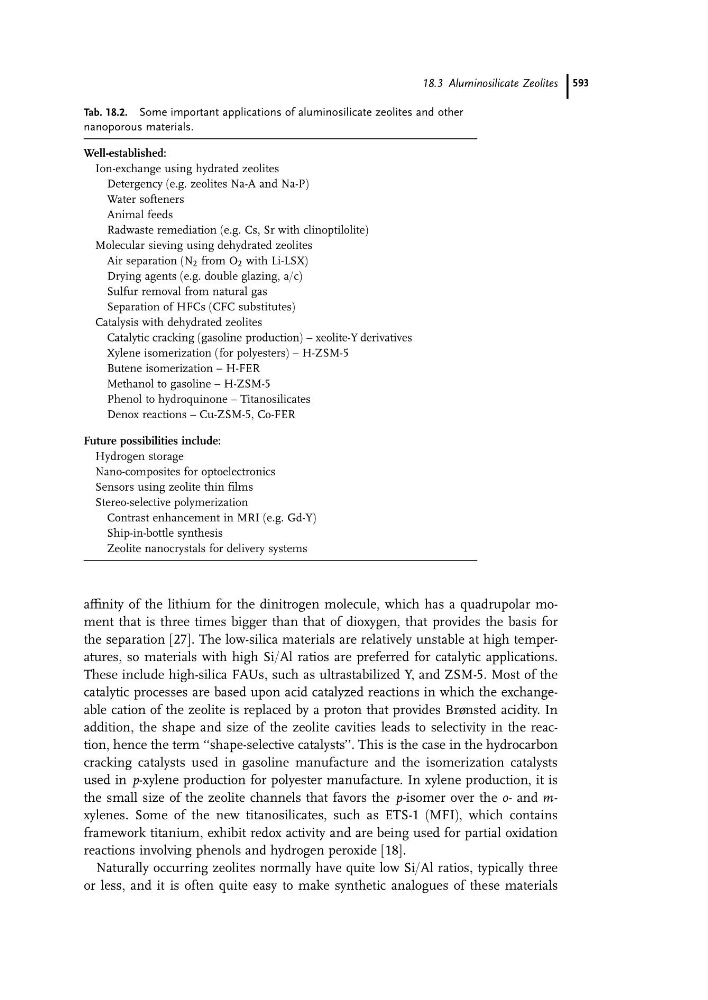
Tab. 18.2. Some important applications of aluminosilicate zeolites and other
nanoporous materials.
Well-established:
Ion-exchange using hydrated zeolites
Detergency (e.g. zeolites Na-A and Na-P)
Water softeners
Animal feeds
Radwaste remediation (e.g. Cs, Sr with clinoptilolite)
Molecular sieving using dehydrated zeolites
Air separation (N 2 from O 2 with Li-LSX)
Drying agents (e.g. double glazing, a/c)
Sulfur removal from natural gas
Separation of HFCs (CFC substitutes)
Catalysis with dehydrated zeolites
Catalytic cracking (gasoline production) – xeolite-Y derivatives
Xylene isomerization (for polyesters) – H-ZSM-5
Butene isomerization – H-FER
Methanol to gasoline – H-ZSM-5
Phenol to hydroquinone – Titanosilicates
Denox reactions – Cu-ZSM-5, Co-FER
Future possibilities include:
Hydrogen storage
Nano-composites for optoelectronics
Sensors using zeolite thin films
Stereo-selective polymerization
Contrast enhancement in MRI (e.g. Gd-Y)
Ship-in-bottle synthesis
Zeolite nanocrystals for delivery systems
18.3 Aluminosilicate Zeolites 593