

more easily integrated to other, larger-scale silicon processing technologies. Additional work on the sensing capabilities of porous silicon has employed polarization
interference [113]. Sailor and Fainman reported shifts in polarization interference
measurements upon exposure of porous silicon to concentrations of ethanol or
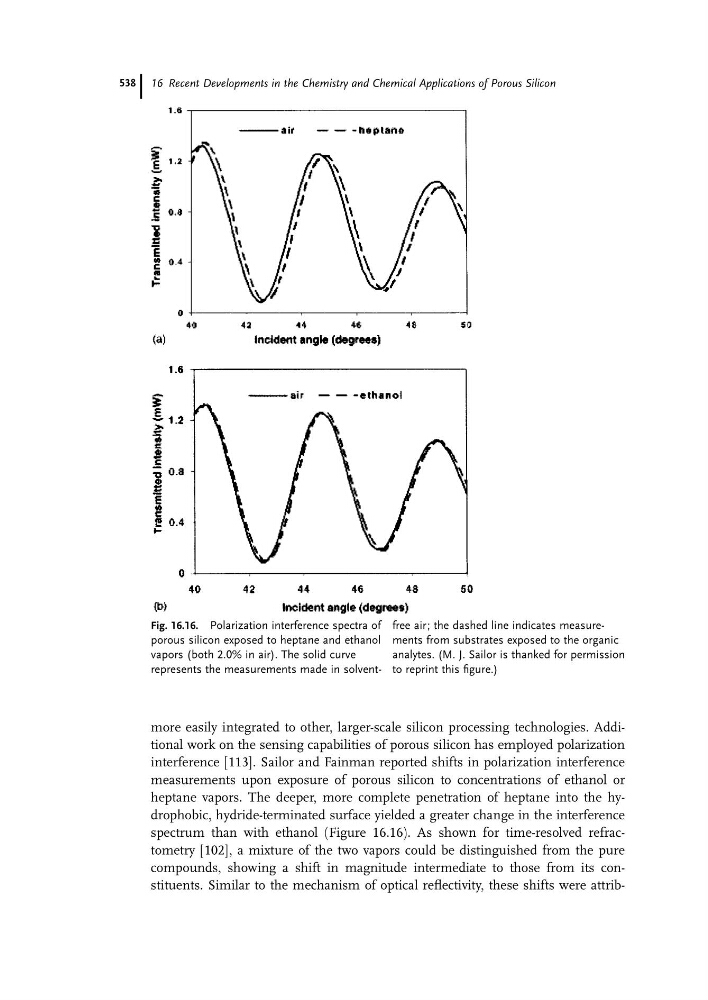
heptane vapors. The deeper, more complete penetration of heptane into the hydrophobic, hydride-terminated surface yielded a greater change in the interference
spectrum than with ethanol (Figure 16.16). As shown for time-resolved refractometry [102], a mixture of the two vapors could be distinguished from the pure
compounds, showing a shift in magnitude intermediate to those from its constituents. Similar to the mechanism of optical reflectivity, these shifts were attribFig. 16.16. Polarization interference spectra of
porous silicon exposed to heptane and ethanol
vapors (both 2.0% in air). The solid curve
represents the measurements made in solventfree air; the dashed line indicates measurements from substrates exposed to the organic
analytes. (M. J. Sailor is thanked for permission
to reprint this figure.)
16 Recent Developments in the Chemistry and Chemical Applications of Porous Silicon
538