

uted to changes in the refractive index of the porous silicon upon adsorption of the
analyte. Sensors employing this transduction scheme exhibited reversible behavior
with these particular analytes, but detection was limited to concentrations at the
parts per thousand level. Sensing based upon the birefringent properties of porous
silicon has also been studied [114] as well as light-addressable potentiometric sensors (LAPS) fashioned from this material [115, 116].
These fascinating results clearly point to the incredible promise of porous silicon
for sensing applications. It is expected that future work will continue to improve
selectivity and discrimination for singular analytes from complex mixtures. To realize success in this endeavor, interfacial tailoring must enable the detection of a
great range of gaseous species and should permit recycling of sensors through
stabilization of the surface, particularly under biological conditions.
16.4.4
Explosive Porous Silicon
Recent work by Mikulec et al. [117] has exploited an unusual property of porous
silicon and used this material as an explosive matrix for atomic emission spectroscopy. Freshly prepared, hydride-terminated substrates soaked in aqueous solutions
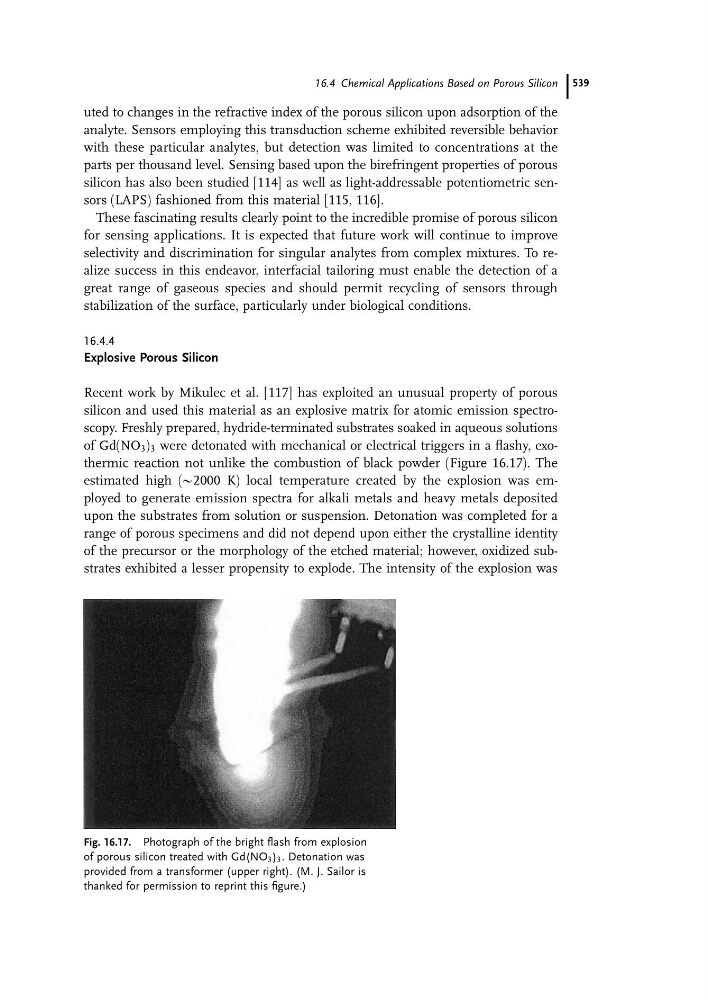
of Gd(NO 3 ) 3 were detonated with mechanical or electrical triggers in a flashy, exothermic reaction not unlike the combustion of black powder (Figure 16.17). The
estimated high (@2000 K) local temperature created by the explosion was employed to generate emission spectra for alkali metals and heavy metals deposited
upon the substrates from solution or suspension. Detonation was completed for a
range of porous specimens and did not depend upon either the crystalline identity
of the precursor or the morphology of the etched material; however, oxidized substrates exhibited a lesser propensity to explode. The intensity of the explosion was
Fig. 16.17. Photograph of the bright flash from explosion
of porous silicon treated with Gd(NO 3 ) 3 . Detonation was
provided from a transformer (upper right). (M. J. Sailor is
thanked for permission to reprint this figure.)
16.4 Chemical Applications Based on Porous Silicon 539