

Derivatization of the porous silicon surface can also affect the sensory properties
[99]. Porous silicon oxidized thermally or by treatment with ozone yielded hydrophilic surfaces that exhibited greater affinity for polar vapors such as ethanol and
methyl ethyl ketone (MEK). Conversely, porous silicon modified with hydrophobic
methyl groups responded more actively to nonpolar, gaseous hexane, although this
affinity was lesser in magnitude than those of the oxidized surfaces. However, the
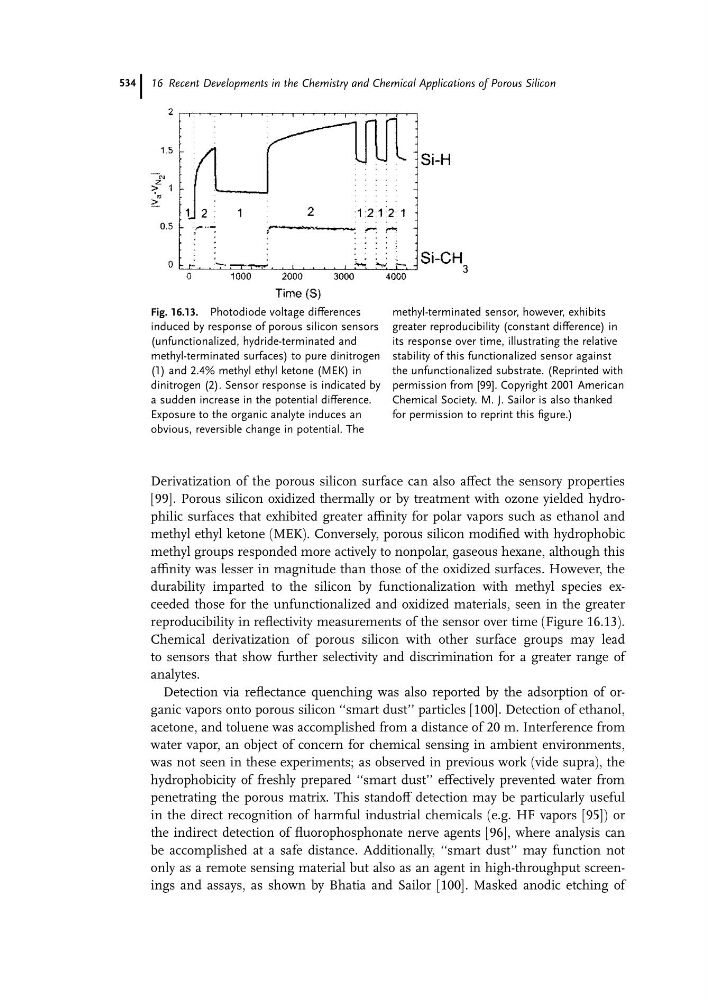
durability imparted to the silicon by functionalization with methyl species exceeded those for the unfunctionalized and oxidized materials, seen in the greater
reproducibility in reflectivity measurements of the sensor over time (Figure 16.13).
Chemical derivatization of porous silicon with other surface groups may lead
to sensors that show further selectivity and discrimination for a greater range of
analytes.
Detection via reflectance quenching was also reported by the adsorption of organic vapors onto porous silicon ‘‘smart dust’’ particles [100]. Detection of ethanol,
acetone, and toluene was accomplished from a distance of 20 m. Interference from
water vapor, an object of concern for chemical sensing in ambient environments,
was not seen in these experiments; as observed in previous work (vide supra), the
hydrophobicity of freshly prepared ‘‘smart dust’’ effectively prevented water from
penetrating the porous matrix. This standoff detection may be particularly useful
in the direct recognition of harmful industrial chemicals (e.g. HF vapors [95]) or
the indirect detection of fluorophosphonate nerve agents [96], where analysis can
be accomplished at a safe distance. Additionally, ‘‘smart dust’’ may function not
only as a remote sensing material but also as an agent in high-throughput screenings and assays, as shown by Bhatia and Sailor [100]. Masked anodic etching of
Fig. 16.13. Photodiode voltage differences
induced by response of porous silicon sensors
(unfunctionalized, hydride-terminated and
methyl-terminated surfaces) to pure dinitrogen
(1) and 2.4% methyl ethyl ketone (MEK) in
dinitrogen (2). Sensor response is indicated by
a sudden increase in the potential difference.
Exposure to the organic analyte induces an
obvious, reversible change in potential. The
methyl-terminated sensor, however, exhibits
greater reproducibility (constant difference) in
its response over time, illustrating the relative
stability of this functionalized sensor against
the unfunctionalized substrate. (Reprinted with
permission from [99]. Copyright 2001 American
Chemical Society. M. J. Sailor is also thanked
for permission to reprint this figure.)
16 Recent Developments in the Chemistry and Chemical Applications of Porous Silicon
534