

crystalline silicon with a specific variable current was employed to prepare regions
of porous silicon multilayers that were then galvanically detached from the underlying semiconductor bulk and ground to optically active particles similar to rugate
filters. The populations and wavelengths of the reflectivity peaks of these porous
silicon particles could be varied and shifted by changing the magnitude and periodicity of the etching current, demonstrating the potential to produce millions of
encoded substrates. Encoded particles treated with rat albumin could be identified
from an antibody-incubated mixture of coded specimens by coupling fluorescence
spectra, which clearly showed the interaction of the albumin-treated substrates
with tagged antibodies, to optical spectra that expressed the characteristic combination of reflectivity peaks. The relative sharpness of peaks, near-IR range of reflective wavelengths, and biocompatibility of ‘‘smart dust’’ offers this material as
an alternative to other substrates (e.g. CdSe particles) which may be toxic or relatively unstable for in vivo and medical diagnostic applications.
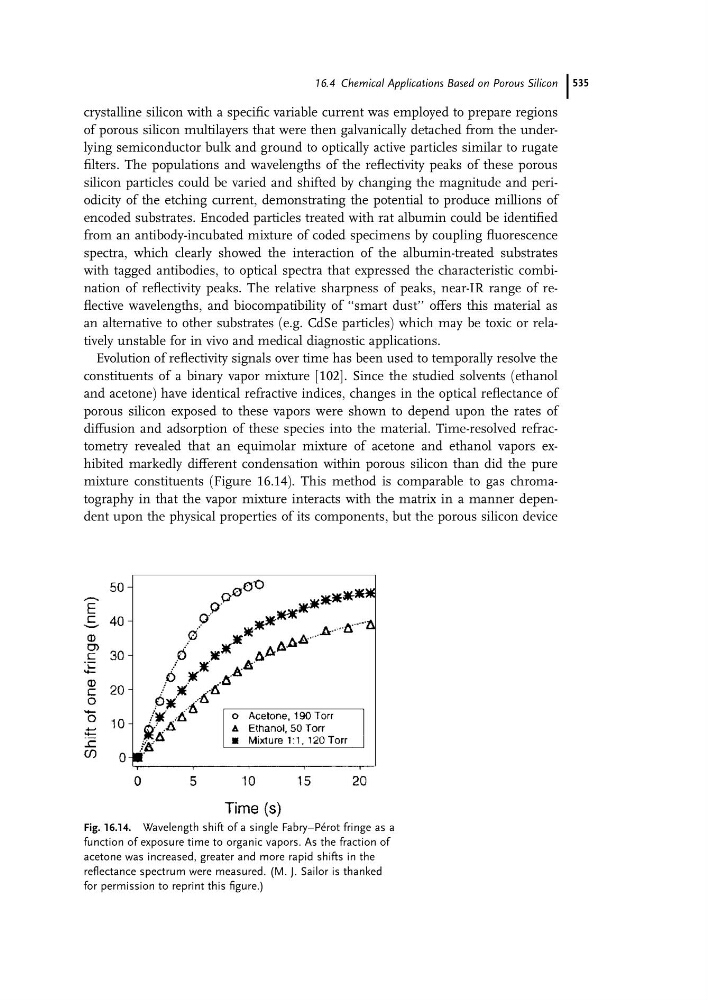
Evolution of reflectivity signals over time has been used to temporally resolve the
constituents of a binary vapor mixture [102]. Since the studied solvents (ethanol
and acetone) have identical refractive indices, changes in the optical reflectance of
porous silicon exposed to these vapors were shown to depend upon the rates of
diffusion and adsorption of these species into the material. Time-resolved refractometry revealed that an equimolar mixture of acetone and ethanol vapors exhibited markedly different condensation within porous silicon than did the pure
mixture constituents (Figure 16.14). This method is comparable to gas chromatography in that the vapor mixture interacts with the matrix in a manner dependent upon the physical properties of its components, but the porous silicon device
Fig. 16.14. Wavelength shift of a single Fabry–Pe ´rot fringe as a
function of exposure time to organic vapors. As the fraction of
acetone was increased, greater and more rapid shifts in the
reflectance spectrum were measured. (M. J. Sailor is thanked
for permission to reprint this figure.)
16.4 Chemical Applications Based on Porous Silicon 535