

hydrophobic bilayer regions of the vesicular structure without disrupting the aggregate morphology. Polymerization of the monomer is then expected to produce
polymer chains that weave through the bilayer structure, lending enhanced stability to the vesicles. Although this concept was presented and attempted almost 20
years ago [85], the recent surge of interest in developing structurally fixed nanostructures has spurred a revival of this idea. Kaler and coworkers, recently utilized
equilibrium vesicles formed by using a combination of anionic and cationic surfactants, such as cetyltrimethylammonium toluene sulfonate (CTAT) and sodium
dodecylbenzene sulfonate (SDBS) for the inclusion of monomers, such as styrene
and divinyl benzene (DVB) [86]. By varying the ratio of CTAT to SDBS, up to 10
wt% of styrene was taken up by the vesicular aggregates without disruption of their
structure. Polymerization of the embedded monomers leads to a dramatic enhancement of the vesicle stability, as shown by lysis experiments. Typical sizes of
these vesicles are ca. 60 nm in diameter and the thickness of the bilayer shell is
around 10 nm.
In a similar study, Meier and coworkers utilized simple kinetically stabilized
vesicles prepared by sonication of a cationic surfactant, like dimethyldioctadecyl
ammonium bromide (DODAC), which was then swollen with the monomer, butyl
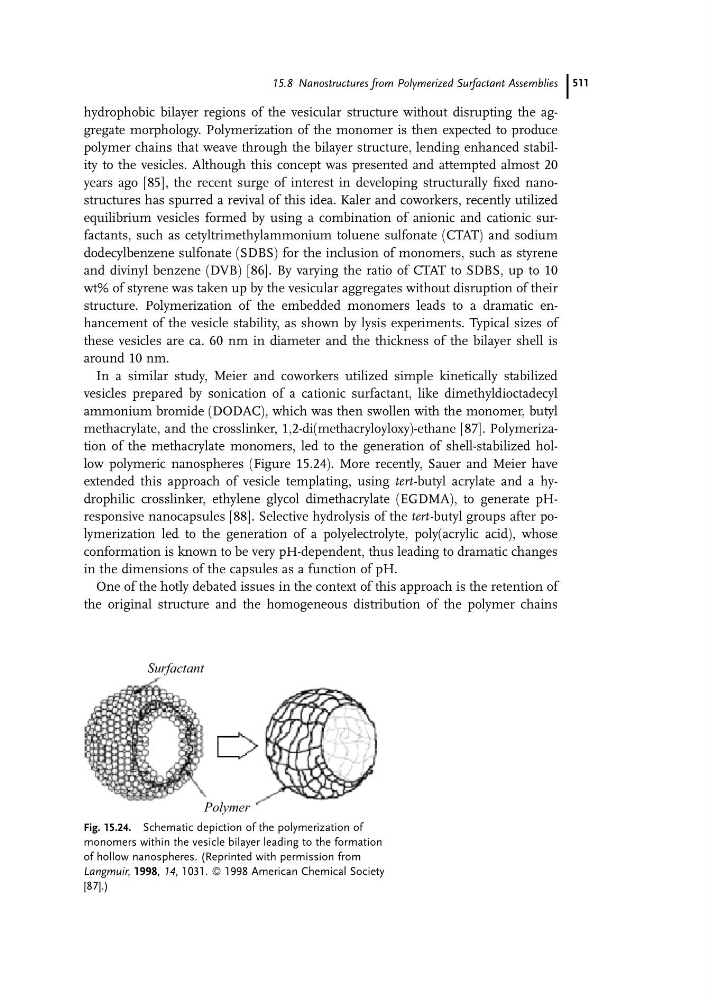
methacrylate, and the crosslinker, 1,2-di(methacryloyloxy)-ethane [87]. Polymerization of the methacrylate monomers, led to the generation of shell-stabilized hollow polymeric nanospheres (Figure 15.24). More recently, Sauer and Meier have
extended this approach of vesicle templating, using tert-butyl acrylate and a hydrophilic crosslinker, ethylene glycol dimethacrylate (EGDMA), to generate pHresponsive nanocapsules [88]. Selective hydrolysis of the tert-butyl groups after polymerization led to the generation of a polyelectrolyte, poly(acrylic acid), whose
conformation is known to be very pH-dependent, thus leading to dramatic changes
in the dimensions of the capsules as a function of pH.
One of the hotly debated issues in the context of this approach is the retention of
the original structure and the homogeneous distribution of the polymer chains
Surfactant
Polymer
Fig. 15.24. Schematic depiction of the polymerization of
monomers within the vesicle bilayer leading to the formation
of hollow nanospheres. (Reprinted with permission from
Langmuir, 1998, 14, 1031. 8 1998 American Chemical Society
[87].)
15.8 Nanostructures from Polymerized Surfactant Assemblies 511