

added advantage of polymer-based organic nanoporous structures is their versatility in terms of functional group incorporation, which in turn should prove valuable
for heterogeneous catalysis. With this objective, the bicontinuous cubic phase
(Ia3d, gyroid symmetry) formed using a glycerol-based nonionic surfactant was
polymerized with retention of morphology [80].
A slightly different and interesting approach is one wherein the polymerizable
group does not form an integral part of the surfactant but is the counter-ion. The
earliest demonstration of such approaches led to the generation of ‘‘ghost vesicles’’
by Regen and co-workers, in which the hydrocarbon tails were removed after polymerization of the counter-ion, a diallylammonium group [81]. More recently, Kline
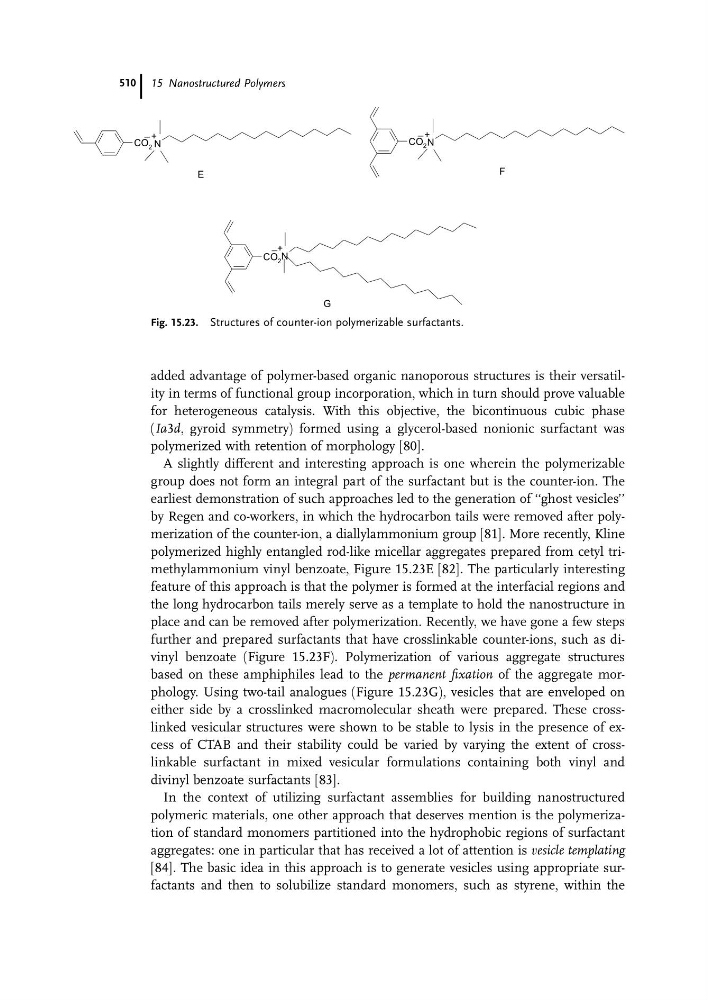
polymerized highly entangled rod-like micellar aggregates prepared from cetyl trimethylammonium vinyl benzoate, Figure 15.23E [82]. The particularly interesting
feature of this approach is that the polymer is formed at the interfacial regions and
the long hydrocarbon tails merely serve as a template to hold the nanostructure in
place and can be removed after polymerization. Recently, we have gone a few steps
further and prepared surfactants that have crosslinkable counter-ions, such as divinyl benzoate (Figure 15.23F). Polymerization of various aggregate structures
based on these amphiphiles lead to the permanent fixation of the aggregate morphology. Using two-tail analogues (Figure 15.23G), vesicles that are enveloped on
either side by a crosslinked macromolecular sheath were prepared. These crosslinked vesicular structures were shown to be stable to lysis in the presence of excess of CTAB and their stability could be varied by varying the extent of crosslinkable surfactant in mixed vesicular formulations containing both vinyl and
divinyl benzoate surfactants [83].
In the context of utilizing surfactant assemblies for building nanostructured
polymeric materials, one other approach that deserves mention is the polymerization of standard monomers partitioned into the hydrophobic regions of surfactant
aggregates: one in particular that has received a lot of attention is vesicle templating
[84]. The basic idea in this approach is to generate vesicles using appropriate surfactants and then to solubilize standard monomers, such as styrene, within the
E
F
G
CO 2
_
N
+
CO 2
_
N
+
N
+
CO 2
_
Fig. 15.23. Structures of counter-ion polymerizable surfactants.
15 Nanostructured Polymers
510