

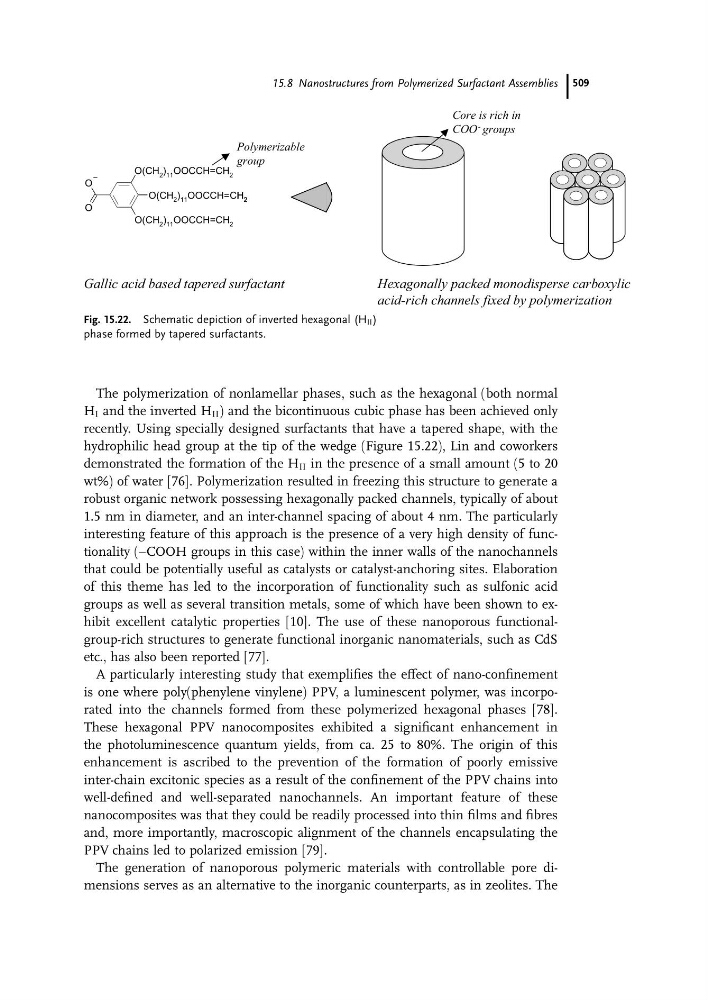
The polymerization of nonlamellar phases, such as the hexagonal (both normal
H I and the inverted H II ) and the bicontinuous cubic phase has been achieved only
recently. Using specially designed surfactants that have a tapered shape, with the
hydrophilic head group at the tip of the wedge (Figure 15.22), Lin and coworkers
demonstrated the formation of the H II in the presence of a small amount (5 to 20
wt%) of water [76]. Polymerization resulted in freezing this structure to generate a
robust organic network possessing hexagonally packed channels, typically of about
1.5 nm in diameter, and an inter-channel spacing of about 4 nm. The particularly
interesting feature of this approach is the presence of a very high density of functionality (aCOOH groups in this case) within the inner walls of the nanochannels
that could be potentially useful as catalysts or catalyst-anchoring sites. Elaboration
of this theme has led to the incorporation of functionality such as sulfonic acid
groups as well as several transition metals, some of which have been shown to exhibit excellent catalytic properties [10]. The use of these nanoporous functionalgroup-rich structures to generate functional inorganic nanomaterials, such as CdS
etc., has also been reported [77].
A particularly interesting study that exemplifies the effect of nano-confinement
is one where poly(phenylene vinylene) PPV, a luminescent polymer, was incorporated into the channels formed from these polymerized hexagonal phases [78].
These hexagonal PPV nanocomposites exhibited a significant enhancement in
the photoluminescence quantum yields, from ca. 25 to 80%. The origin of this
enhancement is ascribed to the prevention of the formation of poorly emissive
inter-chain excitonic species as a result of the confinement of the PPV chains into
well-defined and well-separated nanochannels. An important feature of these
nanocomposites was that they could be readily processed into thin films and fibres
and, more importantly, macroscopic alignment of the channels encapsulating the
PPV chains led to polarized emission [79].
The generation of nanoporous polymeric materials with controllable pore dimensions serves as an alternative to the inorganic counterparts, as in zeolites. The
O
O
O(CH 2 ) 11 OOCCH=CH 2
O(CH 2 ) 11 OOCCH=CH 2
O(CH 2 ) 11 OOCCH=CH 2
Gallic acid based tapered surfactant
Polymerizable
group
Core is rich in
COO - groups
Hexagonally packed monodisperse carboxylic
acid-rich channels fixed by polymerization
H 2
Fig. 15.22. Schematic depiction of inverted hexagonal (H II )
phase formed by tapered surfactants.
15.8 Nanostructures from Polymerized Surfactant Assemblies 509