

within the bilayer membrane after the polymerization of the occluded monomer.
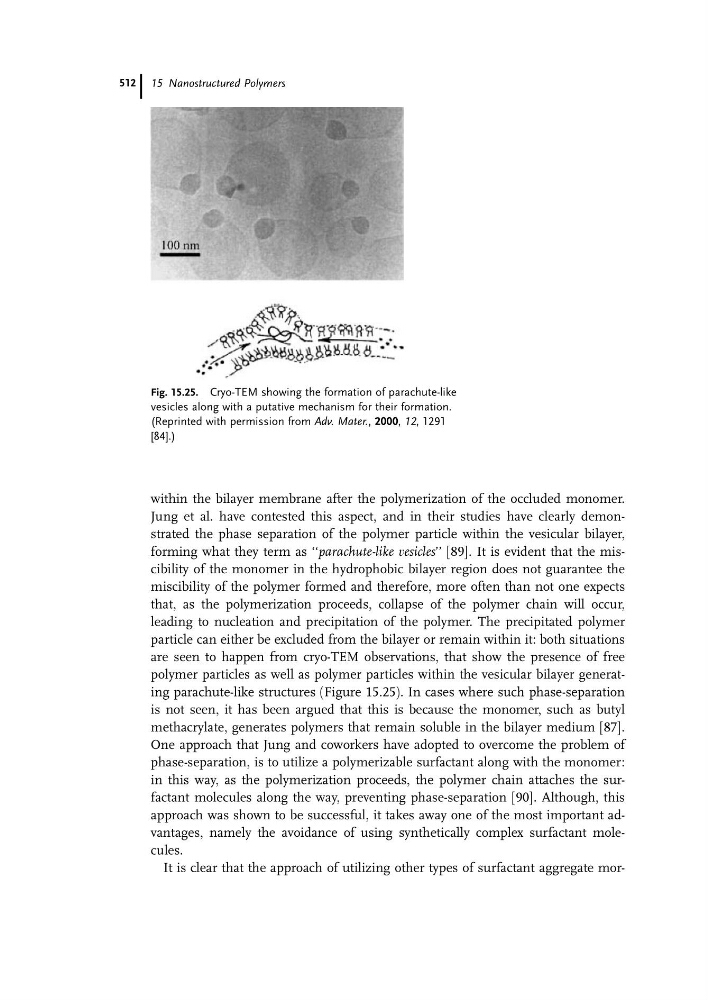
Jung et al. have contested this aspect, and in their studies have clearly demonstrated the phase separation of the polymer particle within the vesicular bilayer,
forming what they term as ‘‘parachute-like vesicles’’ [89]. It is evident that the miscibility of the monomer in the hydrophobic bilayer region does not guarantee the
miscibility of the polymer formed and therefore, more often than not one expects
that, as the polymerization proceeds, collapse of the polymer chain will occur,
leading to nucleation and precipitation of the polymer. The precipitated polymer
particle can either be excluded from the bilayer or remain within it: both situations
are seen to happen from cryo-TEM observations, that show the presence of free
polymer particles as well as polymer particles within the vesicular bilayer generating parachute-like structures (Figure 15.25). In cases where such phase-separation
is not seen, it has been argued that this is because the monomer, such as butyl
methacrylate, generates polymers that remain soluble in the bilayer medium [87].
One approach that Jung and coworkers have adopted to overcome the problem of
phase-separation, is to utilize a polymerizable surfactant along with the monomer:
in this way, as the polymerization proceeds, the polymer chain attaches the surfactant molecules along the way, preventing phase-separation [90]. Although, this
approach was shown to be successful, it takes away one of the most important advantages, namely the avoidance of using synthetically complex surfactant molecules.
It is clear that the approach of utilizing other types of surfactant aggregate morFig. 15.25. Cryo-TEM showing the formation of parachute-like
vesicles along with a putative mechanism for their formation.
(Reprinted with permission from Adv. Mater., 2000, 12, 1291
[84].)
15 Nanostructured Polymers
512