

25
C, re-hydrates the core causing a small increase in the size from 28 to 30 nm.
That crosslinking has indeed occurred is confirmed by the very existence of aggregates at 25
C, as in its absence the diblock copolymers are completely soluble
at this temperature. Tunability of the solubility of the PMEMA block in water arises
from the fact that its lower critical solution temperature (LCST) lies between 25
and 60
C. This reversible hydration of the core could be a very useful feature to
trigger release of occluded guest molecules from the core interior. More recently,
utilizing a similar methodology, zwitterionic shell-crosslinked systems have also
been prepared wherein the core and shell domains contain amine and carboxylic
acid groups, respectively, or vice versa. Such systems exhibit an isoelectric point, at
a pH wherein the crosslinked micelles (@40 nm) become electrically neutral and
precipitate out in water; addition of acid or base causes complete redissolution of
these nanospheres [58].
One of the drawbacks of most approaches described thus far for the preparation
of shell-crosslinked systems, is that the crosslinking of the micellar aggregates
has to be carried out under very dilute conditions in order to prevent inter-micellar
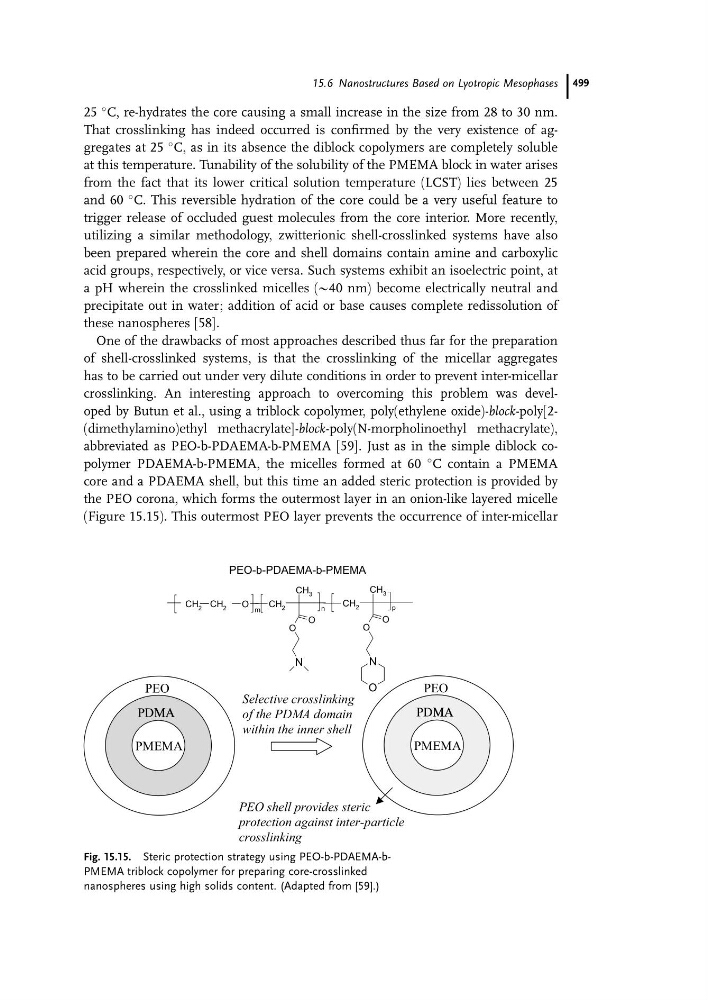
crosslinking. An interesting approach to overcoming this problem was developed by Butun et al., using a triblock copolymer, poly(ethylene oxide)-block-poly[2(dimethylamino)ethyl methacrylate]-block-poly(N-morpholinoethyl methacrylate),
abbreviated as PEO-b-PDAEMA-b-PMEMA [59]. Just as in the simple diblock copolymer PDAEMA-b-PMEMA, the micelles formed at 60
C contain a PMEMA
core and a PDAEMA shell, but this time an added steric protection is provided by
the PEO corona, which forms the outermost layer in an onion-like layered micelle
(Figure 15.15). This outermost PEO layer prevents the occurrence of inter-micellar
PEO
PDMA
PMEMA
Selective crosslinking
of the PDMA domain
within the inner shell
N
O
CH 3
O
O
CH 2
n
m
CH 3
O
O
N
CH 2
CH 2 CH 2
O
PEO-b-PDAEMA-b-PMEMA
p
PEO shell provides steric
protection against inter-particle
crosslinking
MA
PEO
PDMA
PMEMA
MA
Fig. 15.15. Steric protection strategy using PEO-b-PDAEMA-bPMEMA triblock copolymer for preparing core-crosslinked
nanospheres using high solids content. (Adapted from [59].)
15.6 Nanostructures Based on Lyotropic Mesophases 499
C, re-hydrates the core causing a small increase in the size from 28 to 30 nm.
That crosslinking has indeed occurred is confirmed by the very existence of aggregates at 25
C, as in its absence the diblock copolymers are completely soluble
at this temperature. Tunability of the solubility of the PMEMA block in water arises
from the fact that its lower critical solution temperature (LCST) lies between 25
and 60
C. This reversible hydration of the core could be a very useful feature to
trigger release of occluded guest molecules from the core interior. More recently,
utilizing a similar methodology, zwitterionic shell-crosslinked systems have also
been prepared wherein the core and shell domains contain amine and carboxylic
acid groups, respectively, or vice versa. Such systems exhibit an isoelectric point, at
a pH wherein the crosslinked micelles (@40 nm) become electrically neutral and
precipitate out in water; addition of acid or base causes complete redissolution of
these nanospheres [58].
One of the drawbacks of most approaches described thus far for the preparation
of shell-crosslinked systems, is that the crosslinking of the micellar aggregates
has to be carried out under very dilute conditions in order to prevent inter-micellar
crosslinking. An interesting approach to overcoming this problem was developed by Butun et al., using a triblock copolymer, poly(ethylene oxide)-block-poly[2(dimethylamino)ethyl methacrylate]-block-poly(N-morpholinoethyl methacrylate),
abbreviated as PEO-b-PDAEMA-b-PMEMA [59]. Just as in the simple diblock copolymer PDAEMA-b-PMEMA, the micelles formed at 60
C contain a PMEMA
core and a PDAEMA shell, but this time an added steric protection is provided by
the PEO corona, which forms the outermost layer in an onion-like layered micelle
(Figure 15.15). This outermost PEO layer prevents the occurrence of inter-micellar
PEO
PDMA
PMEMA
Selective crosslinking
of the PDMA domain
within the inner shell
N
O
CH 3
O
O
CH 2
n
m
CH 3
O
O
N
CH 2
CH 2 CH 2
O
PEO-b-PDAEMA-b-PMEMA
p
PEO shell provides steric
protection against inter-particle
crosslinking
MA
PEO
PDMA
PMEMA
MA
Fig. 15.15. Steric protection strategy using PEO-b-PDAEMA-bPMEMA triblock copolymer for preparing core-crosslinked
nanospheres using high solids content. (Adapted from [59].)
15.6 Nanostructures Based on Lyotropic Mesophases 499