

nanoparticles for drug delivery applications, it is essential that the diffusion characteristics of various types of molecules be understood. Using special NMR methods, it was shown that hydrophobic guest molecules reside within the core, while
amphiphilic molecules reside at the core–shell interface [55]. More importantly, it
was also established that, at higher crosslink densities, the shell hinders the diffusion of the host into the core, suggesting that chemical tuning of the shell characteristics clearly provides a handle for control of release rates of encapsulated molecules [56].
One of the very important reasons for generating water-soluble nanospheres is
their relevance to biological applications. Most systems discussed thus far contain a
hydrophobic core and a crosslinkable hydrophilic shell and hence inclusion of hydrophilic guest species within the core would clearly be difficult. To overcome this
problem, Butun et al. utilized a specifically designed diblock copolymer wherein
the core-forming block is one whose water-solubility is modulated by varying the
temperature; at higher temperatures of ca. 60
C the block is insoluble in water
while at 25
C it becomes water-soluble [57]. Thus, utilizing a diblock copolymer,
poly[2-(dimethylamino)ethyl methacrylate]-block-poly(N-morpholinoethyl methacrylate), abbreviated as PDAEMA-b-PMEMA, in which the PDAEMA block is
partially quaternized, they prepared micellar aggregates in water at 60
C. The
PMEMA block is water insoluble at this temperature and forms the core of the
micelle, while the partially quaternized PDAEMA block forms the shell. Crosslinking the shell region is achieved at 60
C by quaternization using an a,odiiodo(oligoethylene oxide). Cooling the shell-crosslinked micellar solution to
CH 2
m
n
CH 2
x
CH 2
N
y
Cl
N
+
Core
Shell
Crosslinking via
polymerization
of the styrene
unit
+
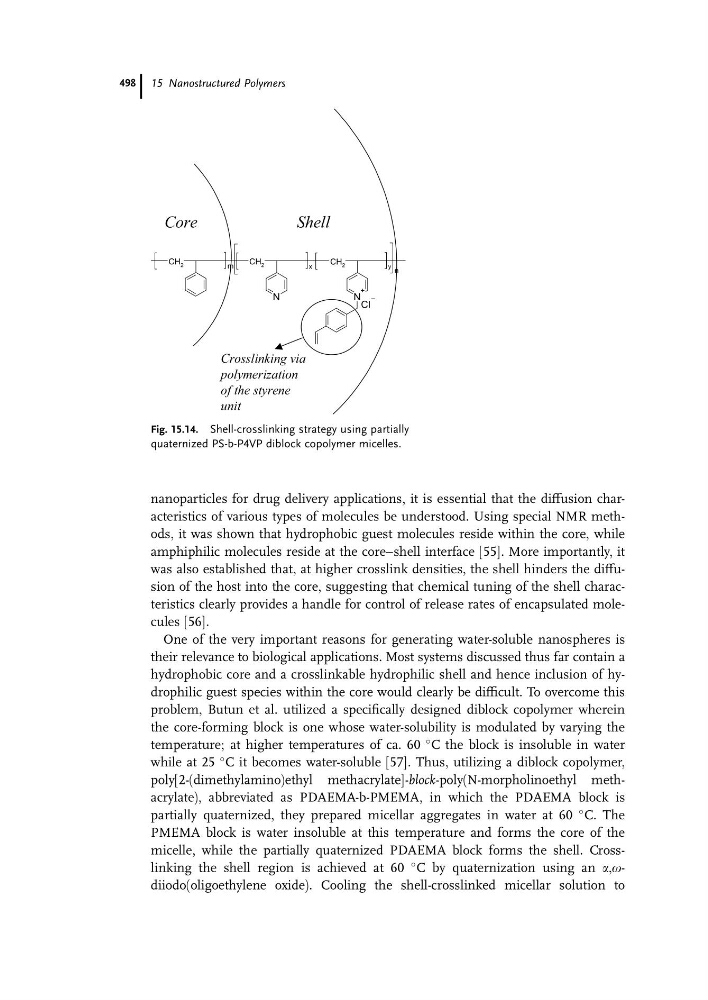
Fig. 15.14. Shell-crosslinking strategy using partially
quaternized PS-b-P4VP diblock copolymer micelles.
15 Nanostructured Polymers
498
amphiphilic molecules reside at the core–shell interface [55]. More importantly, it
was also established that, at higher crosslink densities, the shell hinders the diffusion of the host into the core, suggesting that chemical tuning of the shell characteristics clearly provides a handle for control of release rates of encapsulated molecules [56].
One of the very important reasons for generating water-soluble nanospheres is
their relevance to biological applications. Most systems discussed thus far contain a
hydrophobic core and a crosslinkable hydrophilic shell and hence inclusion of hydrophilic guest species within the core would clearly be difficult. To overcome this
problem, Butun et al. utilized a specifically designed diblock copolymer wherein
the core-forming block is one whose water-solubility is modulated by varying the
temperature; at higher temperatures of ca. 60
C the block is insoluble in water
while at 25
C it becomes water-soluble [57]. Thus, utilizing a diblock copolymer,
poly[2-(dimethylamino)ethyl methacrylate]-block-poly(N-morpholinoethyl methacrylate), abbreviated as PDAEMA-b-PMEMA, in which the PDAEMA block is
partially quaternized, they prepared micellar aggregates in water at 60
C. The
PMEMA block is water insoluble at this temperature and forms the core of the
micelle, while the partially quaternized PDAEMA block forms the shell. Crosslinking the shell region is achieved at 60
C by quaternization using an a,odiiodo(oligoethylene oxide). Cooling the shell-crosslinked micellar solution to
CH 2
m
n
CH 2
x
CH 2
N
y
Cl
N
+
Core
Shell
Crosslinking via
polymerization
of the styrene
unit
+
Fig. 15.14. Shell-crosslinking strategy using partially
quaternized PS-b-P4VP diblock copolymer micelles.
15 Nanostructured Polymers
498