

crosslinking during the crosslinking process, even at a very high solids content of
@10 wt%. Control experiments using the simple diblock copolymer, PDAEMA-bPMEMA lead to the formation of crosslinked gels at such high concentrations,
clearly demonstrating the efficacy of the steric stabilization affected by the PEO
layer.
15.6.3
Nanocages
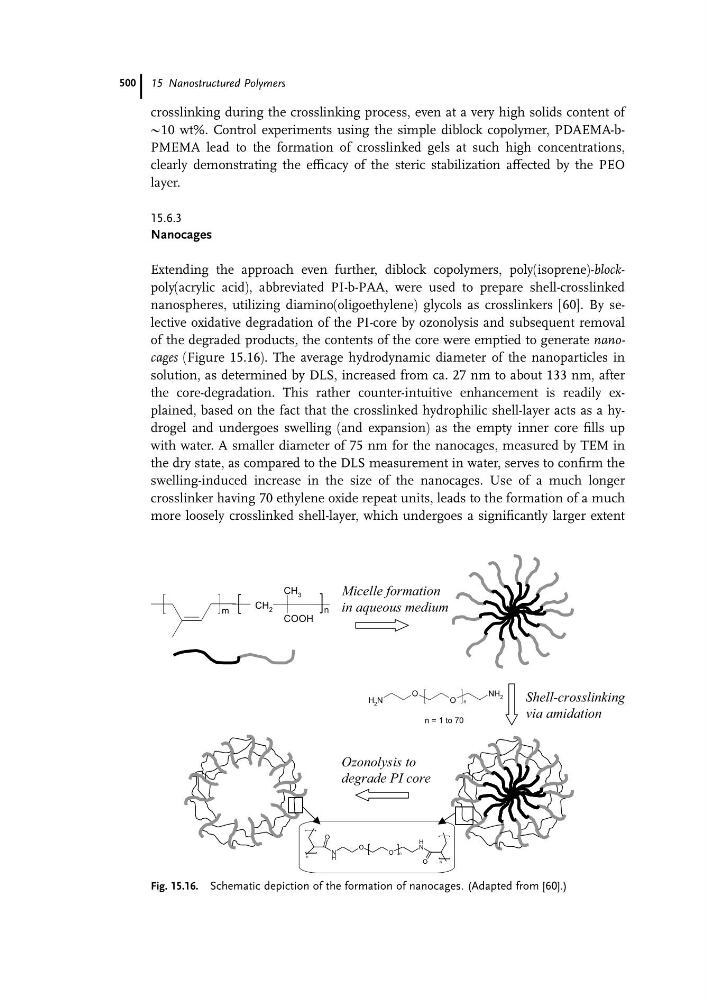
Extending the approach even further, diblock copolymers, poly(isoprene)-blockpoly(acrylic acid), abbreviated PI-b-PAA, were used to prepare shell-crosslinked
nanospheres, utilizing diamino(oligoethylene) glycols as crosslinkers [60]. By selective oxidative degradation of the PI-core by ozonolysis and subsequent removal
of the degraded products, the contents of the core were emptied to generate nanocages (Figure 15.16). The average hydrodynamic diameter of the nanoparticles in
solution, as determined by DLS, increased from ca. 27 nm to about 133 nm, after
the core-degradation. This rather counter-intuitive enhancement is readily explained, based on the fact that the crosslinked hydrophilic shell-layer acts as a hydrogel and undergoes swelling (and expansion) as the empty inner core fills up
with water. A smaller diameter of 75 nm for the nanocages, measured by TEM in
the dry state, as compared to the DLS measurement in water, serves to confirm the
swelling-induced increase in the size of the nanocages. Use of a much longer
crosslinker having 70 ethylene oxide repeat units, leads to the formation of a much
more loosely crosslinked shell-layer, which undergoes a significantly larger extent
CH 2
CH 3
COOH
n
m
Micelle formation
in aqueous medium
Shell-crosslinking
via amidation
O
O
NH 2
N
H 2
n
n = 1 to 70
O
O
N
H
N
H
n
O
O
n
n
Ozonolysis to
degrade PI core
Fig. 15.16. Schematic depiction of the formation of nanocages. (Adapted from [60].)
15 Nanostructured Polymers
500
@10 wt%. Control experiments using the simple diblock copolymer, PDAEMA-bPMEMA lead to the formation of crosslinked gels at such high concentrations,
clearly demonstrating the efficacy of the steric stabilization affected by the PEO
layer.
15.6.3
Nanocages
Extending the approach even further, diblock copolymers, poly(isoprene)-blockpoly(acrylic acid), abbreviated PI-b-PAA, were used to prepare shell-crosslinked
nanospheres, utilizing diamino(oligoethylene) glycols as crosslinkers [60]. By selective oxidative degradation of the PI-core by ozonolysis and subsequent removal
of the degraded products, the contents of the core were emptied to generate nanocages (Figure 15.16). The average hydrodynamic diameter of the nanoparticles in
solution, as determined by DLS, increased from ca. 27 nm to about 133 nm, after
the core-degradation. This rather counter-intuitive enhancement is readily explained, based on the fact that the crosslinked hydrophilic shell-layer acts as a hydrogel and undergoes swelling (and expansion) as the empty inner core fills up
with water. A smaller diameter of 75 nm for the nanocages, measured by TEM in
the dry state, as compared to the DLS measurement in water, serves to confirm the
swelling-induced increase in the size of the nanocages. Use of a much longer
crosslinker having 70 ethylene oxide repeat units, leads to the formation of a much
more loosely crosslinked shell-layer, which undergoes a significantly larger extent
CH 2
CH 3
COOH
n
m
Micelle formation
in aqueous medium
Shell-crosslinking
via amidation
O
O
NH 2
N
H 2
n
n = 1 to 70
O
O
N
H
N
H
n
O
O
n
n
Ozonolysis to
degrade PI core
Fig. 15.16. Schematic depiction of the formation of nanocages. (Adapted from [60].)
15 Nanostructured Polymers
500