

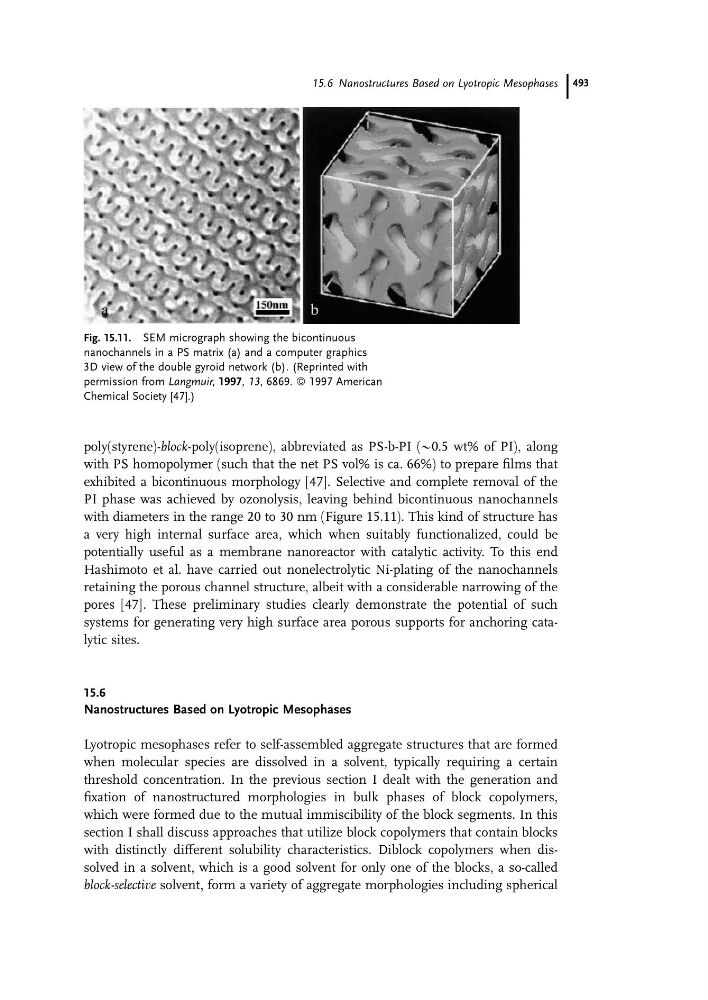
poly(styrene)-block-poly(isoprene), abbreviated as PS-b-PI (@0.5 wt% of PI), along
with PS homopolymer (such that the net PS vol% is ca. 66%) to prepare films that
exhibited a bicontinuous morphology [47]. Selective and complete removal of the
PI phase was achieved by ozonolysis, leaving behind bicontinuous nanochannels
with diameters in the range 20 to 30 nm (Figure 15.11). This kind of structure has
a very high internal surface area, which when suitably functionalized, could be
potentially useful as a membrane nanoreactor with catalytic activity. To this end
Hashimoto et al. have carried out nonelectrolytic Ni-plating of the nanochannels
retaining the porous channel structure, albeit with a considerable narrowing of the
pores [47]. These preliminary studies clearly demonstrate the potential of such
systems for generating very high surface area porous supports for anchoring catalytic sites.
15.6
Nanostructures Based on Lyotropic Mesophases
Lyotropic mesophases refer to self-assembled aggregate structures that are formed
when molecular species are dissolved in a solvent, typically requiring a certain
threshold concentration. In the previous section I dealt with the generation and
fixation of nanostructured morphologies in bulk phases of block copolymers,
which were formed due to the mutual immiscibility of the block segments. In this
section I shall discuss approaches that utilize block copolymers that contain blocks
with distinctly different solubility characteristics. Diblock copolymers when dissolved in a solvent, which is a good solvent for only one of the blocks, a so-called
block-selective solvent, form a variety of aggregate morphologies including spherical
Fig. 15.11. SEM micrograph showing the bicontinuous
nanochannels in a PS matrix (a) and a computer graphics
3D view of the double gyroid network (b). (Reprinted with
permission from Langmuir, 1997, 13, 6869. 8 1997 American
Chemical Society [47].)
15.6 Nanostructures Based on Lyotropic Mesophases 493
with PS homopolymer (such that the net PS vol% is ca. 66%) to prepare films that
exhibited a bicontinuous morphology [47]. Selective and complete removal of the
PI phase was achieved by ozonolysis, leaving behind bicontinuous nanochannels
with diameters in the range 20 to 30 nm (Figure 15.11). This kind of structure has
a very high internal surface area, which when suitably functionalized, could be
potentially useful as a membrane nanoreactor with catalytic activity. To this end
Hashimoto et al. have carried out nonelectrolytic Ni-plating of the nanochannels
retaining the porous channel structure, albeit with a considerable narrowing of the
pores [47]. These preliminary studies clearly demonstrate the potential of such
systems for generating very high surface area porous supports for anchoring catalytic sites.
15.6
Nanostructures Based on Lyotropic Mesophases
Lyotropic mesophases refer to self-assembled aggregate structures that are formed
when molecular species are dissolved in a solvent, typically requiring a certain
threshold concentration. In the previous section I dealt with the generation and
fixation of nanostructured morphologies in bulk phases of block copolymers,
which were formed due to the mutual immiscibility of the block segments. In this
section I shall discuss approaches that utilize block copolymers that contain blocks
with distinctly different solubility characteristics. Diblock copolymers when dissolved in a solvent, which is a good solvent for only one of the blocks, a so-called
block-selective solvent, form a variety of aggregate morphologies including spherical
Fig. 15.11. SEM micrograph showing the bicontinuous
nanochannels in a PS matrix (a) and a computer graphics
3D view of the double gyroid network (b). (Reprinted with
permission from Langmuir, 1997, 13, 6869. 8 1997 American
Chemical Society [47].)
15.6 Nanostructures Based on Lyotropic Mesophases 493