

grade via chain-scission (PMMA is a well-known deep-UV negative photoresist
material), while the PS phase becomes insoluble due to the occurrence of crosslinking. Exploiting this diametrically opposite behaviour of the PMMA and PS
phases to photo-exposure, an array of circular holes axially extending across the
entire thickness of the films was readily prepared after selective removal of the
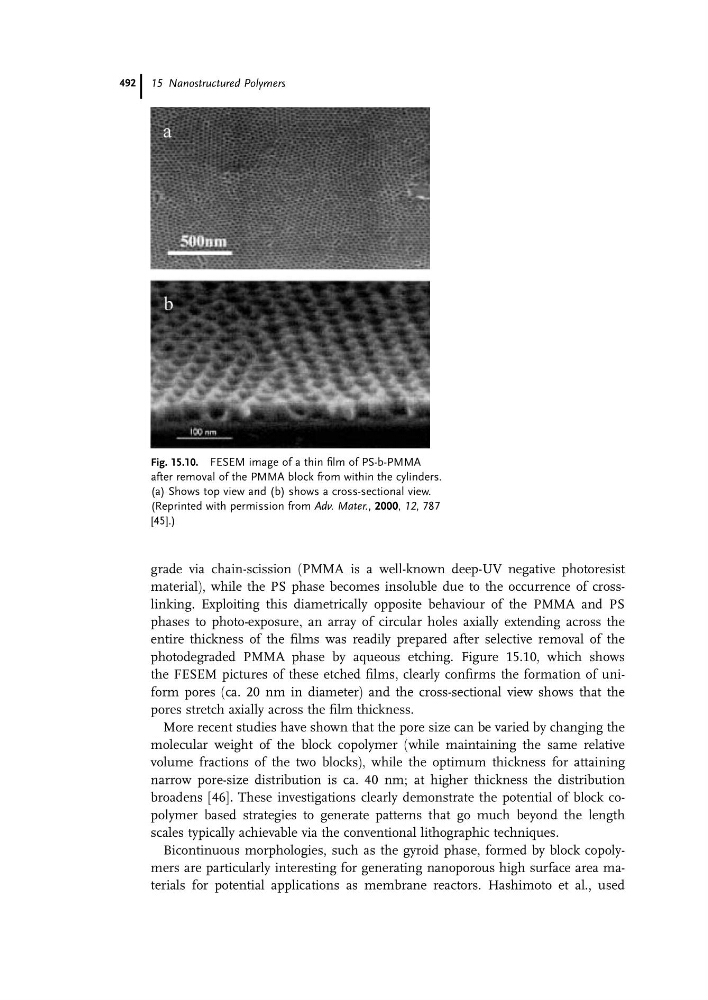
photodegraded PMMA phase by aqueous etching. Figure 15.10, which shows
the FESEM pictures of these etched films, clearly confirms the formation of uniform pores (ca. 20 nm in diameter) and the cross-sectional view shows that the
pores stretch axially across the film thickness.
More recent studies have shown that the pore size can be varied by changing the
molecular weight of the block copolymer (while maintaining the same relative
volume fractions of the two blocks), while the optimum thickness for attaining
narrow pore-size distribution is ca. 40 nm; at higher thickness the distribution
broadens [46]. These investigations clearly demonstrate the potential of block copolymer based strategies to generate patterns that go much beyond the length
scales typically achievable via the conventional lithographic techniques.
Bicontinuous morphologies, such as the gyroid phase, formed by block copolymers are particularly interesting for generating nanoporous high surface area materials for potential applications as membrane reactors. Hashimoto et al., used
Fig. 15.10. FESEM image of a thin film of PS-b-PMMA
after removal of the PMMA block from within the cylinders.
(a) Shows top view and (b) shows a cross-sectional view.
(Reprinted with permission from Adv. Mater., 2000, 12, 787
[45].)
15 Nanostructured Polymers
492
material), while the PS phase becomes insoluble due to the occurrence of crosslinking. Exploiting this diametrically opposite behaviour of the PMMA and PS
phases to photo-exposure, an array of circular holes axially extending across the
entire thickness of the films was readily prepared after selective removal of the
photodegraded PMMA phase by aqueous etching. Figure 15.10, which shows
the FESEM pictures of these etched films, clearly confirms the formation of uniform pores (ca. 20 nm in diameter) and the cross-sectional view shows that the
pores stretch axially across the film thickness.
More recent studies have shown that the pore size can be varied by changing the
molecular weight of the block copolymer (while maintaining the same relative
volume fractions of the two blocks), while the optimum thickness for attaining
narrow pore-size distribution is ca. 40 nm; at higher thickness the distribution
broadens [46]. These investigations clearly demonstrate the potential of block copolymer based strategies to generate patterns that go much beyond the length
scales typically achievable via the conventional lithographic techniques.
Bicontinuous morphologies, such as the gyroid phase, formed by block copolymers are particularly interesting for generating nanoporous high surface area materials for potential applications as membrane reactors. Hashimoto et al., used
Fig. 15.10. FESEM image of a thin film of PS-b-PMMA
after removal of the PMMA block from within the cylinders.
(a) Shows top view and (b) shows a cross-sectional view.
(Reprinted with permission from Adv. Mater., 2000, 12, 787
[45].)
15 Nanostructured Polymers
492