

tion provided for this behaviour is based on the state of ionization of the carboxylic
acid groups on the PAA chains. At pH 3, they exist in the carboxylic acid form,
wherein they are intricately H-bonded to form a network that has very low permeability to water. However, at a higher pH of 12, the carboxylate ions formed are
readily solvated by water, and thereby enhanced permeability to water is observed.
It is anticipated that such nanoporous membranes with tunable porosity could be
useful as templates for semiconductor nanofabrication, for controlled drug delivery
applications as well as in sensing devices.
Direct formation of well-ordered nanoporous thin-film coatings has also been
demonstrated by an innovative utilization of cylindrical domain formation in thin
block copolymer films, followed by selective removal of the cylindrical phase by
photo-degradation. It is anticipated that a well-ordered array of pores on an appropriate substrate could serve as a lithographic template or as scaffolds for periodic
assembly of nanosize electronic materials. For such applications, it is very important to ensure that the cylinders are oriented perpendicular to the film surface. Although, such perpendicular orientation of cylinders in block copolymer films has
been attained by application of an electric field [42, 43], a more elegant approach
uses the intrinsic entropy-driven alignment on a specifically pre-formed neutral
surface [44]. In one study, poly(styrene)-block-poly(methylmethacrylate), PS-bPMMA (containing 30 vol% PMMA) was deposited as very thin films (50 nm) on a
silicon substrate previously coated with a random copolymer of PS and PMMA
[45]. The random copolymer coating renders the substrate neutral and ensures the
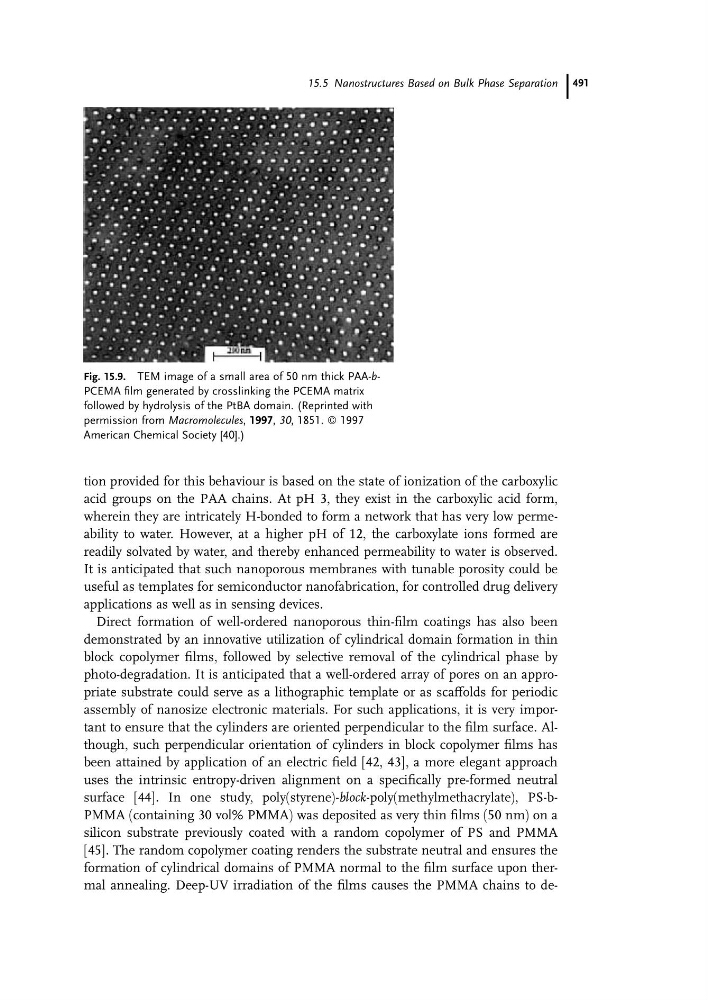
formation of cylindrical domains of PMMA normal to the film surface upon thermal annealing. Deep-UV irradiation of the films causes the PMMA chains to deFig. 15.9. TEM image of a small area of 50 nm thick PAA-bPCEMA film generated by crosslinking the PCEMA matrix
followed by hydrolysis of the PtBA domain. (Reprinted with
permission from Macromolecules, 1997, 30, 1851. 8 1997
American Chemical Society [40].)
15.5 Nanostructures Based on Bulk Phase Separation 491
acid groups on the PAA chains. At pH 3, they exist in the carboxylic acid form,
wherein they are intricately H-bonded to form a network that has very low permeability to water. However, at a higher pH of 12, the carboxylate ions formed are
readily solvated by water, and thereby enhanced permeability to water is observed.
It is anticipated that such nanoporous membranes with tunable porosity could be
useful as templates for semiconductor nanofabrication, for controlled drug delivery
applications as well as in sensing devices.
Direct formation of well-ordered nanoporous thin-film coatings has also been
demonstrated by an innovative utilization of cylindrical domain formation in thin
block copolymer films, followed by selective removal of the cylindrical phase by
photo-degradation. It is anticipated that a well-ordered array of pores on an appropriate substrate could serve as a lithographic template or as scaffolds for periodic
assembly of nanosize electronic materials. For such applications, it is very important to ensure that the cylinders are oriented perpendicular to the film surface. Although, such perpendicular orientation of cylinders in block copolymer films has
been attained by application of an electric field [42, 43], a more elegant approach
uses the intrinsic entropy-driven alignment on a specifically pre-formed neutral
surface [44]. In one study, poly(styrene)-block-poly(methylmethacrylate), PS-bPMMA (containing 30 vol% PMMA) was deposited as very thin films (50 nm) on a
silicon substrate previously coated with a random copolymer of PS and PMMA
[45]. The random copolymer coating renders the substrate neutral and ensures the
formation of cylindrical domains of PMMA normal to the film surface upon thermal annealing. Deep-UV irradiation of the films causes the PMMA chains to deFig. 15.9. TEM image of a small area of 50 nm thick PAA-bPCEMA film generated by crosslinking the PCEMA matrix
followed by hydrolysis of the PtBA domain. (Reprinted with
permission from Macromolecules, 1997, 30, 1851. 8 1997
American Chemical Society [40].)
15.5 Nanostructures Based on Bulk Phase Separation 491