

micelles, vesicles, cylindrical micelles etc. [48]. Thus diblock copolymers, which
contain a hydrophilic block and a hydrophobic one, behave like simple surfactants
and form a rich variety of structures in aqueous media, ranging from simple
spherical micelles to more complex phases, such as the bicontinuous phases. Micelles formed by block copolymers differ from those formed by simple surfactants,
both in terms of their significantly larger sizes and their higher stability (less dynamic).
The majority of the efforts to generate nanostructures utilizing phase-separated
block copolymers in the bulk have focused on the cylindrical domains, while only
limited effort has been made to utilize other morphologies. Efforts to use lyotropic
mesophases formed by block copolymers, in this sense, complement those utilizing the bulk phase-separated systems, since the major focus of research based on
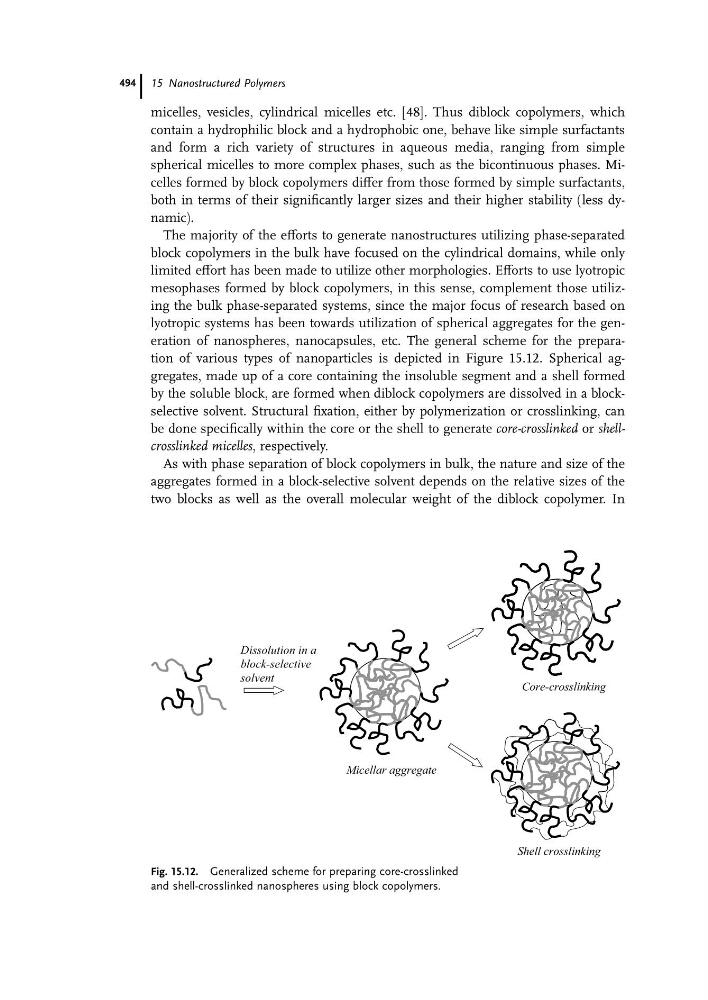
lyotropic systems has been towards utilization of spherical aggregates for the generation of nanospheres, nanocapsules, etc. The general scheme for the preparation of various types of nanoparticles is depicted in Figure 15.12. Spherical aggregates, made up of a core containing the insoluble segment and a shell formed
by the soluble block, are formed when diblock copolymers are dissolved in a blockselective solvent. Structural fixation, either by polymerization or crosslinking, can
be done specifically within the core or the shell to generate core-crosslinked or shellcrosslinked micelles, respectively.
As with phase separation of block copolymers in bulk, the nature and size of the
aggregates formed in a block-selective solvent depends on the relative sizes of the
two blocks as well as the overall molecular weight of the diblock copolymer. In
Dissolution in a
block-selective
solvent
Core-crosslinking
Shell crosslinking
Micellar aggregate
Fig. 15.12. Generalized scheme for preparing core-crosslinked
and shell-crosslinked nanospheres using block copolymers.
15 Nanostructured Polymers
494
contain a hydrophilic block and a hydrophobic one, behave like simple surfactants
and form a rich variety of structures in aqueous media, ranging from simple
spherical micelles to more complex phases, such as the bicontinuous phases. Micelles formed by block copolymers differ from those formed by simple surfactants,
both in terms of their significantly larger sizes and their higher stability (less dynamic).
The majority of the efforts to generate nanostructures utilizing phase-separated
block copolymers in the bulk have focused on the cylindrical domains, while only
limited effort has been made to utilize other morphologies. Efforts to use lyotropic
mesophases formed by block copolymers, in this sense, complement those utilizing the bulk phase-separated systems, since the major focus of research based on
lyotropic systems has been towards utilization of spherical aggregates for the generation of nanospheres, nanocapsules, etc. The general scheme for the preparation of various types of nanoparticles is depicted in Figure 15.12. Spherical aggregates, made up of a core containing the insoluble segment and a shell formed
by the soluble block, are formed when diblock copolymers are dissolved in a blockselective solvent. Structural fixation, either by polymerization or crosslinking, can
be done specifically within the core or the shell to generate core-crosslinked or shellcrosslinked micelles, respectively.
As with phase separation of block copolymers in bulk, the nature and size of the
aggregates formed in a block-selective solvent depends on the relative sizes of the
two blocks as well as the overall molecular weight of the diblock copolymer. In
Dissolution in a
block-selective
solvent
Core-crosslinking
Shell crosslinking
Micellar aggregate
Fig. 15.12. Generalized scheme for preparing core-crosslinked
and shell-crosslinked nanospheres using block copolymers.
15 Nanostructured Polymers
494