

15.5
Nanostructures Based on Bulk Phase Separation
Selective fixation of one of the domains in any of the morphologies formed by
block copolymers, either by polymerization or by photo-crosslinking, is an elegant
way to generate nanostructures. Utilizing such a concept, several types of nanosize
objects, such as nanospheres, nanofibres and nanotubes etc., have been successfully prepared. A schematic representation of this general methodology is shown
in Figure 15.5.
One of the very early examples of this concept for the generation of nanospheres
utilized a diblock copolymer-poly(styrene)-block-poly(4-vinyl pyridine), labeled PS-bP4VP [35]. Using a diblock copolymer with a higher weight-fraction of PS (>75
wt%), solvent cast films were shown to contain spherical micellar aggregates with a
P4VP core embedded in a PS matrix, as confirmed by TEM studies. Exposure of
these films to vapors of 1,4-dibromobutane (DBB), caused crosslinking of the PVP
Im3m
LAM
HPL
Ia3d
HEX
Spheres
Cylinders
Bicontinuous
Perforated
layers
Lamellae
0 0.1 0.2 0.3 0.4 0.5 0.6 0.7 0.8 0.9 1.0
f PI
40
30
20
10
0
χN
Disordered
HEX
HPL
LAM
la3d
HEX
la3m
-
-
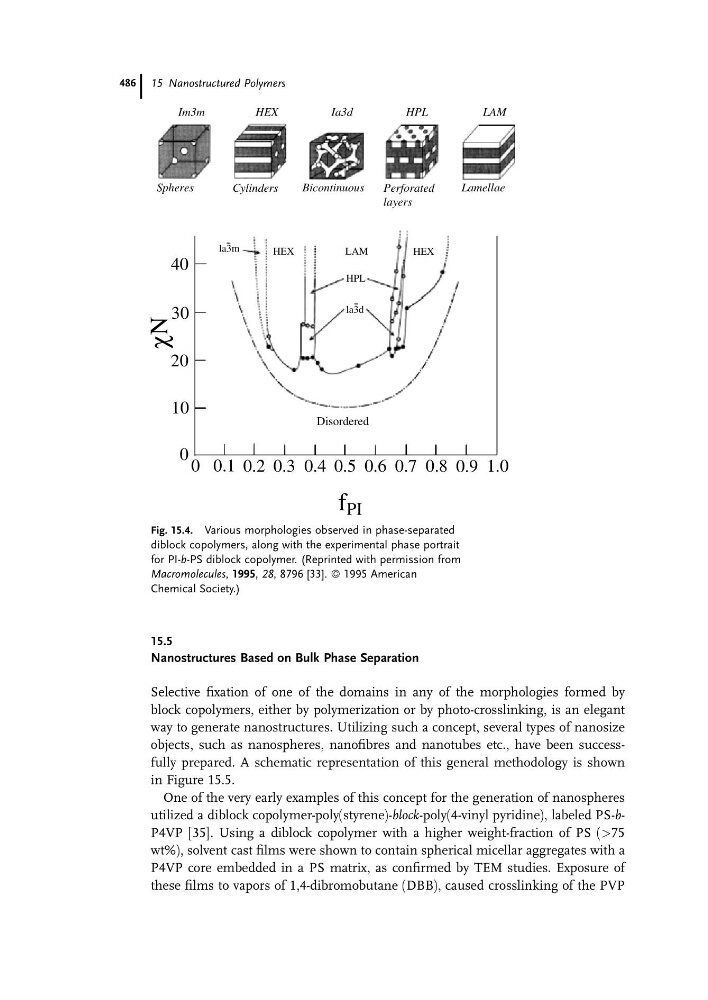
Fig. 15.4. Various morphologies observed in phase-separated
diblock copolymers, along with the experimental phase portrait
for PI-b-PS diblock copolymer. (Reprinted with permission from
Macromolecules, 1995, 28, 8796 [33]. 8 1995 American
Chemical Society.)
15 Nanostructured Polymers
486
Nanostructures Based on Bulk Phase Separation
Selective fixation of one of the domains in any of the morphologies formed by
block copolymers, either by polymerization or by photo-crosslinking, is an elegant
way to generate nanostructures. Utilizing such a concept, several types of nanosize
objects, such as nanospheres, nanofibres and nanotubes etc., have been successfully prepared. A schematic representation of this general methodology is shown
in Figure 15.5.
One of the very early examples of this concept for the generation of nanospheres
utilized a diblock copolymer-poly(styrene)-block-poly(4-vinyl pyridine), labeled PS-bP4VP [35]. Using a diblock copolymer with a higher weight-fraction of PS (>75
wt%), solvent cast films were shown to contain spherical micellar aggregates with a
P4VP core embedded in a PS matrix, as confirmed by TEM studies. Exposure of
these films to vapors of 1,4-dibromobutane (DBB), caused crosslinking of the PVP
Im3m
LAM
HPL
Ia3d
HEX
Spheres
Cylinders
Bicontinuous
Perforated
layers
Lamellae
0 0.1 0.2 0.3 0.4 0.5 0.6 0.7 0.8 0.9 1.0
f PI
40
30
20
10
0
χN
Disordered
HEX
HPL
LAM
la3d
HEX
la3m
-
-
Fig. 15.4. Various morphologies observed in phase-separated
diblock copolymers, along with the experimental phase portrait
for PI-b-PS diblock copolymer. (Reprinted with permission from
Macromolecules, 1995, 28, 8796 [33]. 8 1995 American
Chemical Society.)
15 Nanostructured Polymers
486