

number of monomer repeat units of A, B, and C in the respective block segments.
Depending on the relative volume fractions of the two blocks, diblock copolymers
can form a variety of phase-separated morphologies ranging from spherical dispersions of one phase in the other, to more complex morphologies such as bicontinuous structures [32]. Unlike in polymer blends, in block copolymers each
polymer chain traverses across the boundary between the domains formed by the
two phases. This being the case, the shape and size of the domains are directly
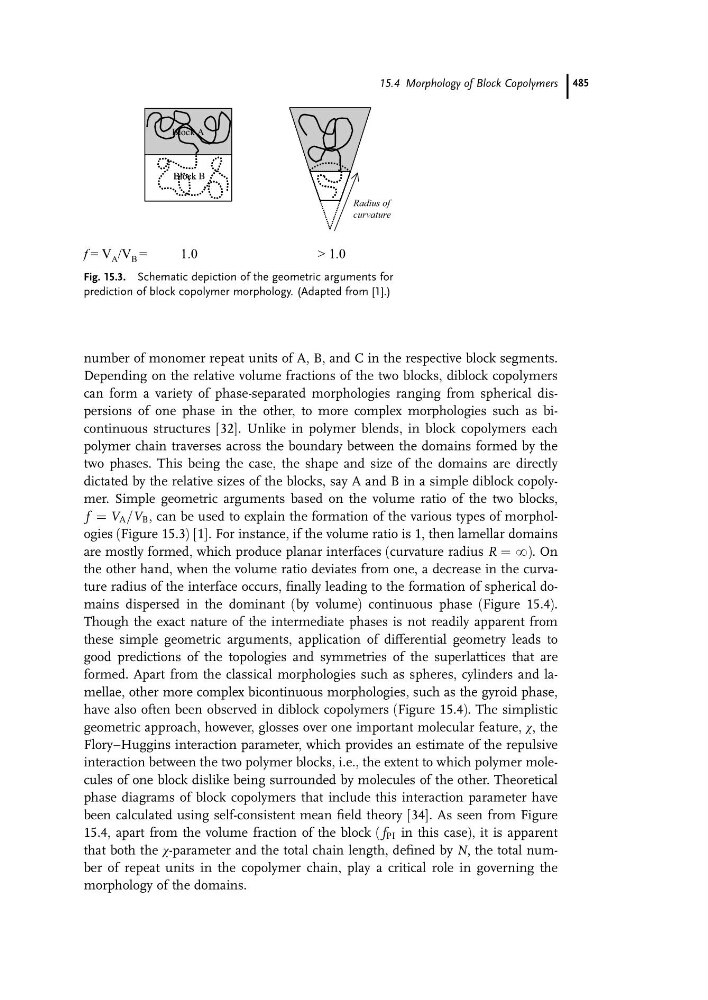
dictated by the relative sizes of the blocks, say A and B in a simple diblock copolymer. Simple geometric arguments based on the volume ratio of the two blocks,
f ¼ V A =V B , can be used to explain the formation of the various types of morphologies (Figure 15.3) [1]. For instance, if the volume ratio is 1, then lamellar domains
are mostly formed, which produce planar interfaces (curvature radius R ¼ y). On
the other hand, when the volume ratio deviates from one, a decrease in the curvature radius of the interface occurs, finally leading to the formation of spherical domains dispersed in the dominant (by volume) continuous phase (Figure 15.4).
Though the exact nature of the intermediate phases is not readily apparent from
these simple geometric arguments, application of differential geometry leads to
good predictions of the topologies and symmetries of the superlattices that are
formed. Apart from the classical morphologies such as spheres, cylinders and lamellae, other more complex bicontinuous morphologies, such as the gyroid phase,
have also often been observed in diblock copolymers (Figure 15.4). The simplistic
geometric approach, however, glosses over one important molecular feature, w, the
Flory–Huggins interaction parameter, which provides an estimate of the repulsive
interaction between the two polymer blocks, i.e., the extent to which polymer molecules of one block dislike being surrounded by molecules of the other. Theoretical
phase diagrams of block copolymers that include this interaction parameter have
been calculated using self-consistent mean field theory [34]. As seen from Figure
15.4, apart from the volume fraction of the block ( f PI in this case), it is apparent
that both the w-parameter and the total chain length, defined by N, the total number of repeat units in the copolymer chain, play a critical role in governing the
morphology of the domains.
Block A
Block B
Radius of
curvature
f = V A /V B =
1.0
> 1.0
Block A
Block
Fig. 15.3. Schematic depiction of the geometric arguments for
prediction of block copolymer morphology. (Adapted from [1].)
15.4 Morphology of Block Copolymers 485
Depending on the relative volume fractions of the two blocks, diblock copolymers
can form a variety of phase-separated morphologies ranging from spherical dispersions of one phase in the other, to more complex morphologies such as bicontinuous structures [32]. Unlike in polymer blends, in block copolymers each
polymer chain traverses across the boundary between the domains formed by the
two phases. This being the case, the shape and size of the domains are directly
dictated by the relative sizes of the blocks, say A and B in a simple diblock copolymer. Simple geometric arguments based on the volume ratio of the two blocks,
f ¼ V A =V B , can be used to explain the formation of the various types of morphologies (Figure 15.3) [1]. For instance, if the volume ratio is 1, then lamellar domains
are mostly formed, which produce planar interfaces (curvature radius R ¼ y). On
the other hand, when the volume ratio deviates from one, a decrease in the curvature radius of the interface occurs, finally leading to the formation of spherical domains dispersed in the dominant (by volume) continuous phase (Figure 15.4).
Though the exact nature of the intermediate phases is not readily apparent from
these simple geometric arguments, application of differential geometry leads to
good predictions of the topologies and symmetries of the superlattices that are
formed. Apart from the classical morphologies such as spheres, cylinders and lamellae, other more complex bicontinuous morphologies, such as the gyroid phase,
have also often been observed in diblock copolymers (Figure 15.4). The simplistic
geometric approach, however, glosses over one important molecular feature, w, the
Flory–Huggins interaction parameter, which provides an estimate of the repulsive
interaction between the two polymer blocks, i.e., the extent to which polymer molecules of one block dislike being surrounded by molecules of the other. Theoretical
phase diagrams of block copolymers that include this interaction parameter have
been calculated using self-consistent mean field theory [34]. As seen from Figure
15.4, apart from the volume fraction of the block ( f PI in this case), it is apparent
that both the w-parameter and the total chain length, defined by N, the total number of repeat units in the copolymer chain, play a critical role in governing the
morphology of the domains.
Block A
Block B
Radius of
curvature
f = V A /V B =
1.0
> 1.0
Block A
Block
Fig. 15.3. Schematic depiction of the geometric arguments for
prediction of block copolymer morphology. (Adapted from [1].)
15.4 Morphology of Block Copolymers 485