

(Figure 14.17). The suction of substrates into this ‘nanosponge’, while simultaneously closing the pores, essentially triggers a restructuring of the incarcerated
solvent molecules, a situation formally comparable to the mentioned intracellular
response to an extracellular stimulus. Moreover, as different types of substrates can
interact with different types of capsule pores, i.e. on a specific spherical nanosurface, the situation might be noted as the beginning of an era of nanoscaled sphericalsurface chemistry. Additionally, since the pore sizes of the clusters can be varied and
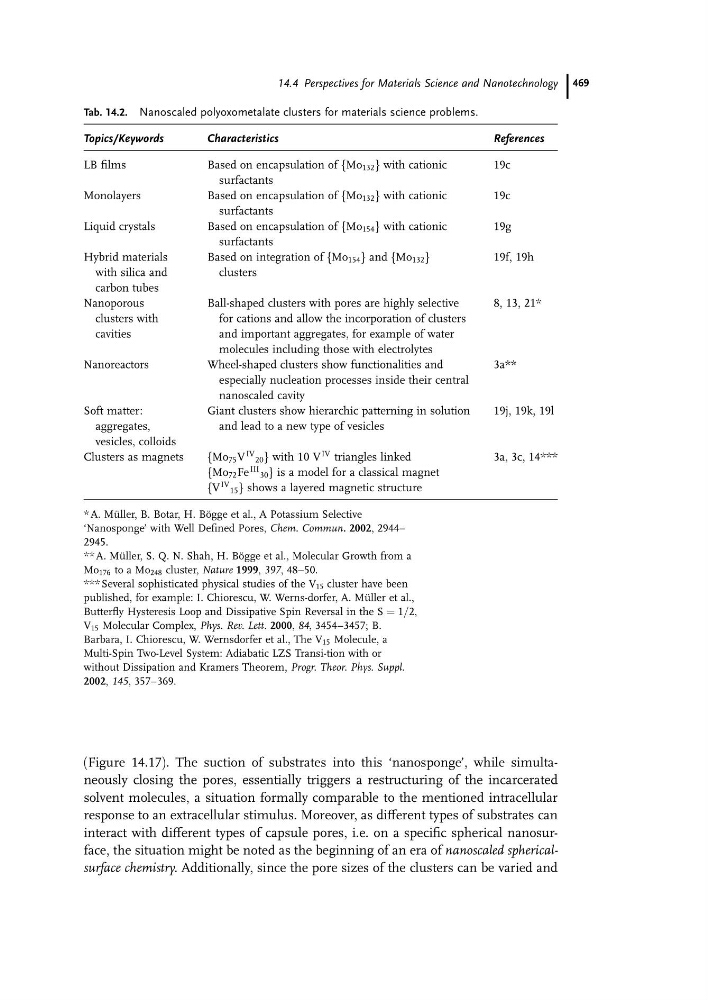
Tab. 14.2. Nanoscaled polyoxometalate clusters for materials science problems.
Topics/Keywords
Characteristics
References
LB films
Based on encapsulation of {Mo 132 } with cationic
surfactants
19c
Monolayers
Based on encapsulation of {Mo 132 } with cationic
surfactants
19c
Liquid crystals
Based on encapsulation of {Mo 154 } with cationic
surfactants
19g
Hybrid materials
with silica and
carbon tubes
Based on integration of {Mo 154 } and {Mo 132 }
clusters
19f, 19h
Nanoporous
clusters with
cavities
Ball-shaped clusters with pores are highly selective
for cations and allow the incorporation of clusters
and important aggregates, for example of water
molecules including those with electrolytes
8, 13, 21*
Nanoreactors
Wheel-shaped clusters show functionalities and
especially nucleation processes inside their central
nanoscaled cavity
3a**
Soft matter:
aggregates,
vesicles, colloids
Giant clusters show hierarchic patterning in solution
and lead to a new type of vesicles
19j, 19k, 19l
Clusters as magnets
{Mo 75 V
IV
20 } with 10 V
IV triangles linked
{Mo 72 Fe
III 30 } is a model for a classical magnet
{V
IV
15 } shows a layered magnetic structure
3a, 3c, 14***
* A. Mu ¨ller, B. Botar, H. Bo ¨gge et al., A Potassium Selective
‘Nanosponge’ with Well Defined Pores, Chem. Commun. 2002, 2944–
2945.
** A. Mu ¨ller, S. Q. N. Shah, H. Bo ¨gge et al., Molecular Growth from a
Mo 176 to a Mo 248 cluster, Nature 1999, 397, 48–50.
*** Several sophisticated physical studies of the V 15 cluster have been
published, for example: I. Chiorescu, W. Werns-dorfer, A. Mu ¨ller et al.,
Butterfly Hysteresis Loop and Dissipative Spin Reversal in the S ¼ 1=2,
V 15 Molecular Complex, Phys. Rev. Lett. 2000, 84, 3454–3457; B.
Barbara, I. Chiorescu, W. Wernsdorfer et al., The V 15 Molecule, a
Multi-Spin Two-Level System: Adiabatic LZS Transi-tion with or
without Dissipation and Kramers Theorem, Progr. Theor. Phys. Suppl.
2002, 145, 357–369.
14.4 Perspectives for Materials Science and Nanotechnology 469
solvent molecules, a situation formally comparable to the mentioned intracellular
response to an extracellular stimulus. Moreover, as different types of substrates can
interact with different types of capsule pores, i.e. on a specific spherical nanosurface, the situation might be noted as the beginning of an era of nanoscaled sphericalsurface chemistry. Additionally, since the pore sizes of the clusters can be varied and
Tab. 14.2. Nanoscaled polyoxometalate clusters for materials science problems.
Topics/Keywords
Characteristics
References
LB films
Based on encapsulation of {Mo 132 } with cationic
surfactants
19c
Monolayers
Based on encapsulation of {Mo 132 } with cationic
surfactants
19c
Liquid crystals
Based on encapsulation of {Mo 154 } with cationic
surfactants
19g
Hybrid materials
with silica and
carbon tubes
Based on integration of {Mo 154 } and {Mo 132 }
clusters
19f, 19h
Nanoporous
clusters with
cavities
Ball-shaped clusters with pores are highly selective
for cations and allow the incorporation of clusters
and important aggregates, for example of water
molecules including those with electrolytes
8, 13, 21*
Nanoreactors
Wheel-shaped clusters show functionalities and
especially nucleation processes inside their central
nanoscaled cavity
3a**
Soft matter:
aggregates,
vesicles, colloids
Giant clusters show hierarchic patterning in solution
and lead to a new type of vesicles
19j, 19k, 19l
Clusters as magnets
{Mo 75 V
IV
20 } with 10 V
IV triangles linked
{Mo 72 Fe
III 30 } is a model for a classical magnet
{V
IV
15 } shows a layered magnetic structure
3a, 3c, 14***
* A. Mu ¨ller, B. Botar, H. Bo ¨gge et al., A Potassium Selective
‘Nanosponge’ with Well Defined Pores, Chem. Commun. 2002, 2944–
2945.
** A. Mu ¨ller, S. Q. N. Shah, H. Bo ¨gge et al., Molecular Growth from a
Mo 176 to a Mo 248 cluster, Nature 1999, 397, 48–50.
*** Several sophisticated physical studies of the V 15 cluster have been
published, for example: I. Chiorescu, W. Werns-dorfer, A. Mu ¨ller et al.,
Butterfly Hysteresis Loop and Dissipative Spin Reversal in the S ¼ 1=2,
V 15 Molecular Complex, Phys. Rev. Lett. 2000, 84, 3454–3457; B.
Barbara, I. Chiorescu, W. Wernsdorfer et al., The V 15 Molecule, a
Multi-Spin Two-Level System: Adiabatic LZS Transi-tion with or
without Dissipation and Kramers Theorem, Progr. Theor. Phys. Suppl.
2002, 145, 357–369.
14.4 Perspectives for Materials Science and Nanotechnology 469