

cavities, ‘nanosized’ changeable pores, unique surfaces, unusual electronic structures, and
last but not least abundance of magnetic centres in a variety of topologies. Moreover, most of the clusters, especially the spherical ones, can be manipulated whilst
keeping the robust nanoscopic oxomolybdate skeleton intact. Encapsulation of the
giant clusters with surfactant molecules allows one to produce LB films and monolayers. Some of these even form a new type of vesicle perhaps with the option of
getting information about the structure of liquid water. A summary of these and
other relevant aspects is presented in Table 14.2; for further details see the collection of papers in [19].
A recent challenge in nanotechnology is to mimic the material constructions and
molecular-recognition-type responsive sensing of biological systems. Intracellular
response to extracellular signals involves signal transduction via molecular recognition of the specific receptors on the cell surface, which can trigger enzymatic reactions in the cell. Such a ‘‘cognitive isomorphism’’ on a molecular level, a rare
phenomenon in classical chemistry, is, for example, of immense importance for
understanding the complex dynamics of ‘uptake and release’ of substrates in
general.
The nanoball of the type {Mo 132 } shows such molecule-response activity. It can
be compared to a ‘nanosponge’ with a multitude of open pores accessible for a
specific substrate, for example, guanidinium cation guests in the case of {Mo 132 }
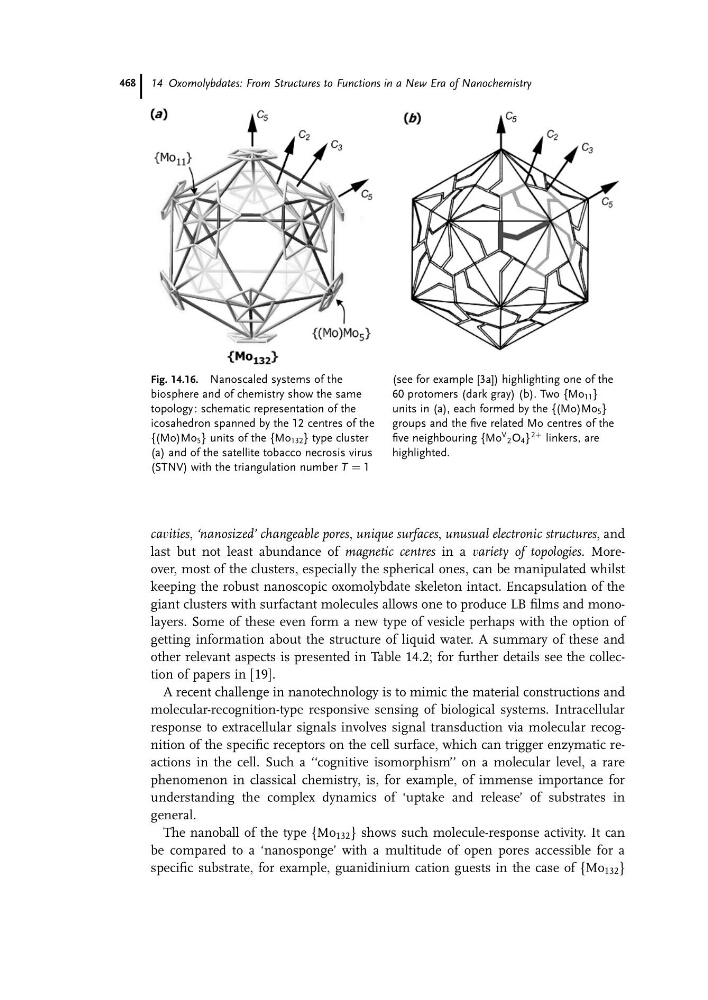
Fig. 14.16. Nanoscaled systems of the
biosphere and of chemistry show the same
topology : schematic representation of the
icosahedron spanned by the 12 centres of the
{(Mo)Mo 5 } units of the {Mo 132 } type cluster
(a) and of the satellite tobacco necrosis virus
(STNV) with the triangulation number T ¼ 1
(see for example [3a]) highlighting one of the
60 protomers (dark gray) (b). Two {Mo 11 }
units in (a), each formed by the {(Mo)Mo 5 }
groups and the five related Mo centres of the
five neighbouring {Mo
V
2 O 4 }
2þ linkers, are
highlighted.
14 Oxomolybdates: From Structures to Functions in a New Era of Nanochemistry
468
last but not least abundance of magnetic centres in a variety of topologies. Moreover, most of the clusters, especially the spherical ones, can be manipulated whilst
keeping the robust nanoscopic oxomolybdate skeleton intact. Encapsulation of the
giant clusters with surfactant molecules allows one to produce LB films and monolayers. Some of these even form a new type of vesicle perhaps with the option of
getting information about the structure of liquid water. A summary of these and
other relevant aspects is presented in Table 14.2; for further details see the collection of papers in [19].
A recent challenge in nanotechnology is to mimic the material constructions and
molecular-recognition-type responsive sensing of biological systems. Intracellular
response to extracellular signals involves signal transduction via molecular recognition of the specific receptors on the cell surface, which can trigger enzymatic reactions in the cell. Such a ‘‘cognitive isomorphism’’ on a molecular level, a rare
phenomenon in classical chemistry, is, for example, of immense importance for
understanding the complex dynamics of ‘uptake and release’ of substrates in
general.
The nanoball of the type {Mo 132 } shows such molecule-response activity. It can
be compared to a ‘nanosponge’ with a multitude of open pores accessible for a
specific substrate, for example, guanidinium cation guests in the case of {Mo 132 }
Fig. 14.16. Nanoscaled systems of the
biosphere and of chemistry show the same
topology : schematic representation of the
icosahedron spanned by the 12 centres of the
{(Mo)Mo 5 } units of the {Mo 132 } type cluster
(a) and of the satellite tobacco necrosis virus
(STNV) with the triangulation number T ¼ 1
(see for example [3a]) highlighting one of the
60 protomers (dark gray) (b). Two {Mo 11 }
units in (a), each formed by the {(Mo)Mo 5 }
groups and the five related Mo centres of the
five neighbouring {Mo
V
2 O 4 }
2þ linkers, are
highlighted.
14 Oxomolybdates: From Structures to Functions in a New Era of Nanochemistry
468