

show correspondingly different reactivities, we can also refer to a new type of
nanoporous-cluster chemistry and, because of the large number of receptors involved
(20 in the case of icosahedral spheres), to a super-supramolecular chemistry. In this
connection recent unpublished
1 H NMR investigations have revealed that the uptake and release of ‘guanidinium’ substrates in solution by the ‘nanosponge’ shows
an interesting temperature dependence corresponding to an open-and-shut process
[20].
An aspect of particular relevance refers to the exciting problem of the structure
of liquid water. The closing of the cluster’s ‘nanowindow’ leads, in the case of the
{Mo 132 } cluster, to the reorganization of the internal H 2 O molecules into a giant
and structurally well-defined (H 2 O) 100 cluster which can perhaps be considered as
a snapshot of liquid water (see [8, 21] and Figures 14.18 and 14.19). (The endohedral clusterization of water molecules upon substrate uptake into the pores formally corresponds to the cellular response to an extracellular stimulus on the cell
surface.) Our special endohedral clusterization of water molecules would certainly
have pleased both Plato and Archimedes as the water cluster can be formally (!)
arranged in shells showing a larger and smaller dodecahedron, each composed of a
(H 2 O) 20 segment and one rhombicosidodecahedron (H 2 O) 60 [8, 21]. This example
shows that with the present nanocontainers, available for the encapsulation of
segments of different kinds of (macroscopic) substances and even rather large
molecular systems, problems of tremendous importance for contemporary nanoscience can be solved. Even perhaps the liquid water problem which has been
characterized as ‘‘The most important problem in science that hardly anyone wants to
solve’’ [22].
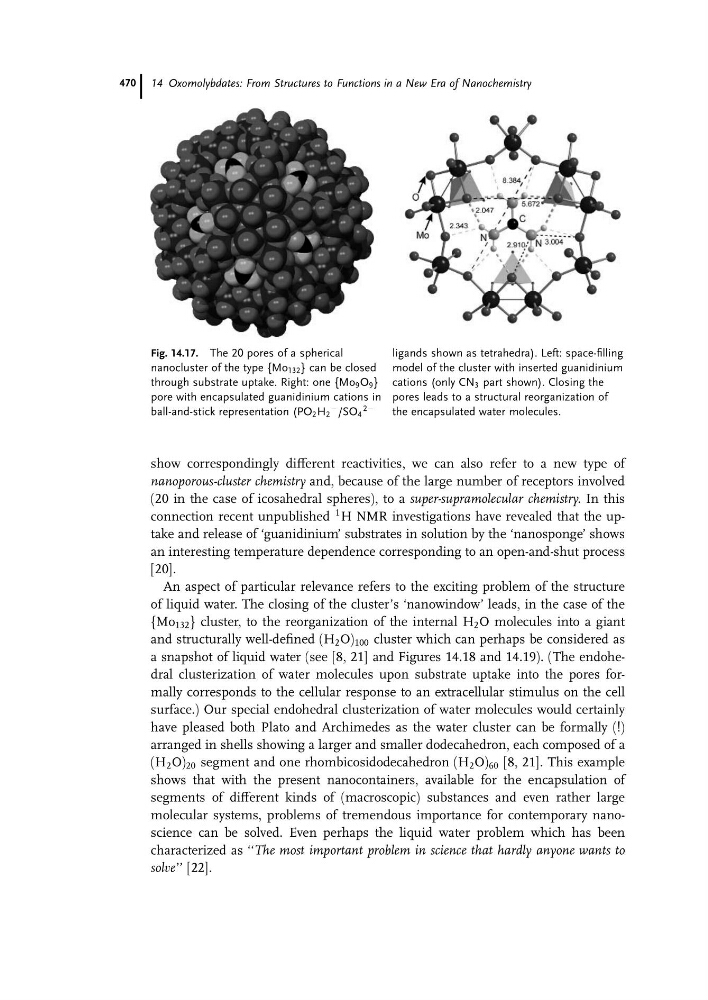
Fig. 14.17. The 20 pores of a spherical
nanocluster of the type {Mo 132 } can be closed
through substrate uptake. Right: one {Mo 9 O 9 }
pore with encapsulated guanidinium cations in
ball-and-stick representation (PO 2 H 2
À /SO 4
2À
ligands shown as tetrahedra). Left: space-filling
model of the cluster with inserted guanidinium
cations (only CN 3 part shown). Closing the
pores leads to a structural reorganization of
the encapsulated water molecules.
14 Oxomolybdates: From Structures to Functions in a New Era of Nanochemistry
470
nanoporous-cluster chemistry and, because of the large number of receptors involved
(20 in the case of icosahedral spheres), to a super-supramolecular chemistry. In this
connection recent unpublished
1 H NMR investigations have revealed that the uptake and release of ‘guanidinium’ substrates in solution by the ‘nanosponge’ shows
an interesting temperature dependence corresponding to an open-and-shut process
[20].
An aspect of particular relevance refers to the exciting problem of the structure
of liquid water. The closing of the cluster’s ‘nanowindow’ leads, in the case of the
{Mo 132 } cluster, to the reorganization of the internal H 2 O molecules into a giant
and structurally well-defined (H 2 O) 100 cluster which can perhaps be considered as
a snapshot of liquid water (see [8, 21] and Figures 14.18 and 14.19). (The endohedral clusterization of water molecules upon substrate uptake into the pores formally corresponds to the cellular response to an extracellular stimulus on the cell
surface.) Our special endohedral clusterization of water molecules would certainly
have pleased both Plato and Archimedes as the water cluster can be formally (!)
arranged in shells showing a larger and smaller dodecahedron, each composed of a
(H 2 O) 20 segment and one rhombicosidodecahedron (H 2 O) 60 [8, 21]. This example
shows that with the present nanocontainers, available for the encapsulation of
segments of different kinds of (macroscopic) substances and even rather large
molecular systems, problems of tremendous importance for contemporary nanoscience can be solved. Even perhaps the liquid water problem which has been
characterized as ‘‘The most important problem in science that hardly anyone wants to
solve’’ [22].
Fig. 14.17. The 20 pores of a spherical
nanocluster of the type {Mo 132 } can be closed
through substrate uptake. Right: one {Mo 9 O 9 }
pore with encapsulated guanidinium cations in
ball-and-stick representation (PO 2 H 2
À /SO 4
2À
ligands shown as tetrahedra). Left: space-filling
model of the cluster with inserted guanidinium
cations (only CN 3 part shown). Closing the
pores leads to a structural reorganization of
the encapsulated water molecules.
14 Oxomolybdates: From Structures to Functions in a New Era of Nanochemistry
470