

growth processes might be allied to biomineralization processes in compartments.
In this context the molybdenum-atom uptake of the Mo storage protein of the
N 2 -fixing microorganism A. vinelandii is worth mentioning. According to our
preliminary results the inorganic nucleus corresponds to a rather large polyoxomolybdate.
. The nucleophilic {Mo 6 O 6 } type hexagonal ring-shaped sites act as (formal) receptors for cations, for example protonated urea guests [12b], to some extent a
comparable situation to the above-mentioned case of the integrated 16 K
þ [10].
In the urea case this can be used to decrease the negative charge thereby nicely
facilitating chain formation [12b], a fact which shows perspectives for related
nano-, supramolecular-, and solid-state chemistry.
In the case of the spherical nano-objects (Table 14.1), formed by 12 pentagonal
{(Mo)Mo 5 } units linked by 30 mono- or dinuclear linkers, there is, for each species,
a nanoscaled capsule cavity and 20 size-tunable specific nanopores of the type
{M n O n } (for example with n ¼ 6 or 9), which can act as substrate specific receptors
[8]. The cavity can even house smaller polyoxometalates, like different Keggin ions,
to form a supramolecular nanocomposite of a unique kind (see Figure 14.10) [13].
Some typical interesting reactions are:
. The replacement of the 30 diamagnetic {Mo 2 }-type linkers of the spherical
{Mo 132 }-type clusters by 30 paramagnetic centres like Fe
III leads to the emergence of unusual molecular nanoantiferromagnets of the type {Mo 72 Fe 30 } (see
Figures 14.2 and 14.11) [14].
. The neutral spherical nano-objects of the type {Mo 72 Fe 30 } can be crosslinked in
a solid-state reaction, even at room temperature (!), to form layers by following
an elementary inorganic condensation reaction, known already for the formation of polycations like those of Fe
III in aqueous solution. The rapid loss of
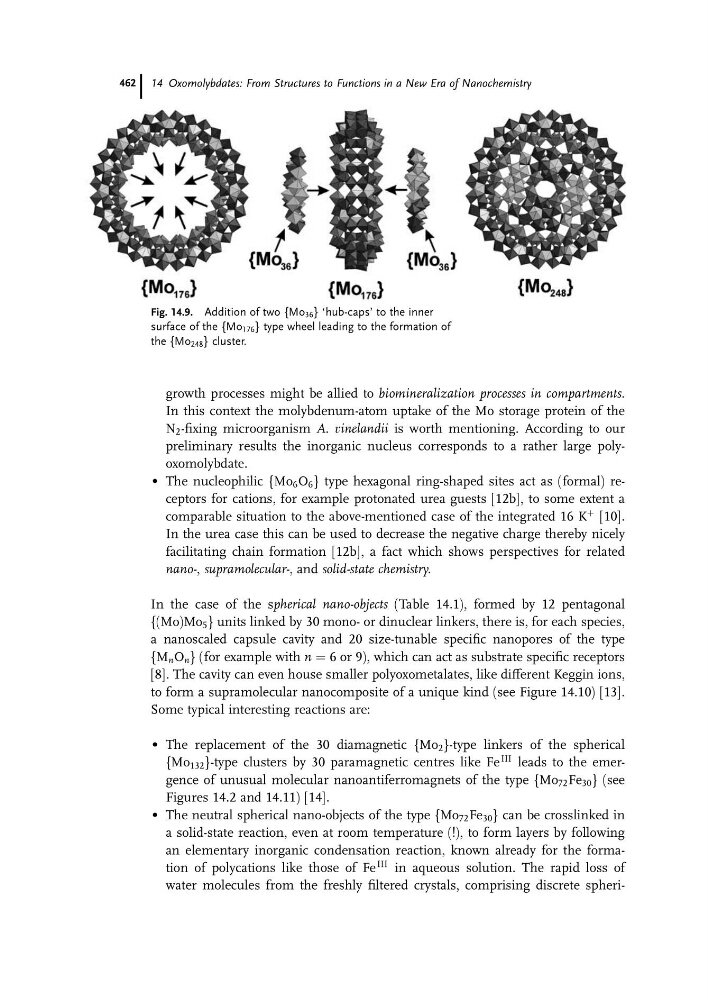
water molecules from the freshly filtered crystals, comprising discrete spheriFig. 14.9. Addition of two {Mo 36 } ‘hub-caps’ to the inner
surface of the {Mo 176 } type wheel leading to the formation of
the {Mo 248 } cluster.
14 Oxomolybdates: From Structures to Functions in a New Era of Nanochemistry
462
In this context the molybdenum-atom uptake of the Mo storage protein of the
N 2 -fixing microorganism A. vinelandii is worth mentioning. According to our
preliminary results the inorganic nucleus corresponds to a rather large polyoxomolybdate.
. The nucleophilic {Mo 6 O 6 } type hexagonal ring-shaped sites act as (formal) receptors for cations, for example protonated urea guests [12b], to some extent a
comparable situation to the above-mentioned case of the integrated 16 K
þ [10].
In the urea case this can be used to decrease the negative charge thereby nicely
facilitating chain formation [12b], a fact which shows perspectives for related
nano-, supramolecular-, and solid-state chemistry.
In the case of the spherical nano-objects (Table 14.1), formed by 12 pentagonal
{(Mo)Mo 5 } units linked by 30 mono- or dinuclear linkers, there is, for each species,
a nanoscaled capsule cavity and 20 size-tunable specific nanopores of the type
{M n O n } (for example with n ¼ 6 or 9), which can act as substrate specific receptors
[8]. The cavity can even house smaller polyoxometalates, like different Keggin ions,
to form a supramolecular nanocomposite of a unique kind (see Figure 14.10) [13].
Some typical interesting reactions are:
. The replacement of the 30 diamagnetic {Mo 2 }-type linkers of the spherical
{Mo 132 }-type clusters by 30 paramagnetic centres like Fe
III leads to the emergence of unusual molecular nanoantiferromagnets of the type {Mo 72 Fe 30 } (see
Figures 14.2 and 14.11) [14].
. The neutral spherical nano-objects of the type {Mo 72 Fe 30 } can be crosslinked in
a solid-state reaction, even at room temperature (!), to form layers by following
an elementary inorganic condensation reaction, known already for the formation of polycations like those of Fe
III in aqueous solution. The rapid loss of
water molecules from the freshly filtered crystals, comprising discrete spheriFig. 14.9. Addition of two {Mo 36 } ‘hub-caps’ to the inner
surface of the {Mo 176 } type wheel leading to the formation of
the {Mo 248 } cluster.
14 Oxomolybdates: From Structures to Functions in a New Era of Nanochemistry
462