

cal clusters, leads to their approach which is a condition for their covalent linking
(see Figure 14.12) [15]. The possibility of forming a related one-dimensional
chain (paramagnetic Keplerate ‘‘necklaces’’) from similar spherical nanospheres
in a room-temperature reaction also exists [16].
. It is even possible to ‘kick out’, like soccer balls, the neutral giant molybdenum
oxide spheres, for example the {Mo 72 Fe 30 } ones, into the gas phase using all
matrix-assisted laser desorption and ionization (MALDI) methods. It is important that the clusters range from dimers to pentamers (see Figure 14.13) [17].
A further fascinating point refers to the possibility of performing different types
of reactions inside the cavities of such spherical clusters at well-defined sites,
which can be hydrophilic or hydrophobic. Here we describe for the first time
an example, the details of which have, as yet, not been published: the reaction
of [{(Mo
VI )Mo
VI 5 } 12 {L} 30 ]
42À (L ¼ {Mo 2 O 4 (CH 3 COO)}
þ ) with phosphate and molybdate in aqueous solution at different pH values demonstrates that, after replacement of the acetate ligands, the cluster shows in its cavity a pH-dependent
nucleation process in the presence of molybdate. This leads to the formation of
new PaOaMo bonds at low pH, a situation comparable to the formation of the
[PMo 12 O 40 ]
3À Keggin anion at low pH values [18] (see also Figure 14.14).
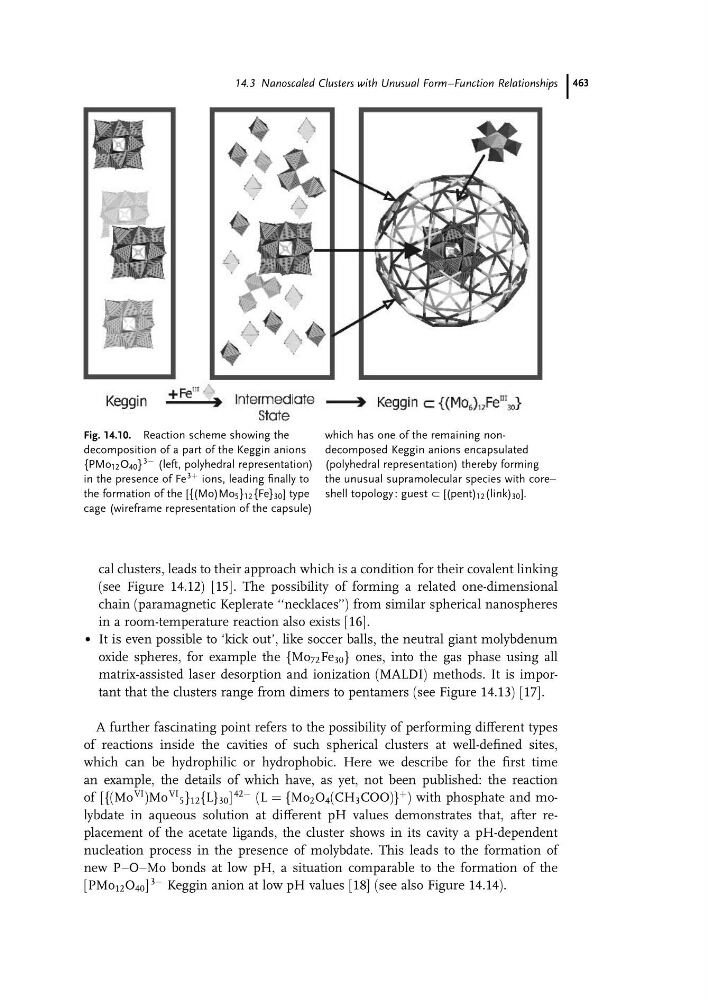
Fig. 14.10. Reaction scheme showing the
decomposition of a part of the Keggin anions
{PMo 12 O 40 }
3À (left, polyhedral representation)
in the presence of Fe
3þ ions, leading finally to
the formation of the [{(Mo)Mo 5 } 12 {Fe} 30 ] type
cage (wireframe representation of the capsule)
which has one of the remaining nondecomposed Keggin anions encapsulated
(polyhedral representation) thereby forming
the unusual supramolecular species with core–
shell topology : guest H [(pent) 12 (link) 30 ].
14.3 Nanoscaled Clusters with Unusual Form–Function Relationships 463
(see Figure 14.12) [15]. The possibility of forming a related one-dimensional
chain (paramagnetic Keplerate ‘‘necklaces’’) from similar spherical nanospheres
in a room-temperature reaction also exists [16].
. It is even possible to ‘kick out’, like soccer balls, the neutral giant molybdenum
oxide spheres, for example the {Mo 72 Fe 30 } ones, into the gas phase using all
matrix-assisted laser desorption and ionization (MALDI) methods. It is important that the clusters range from dimers to pentamers (see Figure 14.13) [17].
A further fascinating point refers to the possibility of performing different types
of reactions inside the cavities of such spherical clusters at well-defined sites,
which can be hydrophilic or hydrophobic. Here we describe for the first time
an example, the details of which have, as yet, not been published: the reaction
of [{(Mo
VI )Mo
VI 5 } 12 {L} 30 ]
42À (L ¼ {Mo 2 O 4 (CH 3 COO)}
þ ) with phosphate and molybdate in aqueous solution at different pH values demonstrates that, after replacement of the acetate ligands, the cluster shows in its cavity a pH-dependent
nucleation process in the presence of molybdate. This leads to the formation of
new PaOaMo bonds at low pH, a situation comparable to the formation of the
[PMo 12 O 40 ]
3À Keggin anion at low pH values [18] (see also Figure 14.14).
Fig. 14.10. Reaction scheme showing the
decomposition of a part of the Keggin anions
{PMo 12 O 40 }
3À (left, polyhedral representation)
in the presence of Fe
3þ ions, leading finally to
the formation of the [{(Mo)Mo 5 } 12 {Fe} 30 ] type
cage (wireframe representation of the capsule)
which has one of the remaining nondecomposed Keggin anions encapsulated
(polyhedral representation) thereby forming
the unusual supramolecular species with core–
shell topology : guest H [(pent) 12 (link) 30 ].
14.3 Nanoscaled Clusters with Unusual Form–Function Relationships 463