

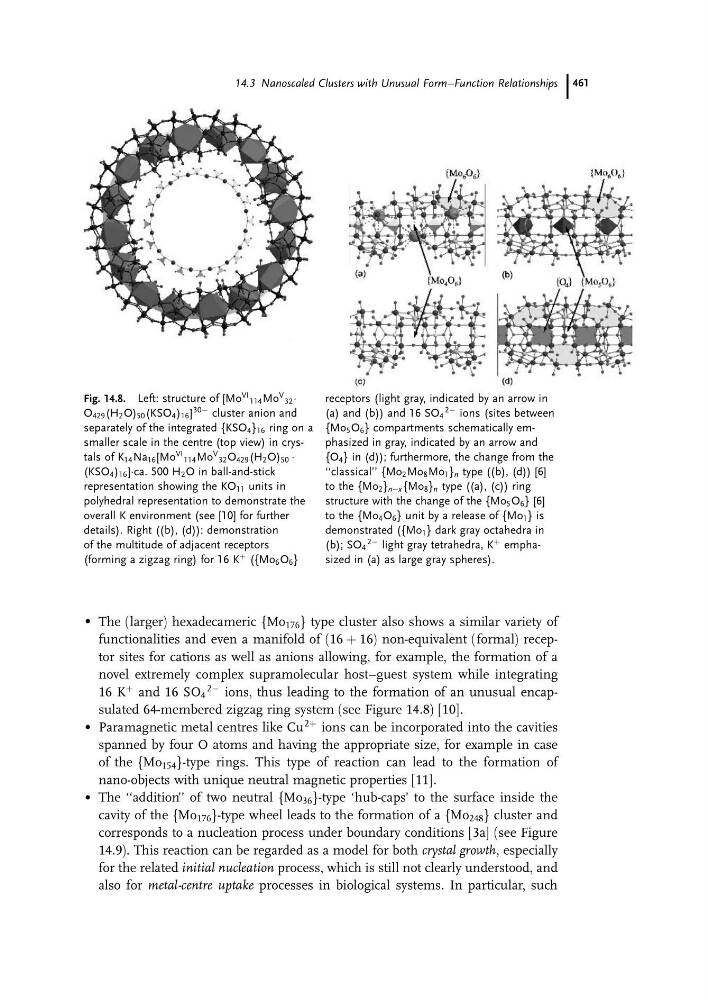
. The (larger) hexadecameric {Mo 176 } type cluster also shows a similar variety of
functionalities and even a manifold of (16 þ 16) non-equivalent (formal) receptor sites for cations as well as anions allowing, for example, the formation of a
novel extremely complex supramolecular host–guest system while integrating
16 K
þ and 16 SO 4
2À ions, thus leading to the formation of an unusual encapsulated 64-membered zigzag ring system (see Figure 14.8) [10].
. Paramagnetic metal centres like Cu
2þ ions can be incorporated into the cavities
spanned by four O atoms and having the appropriate size, for example in case
of the {Mo 154 }-type rings. This type of reaction can lead to the formation of
nano-objects with unique neutral magnetic properties [11].
. The ‘‘addition’’ of two neutral {Mo 36 }-type ‘hub-caps’ to the surface inside the
cavity of the {Mo 176 }-type wheel leads to the formation of a {Mo 248 } cluster and
corresponds to a nucleation process under boundary conditions [3a] (see Figure
14.9). This reaction can be regarded as a model for both crystal growth, especially
for the related initial nucleation process, which is still not clearly understood, and
also for metal-centre uptake processes in biological systems. In particular, such
Fig. 14.8. Left: structure of [Mo
VI
114 Mo
V
32 Á
O 429 (H 2 O) 50 (KSO 4 ) 16 ]
30À cluster anion and
separately of the integrated {KSO 4 } 16 ring on a
smaller scale in the centre (top view) in crystals of K 14 Na 16 [Mo
VI
114 Mo
V
32 O 429 (H 2 O) 50 Á
(KSO 4 ) 16 ]Áca. 500 H 2 O in ball-and-stick
representation showing the KO 11 units in
polyhedral representation to demonstrate the
overall K environment (see [10] for further
details). Right ((b), (d)): demonstration
of the multitude of adjacent receptors
(forming a zigzag ring) for 16 K
þ ({Mo 6 O 6 }
receptors (light gray, indicated by an arrow in
(a) and (b)) and 16 SO 4
2À ions (sites between
{Mo 5 O 6 } compartments schematically emphasized in gray, indicated by an arrow and
{O 4 } in (d)); furthermore, the change from the
‘‘classical’’ {Mo 2 Mo 8 Mo 1 } n type ((b), (d)) [6]
to the {Mo 2 } nÀx {Mo 8 } n type ((a), (c)) ring
structure with the change of the {Mo 5 O 6 } [6]
to the {Mo 4 O 6 } unit by a release of {Mo 1 } is
demonstrated ({Mo 1 } dark gray octahedra in
(b); SO 4
2À light gray tetrahedra, K
þ emphasized in (a) as large gray spheres).
14.3 Nanoscaled Clusters with Unusual Form–Function Relationships 461
functionalities and even a manifold of (16 þ 16) non-equivalent (formal) receptor sites for cations as well as anions allowing, for example, the formation of a
novel extremely complex supramolecular host–guest system while integrating
16 K
þ and 16 SO 4
2À ions, thus leading to the formation of an unusual encapsulated 64-membered zigzag ring system (see Figure 14.8) [10].
. Paramagnetic metal centres like Cu
2þ ions can be incorporated into the cavities
spanned by four O atoms and having the appropriate size, for example in case
of the {Mo 154 }-type rings. This type of reaction can lead to the formation of
nano-objects with unique neutral magnetic properties [11].
. The ‘‘addition’’ of two neutral {Mo 36 }-type ‘hub-caps’ to the surface inside the
cavity of the {Mo 176 }-type wheel leads to the formation of a {Mo 248 } cluster and
corresponds to a nucleation process under boundary conditions [3a] (see Figure
14.9). This reaction can be regarded as a model for both crystal growth, especially
for the related initial nucleation process, which is still not clearly understood, and
also for metal-centre uptake processes in biological systems. In particular, such
Fig. 14.8. Left: structure of [Mo
VI
114 Mo
V
32 Á
O 429 (H 2 O) 50 (KSO 4 ) 16 ]
30À cluster anion and
separately of the integrated {KSO 4 } 16 ring on a
smaller scale in the centre (top view) in crystals of K 14 Na 16 [Mo
VI
114 Mo
V
32 O 429 (H 2 O) 50 Á
(KSO 4 ) 16 ]Áca. 500 H 2 O in ball-and-stick
representation showing the KO 11 units in
polyhedral representation to demonstrate the
overall K environment (see [10] for further
details). Right ((b), (d)): demonstration
of the multitude of adjacent receptors
(forming a zigzag ring) for 16 K
þ ({Mo 6 O 6 }
receptors (light gray, indicated by an arrow in
(a) and (b)) and 16 SO 4
2À ions (sites between
{Mo 5 O 6 } compartments schematically emphasized in gray, indicated by an arrow and
{O 4 } in (d)); furthermore, the change from the
‘‘classical’’ {Mo 2 Mo 8 Mo 1 } n type ((b), (d)) [6]
to the {Mo 2 } nÀx {Mo 8 } n type ((a), (c)) ring
structure with the change of the {Mo 5 O 6 } [6]
to the {Mo 4 O 6 } unit by a release of {Mo 1 } is
demonstrated ({Mo 1 } dark gray octahedra in
(b); SO 4
2À light gray tetrahedra, K
þ emphasized in (a) as large gray spheres).
14.3 Nanoscaled Clusters with Unusual Form–Function Relationships 461