

The copper phosphide complex [Cu 96 P 30 {P(SiMe 3 ) 2 } 6 (PEt 3 ) 18 ] 28 (Figure 13.24) for
example is formed from the 10:5:6 reaction of CuCl:PEt 3 :P(SiMe 3 ) 3 in tetrahydrofuran [99]. The @3:1 ratio of Cu:P and the A–B–C packing of the phosphide
(P
3À ) centers in 28 enable an analogy to be drawn between this molecular species
and the semiconductor Cu 3 P, however close structural relationships are not dominant. The Cu(I) ions in 28 lie both within and between the phosphide layers. A
similar methodology has also resulted in the formation of the shell-like copper arsenide [Cu 32 As 30 (Ph 2 PCH 2 PPh 2 ) 8 ] [57] and palladium arsenide [Pd 20 As 12 (PPh 3 ) 12 ]
nanoclusters using As(SiMe 3 ) 3 [100].
13.7
Conclusions and Outlook
The wealth of structural chemistry that has appeared over the past several years
with metal-chalcogen nanoclusters has permitted the investigation and evaluation
of the evolution of the properties of metal-chalcogenides on going from molecular
to bulk solid systems. As is clear from the material reviewed in the preceding sections, these nanometer-sized solids continue to hold promise as novel electronic
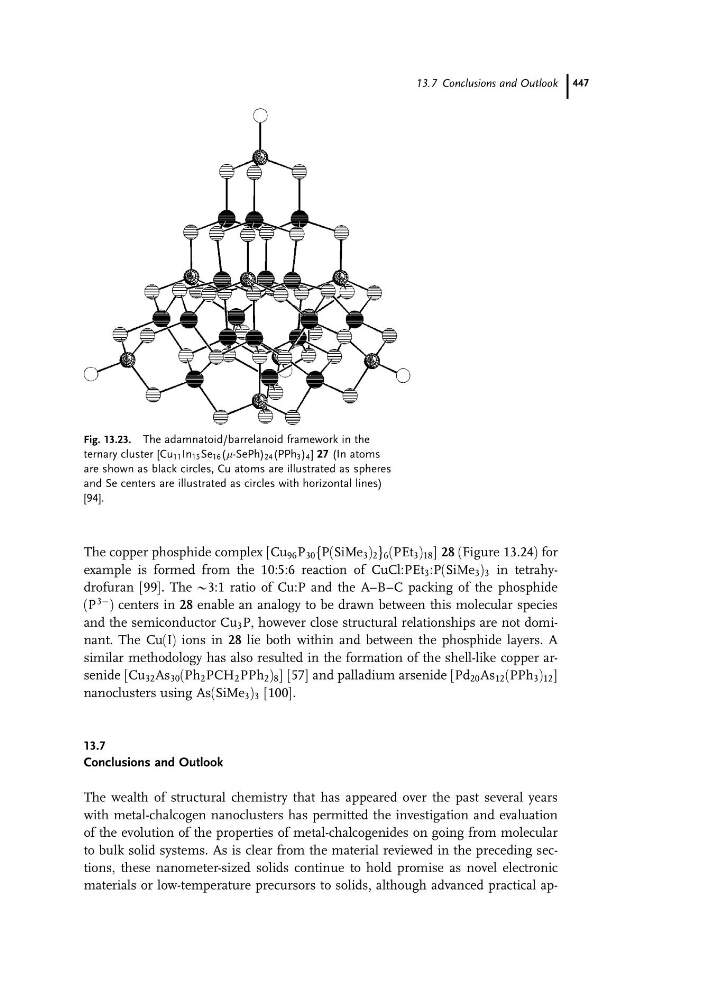
materials or low-temperature precursors to solids, although advanced practical apFig. 13.23. The adamnatoid/barrelanoid framework in the
ternary cluster [Cu 11 In 15 Se 16 (m-SePh) 24 (PPh 3 ) 4 ] 27 (In atoms
are shown as black circles, Cu atoms are illustrated as spheres
and Se centers are illustrated as circles with horizontal lines)
[94].
13.7 Conclusions and Outlook 447
example is formed from the 10:5:6 reaction of CuCl:PEt 3 :P(SiMe 3 ) 3 in tetrahydrofuran [99]. The @3:1 ratio of Cu:P and the A–B–C packing of the phosphide
(P
3À ) centers in 28 enable an analogy to be drawn between this molecular species
and the semiconductor Cu 3 P, however close structural relationships are not dominant. The Cu(I) ions in 28 lie both within and between the phosphide layers. A
similar methodology has also resulted in the formation of the shell-like copper arsenide [Cu 32 As 30 (Ph 2 PCH 2 PPh 2 ) 8 ] [57] and palladium arsenide [Pd 20 As 12 (PPh 3 ) 12 ]
nanoclusters using As(SiMe 3 ) 3 [100].
13.7
Conclusions and Outlook
The wealth of structural chemistry that has appeared over the past several years
with metal-chalcogen nanoclusters has permitted the investigation and evaluation
of the evolution of the properties of metal-chalcogenides on going from molecular
to bulk solid systems. As is clear from the material reviewed in the preceding sections, these nanometer-sized solids continue to hold promise as novel electronic
materials or low-temperature precursors to solids, although advanced practical apFig. 13.23. The adamnatoid/barrelanoid framework in the
ternary cluster [Cu 11 In 15 Se 16 (m-SePh) 24 (PPh 3 ) 4 ] 27 (In atoms
are shown as black circles, Cu atoms are illustrated as spheres
and Se centers are illustrated as circles with horizontal lines)
[94].
13.7 Conclusions and Outlook 447