

reactions of the BuSe fragments, and this allows for the formation of extremely
large AgaSe frameworks. Although this reactivity limits the number of ‘‘low nuclearity’’ complexes that can be isolated, and thus the amount of information that
can be obtained with respect to condensation pathways, it results in a facile route
to high nuclearity silver selenide clusters. Also of note is the requirement of acetate
salts of silver for the successful isolation of these polynuclear complexes.
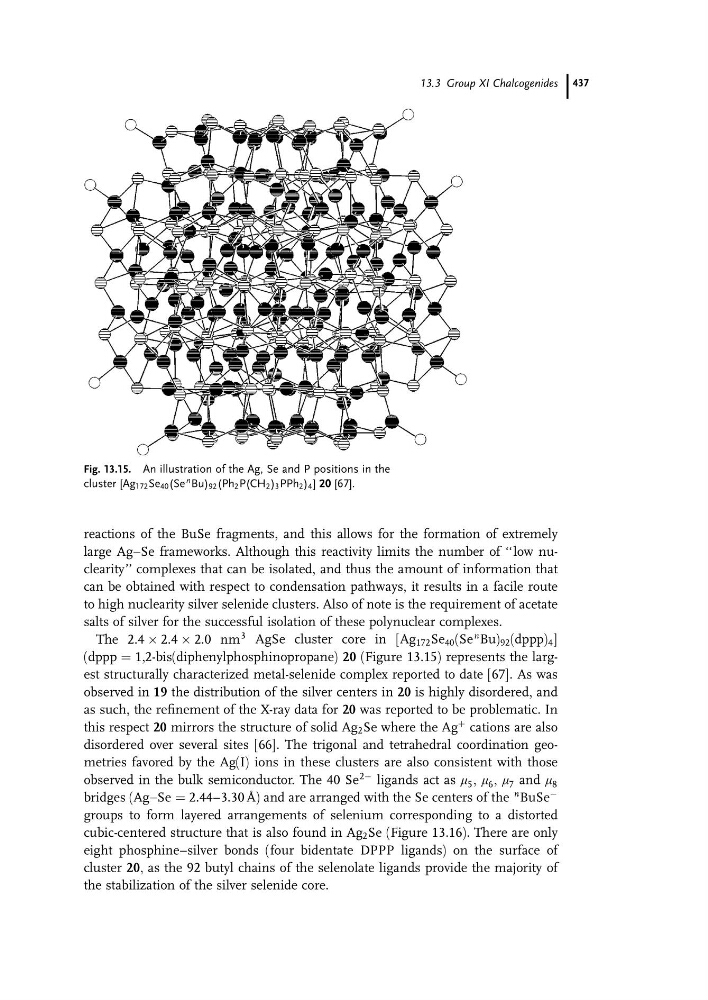
The 2.4 Â 2.4 Â 2.0 nm
3 AgSe cluster core in [Ag 172 Se 40 (Se
n Bu) 92 (dppp) 4 ]
(dppp ¼ 1,2-bis(diphenylphosphinopropane) 20 (Figure 13.15) represents the largest structurally characterized metal-selenide complex reported to date [67]. As was
observed in 19 the distribution of the silver centers in 20 is highly disordered, and
as such, the refinement of the X-ray data for 20 was reported to be problematic. In
this respect 20 mirrors the structure of solid Ag 2 Se where the Ag
þ cations are also
disordered over several sites [66]. The trigonal and tetrahedral coordination geometries favored by the Ag(I) ions in these clusters are also consistent with those
observed in the bulk semiconductor. The 40 Se
2À ligands act as m 5 , m 6 , m 7 and m 8
bridges (AgaSe ¼ 2.44–3.30 A ˚ ) and are arranged with the Se centers of the
n BuSe
À
groups to form layered arrangements of selenium corresponding to a distorted
cubic-centered structure that is also found in Ag 2 Se (Figure 13.16). There are only
eight phosphine–silver bonds (four bidentate DPPP ligands) on the surface of
cluster 20, as the 92 butyl chains of the selenolate ligands provide the majority of
the stabilization of the silver selenide core.
Fig. 13.15. An illustration of the Ag, Se and P positions in the
cluster [Ag 172 Se 40 (Se
n Bu) 92 (Ph 2 P(CH 2 ) 3 PPh 2 ) 4 ] 20 [67].
13.3 Group XI Chalcogenides 437
large AgaSe frameworks. Although this reactivity limits the number of ‘‘low nuclearity’’ complexes that can be isolated, and thus the amount of information that
can be obtained with respect to condensation pathways, it results in a facile route
to high nuclearity silver selenide clusters. Also of note is the requirement of acetate
salts of silver for the successful isolation of these polynuclear complexes.
The 2.4 Â 2.4 Â 2.0 nm
3 AgSe cluster core in [Ag 172 Se 40 (Se
n Bu) 92 (dppp) 4 ]
(dppp ¼ 1,2-bis(diphenylphosphinopropane) 20 (Figure 13.15) represents the largest structurally characterized metal-selenide complex reported to date [67]. As was
observed in 19 the distribution of the silver centers in 20 is highly disordered, and
as such, the refinement of the X-ray data for 20 was reported to be problematic. In
this respect 20 mirrors the structure of solid Ag 2 Se where the Ag
þ cations are also
disordered over several sites [66]. The trigonal and tetrahedral coordination geometries favored by the Ag(I) ions in these clusters are also consistent with those
observed in the bulk semiconductor. The 40 Se
2À ligands act as m 5 , m 6 , m 7 and m 8
bridges (AgaSe ¼ 2.44–3.30 A ˚ ) and are arranged with the Se centers of the
n BuSe
À
groups to form layered arrangements of selenium corresponding to a distorted
cubic-centered structure that is also found in Ag 2 Se (Figure 13.16). There are only
eight phosphine–silver bonds (four bidentate DPPP ligands) on the surface of
cluster 20, as the 92 butyl chains of the selenolate ligands provide the majority of
the stabilization of the silver selenide core.
Fig. 13.15. An illustration of the Ag, Se and P positions in the
cluster [Ag 172 Se 40 (Se
n Bu) 92 (Ph 2 P(CH 2 ) 3 PPh 2 ) 4 ] 20 [67].
13.3 Group XI Chalcogenides 437