

is present at the cluster periphery. Despite these relationships to the bulk solid,
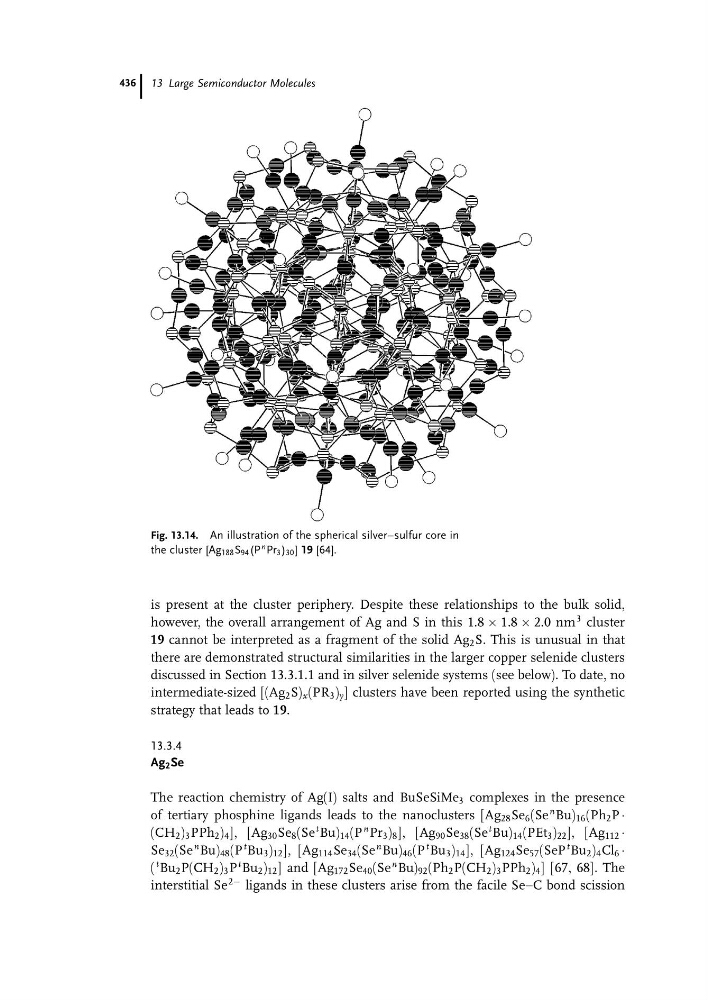
however, the overall arrangement of Ag and S in this 1.8 Â 1.8 Â 2.0 nm
3 cluster
19 cannot be interpreted as a fragment of the solid Ag 2 S. This is unusual in that
there are demonstrated structural similarities in the larger copper selenide clusters
discussed in Section 13.3.1.1 and in silver selenide systems (see below). To date, no
intermediate-sized [(Ag 2 S) x (PR 3 ) y ] clusters have been reported using the synthetic
strategy that leads to 19.
13.3.4
Ag 2 Se
The reaction chemistry of Ag(I) salts and BuSeSiMe 3 complexes in the presence
of tertiary phosphine ligands leads to the nanoclusters [Ag 28 Se 6 (Se
n Bu) 16 (Ph 2 P Á
(CH 2 ) 3 PPh 2 ) 4 ], [Ag 30 Se 8 (Se
t Bu) 14 (P
n Pr 3 ) 8 ], [Ag 90 Se 38 (Se
t Bu) 14 (PEt 3 ) 22 ], [Ag 112 Á
Se 32 (Se
n Bu) 48 (P
t Bu 3 ) 12 ], [Ag 114 Se 34 (Se
n Bu) 46 (P
t Bu 3 ) 14 ], [Ag 124 Se 57 (SeP
t Bu 2 ) 4 Cl 6 Á
(
t Bu 2 P(CH 2 ) 3 P
t Bu 2 ) 12 ] and [Ag 172 Se 40 (Se
n Bu) 92 (Ph 2 P(CH 2 ) 3 PPh 2 ) 4 ] [67, 68]. The
interstitial Se
2À ligands in these clusters arise from the facile SeaC bond scission
Fig. 13.14. An illustration of the spherical silver–sulfur core in
the cluster [Ag 188 S 94 (P
n Pr 3 ) 30 ] 19 [64].
13 Large Semiconductor Molecules
436
however, the overall arrangement of Ag and S in this 1.8 Â 1.8 Â 2.0 nm
3 cluster
19 cannot be interpreted as a fragment of the solid Ag 2 S. This is unusual in that
there are demonstrated structural similarities in the larger copper selenide clusters
discussed in Section 13.3.1.1 and in silver selenide systems (see below). To date, no
intermediate-sized [(Ag 2 S) x (PR 3 ) y ] clusters have been reported using the synthetic
strategy that leads to 19.
13.3.4
Ag 2 Se
The reaction chemistry of Ag(I) salts and BuSeSiMe 3 complexes in the presence
of tertiary phosphine ligands leads to the nanoclusters [Ag 28 Se 6 (Se
n Bu) 16 (Ph 2 P Á
(CH 2 ) 3 PPh 2 ) 4 ], [Ag 30 Se 8 (Se
t Bu) 14 (P
n Pr 3 ) 8 ], [Ag 90 Se 38 (Se
t Bu) 14 (PEt 3 ) 22 ], [Ag 112 Á
Se 32 (Se
n Bu) 48 (P
t Bu 3 ) 12 ], [Ag 114 Se 34 (Se
n Bu) 46 (P
t Bu 3 ) 14 ], [Ag 124 Se 57 (SeP
t Bu 2 ) 4 Cl 6 Á
(
t Bu 2 P(CH 2 ) 3 P
t Bu 2 ) 12 ] and [Ag 172 Se 40 (Se
n Bu) 92 (Ph 2 P(CH 2 ) 3 PPh 2 ) 4 ] [67, 68]. The
interstitial Se
2À ligands in these clusters arise from the facile SeaC bond scission
Fig. 13.14. An illustration of the spherical silver–sulfur core in
the cluster [Ag 188 S 94 (P
n Pr 3 ) 30 ] 19 [64].
13 Large Semiconductor Molecules
436