

systems, oxidation states of (þ1 and þ2) and (þ1 and 0) respectively must be designated to the copper atoms. Theoretical analyses have shown that in the latter
case, as is observed in the cluster [Cu 26 Te 12 (PEt 2 Ph) 12 ], localization of charge creating Cu(0) centers is not possible and the ‘‘extra’’ electrons occupy a valence band
comprised of Te(5p) and Cu(4s) orbitals [57]. Close structural similarities between
molecular species and bulk materials, such as those observed in the Cu 2 Se system,
are not found. As previously discussed, strong correlations to the bulk structure
for molecular [Cu 2 Se] n clusters do not occur until the number of copper atoms
is greater than 59. As the largest copper telluride clusters characterized to date
[Cu 58 Te 32 (PR 2 R
0 ) 16Àn ] (n ¼ 0; 2) [52, 54] do reveal a layered type structure for the
32 Te atoms (14, Figure 13.11), the isolation of larger complexes may yet reveal
more pronounced relationships. Interestingly, the telluride cluster 14 is generated
using BuTeSiMe 3 as the source of tellurium, with concomitant TeaC bond cleavage. Typically the copper telluride nanoclusters formed from reactions of phosphine solubilized Cu(I) salts with Te(SiMe 3 ) 2 consist of spherical CuTe cores and
the distribution of tellurium centers can be described in terms of deltahedral
frameworks, many of which are related to Frank–Kasper polyhedra, as observed
in the cluster [Cu 29 Te 16 (P
i Pr 3 ) 12 ] (15, Figure 13.11) [55]. Such non-stoichimetric
CuTe clusters often display broad intervalence absorption bands in the near IR
[53]. The coordination numbers of Te
2À ligands vary from 4 to 12, with Cu atoms
adopting three-coordinate (PCuTe 2 or CuTe 3 ) or four-coordinate (PCuTe 3 or CuTe 4 )
geometries. A number of clusters containing ditelluride (Te 2
2À ) ligands have also
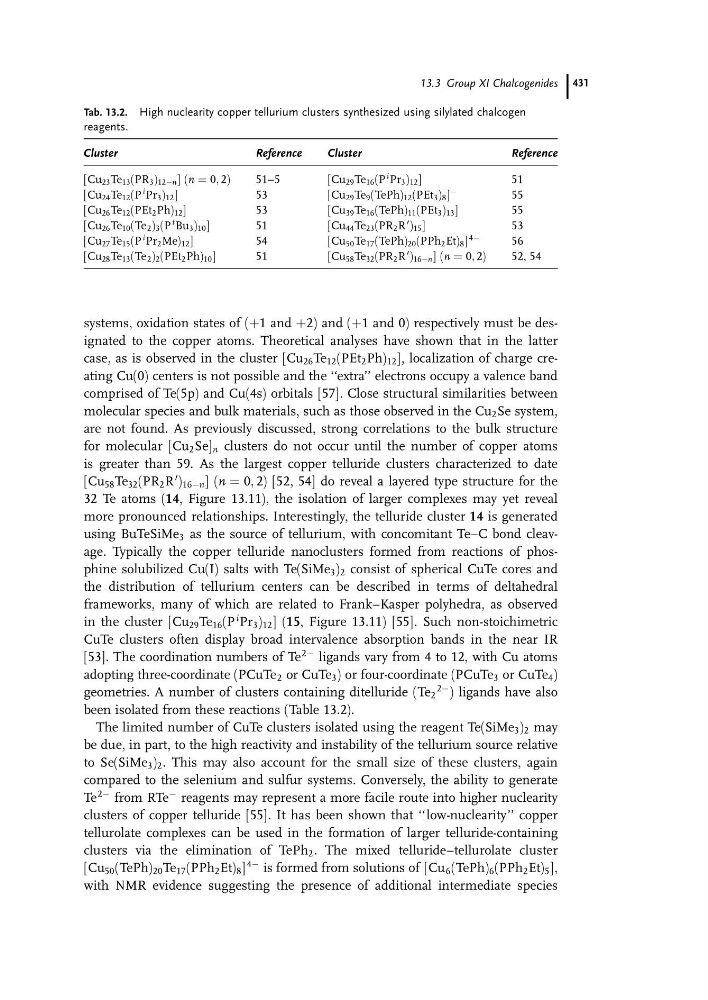
been isolated from these reactions (Table 13.2).
The limited number of CuTe clusters isolated using the reagent Te(SiMe 3 ) 2 may
be due, in part, to the high reactivity and instability of the tellurium source relative
to Se(SiMe 3 ) 2 . This may also account for the small size of these clusters, again
compared to the selenium and sulfur systems. Conversely, the ability to generate
Te
2À from RTe
À reagents may represent a more facile route into higher nuclearity
clusters of copper telluride [55]. It has been shown that ‘‘low-nuclearity’’ copper
tellurolate complexes can be used in the formation of larger telluride-containing
clusters via the elimination of TePh 2 . The mixed telluride–tellurolate cluster
[Cu 50 (TePh) 20 Te 17 (PPh 2 Et) 8 ]
4À is formed from solutions of [Cu 6 (TePh) 6 (PPh 2 Et) 5 ],
with NMR evidence suggesting the presence of additional intermediate species
Tab. 13.2. High nuclearity copper tellurium clusters synthesized using silylated chalcogen
reagents.
Cluster
Reference
Cluster
Reference
[Cu 23 Te 13 (PR 3 ) 12Àn ] (n ¼ 0; 2)
51–5
[Cu 29 Te 16 (P
i Pr 3 ) 12 ]
5 1
[Cu 24 Te 12 (P
i Pr 3 ) 12 ]
53
[Cu 29 Te 9 (TePh) 12 (PEt 3 ) 8 ]
À
55
[Cu 26 Te 12 (PEt 2 Ph) 12 ]
53
[Cu 39 Te 16 (TePh) 11 (PEt 3 ) 13 ]
5 5
[Cu 26 Te 10 (Te 2 ) 3 (P
t Bu 3 ) 10 ]
51
[Cu 44 Te 23 (PR 2 R
0 ) 15 ]
5 3
[Cu 27 Te 15 (P
i Pr 2 Me) 12 ]
54
[Cu 50 Te 17 (TePh) 20 (PPh 2 Et) 8 ]
4À
56
[Cu 28 Te 13 (Te 2 ) 2 (PEt 2 Ph) 10 ]
51
[Cu 58 Te 32 (PR 2 R
0 ) 16Àn ] (n ¼ 0; 2)
52, 54
13.3 Group XI Chalcogenides 431
case, as is observed in the cluster [Cu 26 Te 12 (PEt 2 Ph) 12 ], localization of charge creating Cu(0) centers is not possible and the ‘‘extra’’ electrons occupy a valence band
comprised of Te(5p) and Cu(4s) orbitals [57]. Close structural similarities between
molecular species and bulk materials, such as those observed in the Cu 2 Se system,
are not found. As previously discussed, strong correlations to the bulk structure
for molecular [Cu 2 Se] n clusters do not occur until the number of copper atoms
is greater than 59. As the largest copper telluride clusters characterized to date
[Cu 58 Te 32 (PR 2 R
0 ) 16Àn ] (n ¼ 0; 2) [52, 54] do reveal a layered type structure for the
32 Te atoms (14, Figure 13.11), the isolation of larger complexes may yet reveal
more pronounced relationships. Interestingly, the telluride cluster 14 is generated
using BuTeSiMe 3 as the source of tellurium, with concomitant TeaC bond cleavage. Typically the copper telluride nanoclusters formed from reactions of phosphine solubilized Cu(I) salts with Te(SiMe 3 ) 2 consist of spherical CuTe cores and
the distribution of tellurium centers can be described in terms of deltahedral
frameworks, many of which are related to Frank–Kasper polyhedra, as observed
in the cluster [Cu 29 Te 16 (P
i Pr 3 ) 12 ] (15, Figure 13.11) [55]. Such non-stoichimetric
CuTe clusters often display broad intervalence absorption bands in the near IR
[53]. The coordination numbers of Te
2À ligands vary from 4 to 12, with Cu atoms
adopting three-coordinate (PCuTe 2 or CuTe 3 ) or four-coordinate (PCuTe 3 or CuTe 4 )
geometries. A number of clusters containing ditelluride (Te 2
2À ) ligands have also
been isolated from these reactions (Table 13.2).
The limited number of CuTe clusters isolated using the reagent Te(SiMe 3 ) 2 may
be due, in part, to the high reactivity and instability of the tellurium source relative
to Se(SiMe 3 ) 2 . This may also account for the small size of these clusters, again
compared to the selenium and sulfur systems. Conversely, the ability to generate
Te
2À from RTe
À reagents may represent a more facile route into higher nuclearity
clusters of copper telluride [55]. It has been shown that ‘‘low-nuclearity’’ copper
tellurolate complexes can be used in the formation of larger telluride-containing
clusters via the elimination of TePh 2 . The mixed telluride–tellurolate cluster
[Cu 50 (TePh) 20 Te 17 (PPh 2 Et) 8 ]
4À is formed from solutions of [Cu 6 (TePh) 6 (PPh 2 Et) 5 ],
with NMR evidence suggesting the presence of additional intermediate species
Tab. 13.2. High nuclearity copper tellurium clusters synthesized using silylated chalcogen
reagents.
Cluster
Reference
Cluster
Reference
[Cu 23 Te 13 (PR 3 ) 12Àn ] (n ¼ 0; 2)
51–5
[Cu 29 Te 16 (P
i Pr 3 ) 12 ]
5 1
[Cu 24 Te 12 (P
i Pr 3 ) 12 ]
53
[Cu 29 Te 9 (TePh) 12 (PEt 3 ) 8 ]
À
55
[Cu 26 Te 12 (PEt 2 Ph) 12 ]
53
[Cu 39 Te 16 (TePh) 11 (PEt 3 ) 13 ]
5 5
[Cu 26 Te 10 (Te 2 ) 3 (P
t Bu 3 ) 10 ]
51
[Cu 44 Te 23 (PR 2 R
0 ) 15 ]
5 3
[Cu 27 Te 15 (P
i Pr 2 Me) 12 ]
54
[Cu 50 Te 17 (TePh) 20 (PPh 2 Et) 8 ]
4À
56
[Cu 28 Te 13 (Te 2 ) 2 (PEt 2 Ph) 10 ]
51
[Cu 58 Te 32 (PR 2 R
0 ) 16Àn ] (n ¼ 0; 2)
52, 54
13.3 Group XI Chalcogenides 431