

control of the M/E/PR 3 ratio, the nature of the phosphine, and the solvent system
can have an incredible effect on the products formed. Thus a comprehensive description of the numerous ‘‘CuE nanoclusters’’ accessed with this methodology is
not possible here, however the reader is directed towards a comprehensive and
timely review on the subject [31]. Despite the differences observed in both the
structures and nuclearities, clusters synthesized via the reaction of Cu(I) salts with
E(SiMe 3 ) 2 (E ¼ S, Se) have Cu:E ratios that permit a þ1 oxidation state to be assigned to the metal centers. This is strictly observed in the Cu 2 S clusters and normally holds true for CuaSe, a consequence of the (relatively) large discrepancies in
ionization potentials, electron affinities, and electronegativities of the relevant ions.
In the clusters [Cu 59 Se 30 (PCy 3 ) 15 ] [46] and [Cu 58 Se 16 (SePh) 24 (dppa) 6 ] (dppa ¼ 1,2bis(diphenyl)phosphinoacetylene) [45] mixed valence copper states of Cu(I)/Cu(II)
and Cu(I)/Cu(0), respectively, have however been proposed.
13.3.2
Cu 2Cx Te and Ag 2 Te
Smaller differences in ionization potentials, electron affinities and electronegativities between Cu(I) and Te
2À (versus S, Se) often results, in addition to stoichiometric CuTe complexes, in the formation of non-stoichiometric ‘‘electron-rich’’
(Cu 2þx Te) and ‘‘electron-deficient’’ (Cu 2Àx Te) nanocluster complexes (Table 13.2)
[51–56]. If a formal charge of 2À is assigned to the telluride ligands in the latter
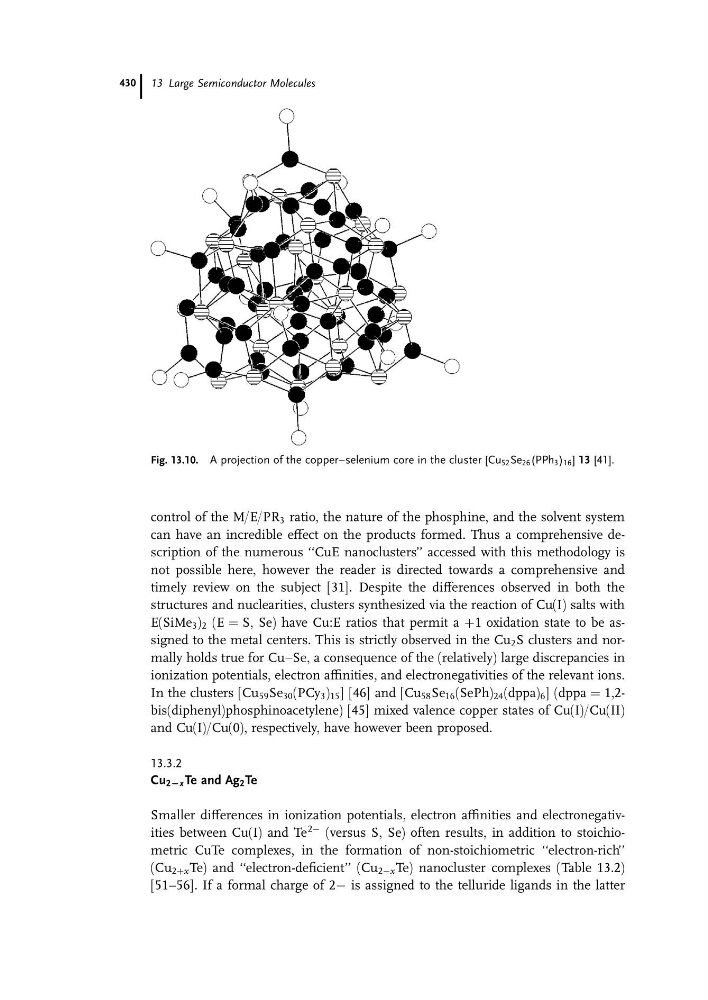
Fig. 13.10. A projection of the copper–selenium core in the cluster [Cu 52 Se 26 (PPh 3 ) 16 ] 13 [41].
13 Large Semiconductor Molecules
430
can have an incredible effect on the products formed. Thus a comprehensive description of the numerous ‘‘CuE nanoclusters’’ accessed with this methodology is
not possible here, however the reader is directed towards a comprehensive and
timely review on the subject [31]. Despite the differences observed in both the
structures and nuclearities, clusters synthesized via the reaction of Cu(I) salts with
E(SiMe 3 ) 2 (E ¼ S, Se) have Cu:E ratios that permit a þ1 oxidation state to be assigned to the metal centers. This is strictly observed in the Cu 2 S clusters and normally holds true for CuaSe, a consequence of the (relatively) large discrepancies in
ionization potentials, electron affinities, and electronegativities of the relevant ions.
In the clusters [Cu 59 Se 30 (PCy 3 ) 15 ] [46] and [Cu 58 Se 16 (SePh) 24 (dppa) 6 ] (dppa ¼ 1,2bis(diphenyl)phosphinoacetylene) [45] mixed valence copper states of Cu(I)/Cu(II)
and Cu(I)/Cu(0), respectively, have however been proposed.
13.3.2
Cu 2Cx Te and Ag 2 Te
Smaller differences in ionization potentials, electron affinities and electronegativities between Cu(I) and Te
2À (versus S, Se) often results, in addition to stoichiometric CuTe complexes, in the formation of non-stoichiometric ‘‘electron-rich’’
(Cu 2þx Te) and ‘‘electron-deficient’’ (Cu 2Àx Te) nanocluster complexes (Table 13.2)
[51–56]. If a formal charge of 2À is assigned to the telluride ligands in the latter
Fig. 13.10. A projection of the copper–selenium core in the cluster [Cu 52 Se 26 (PPh 3 ) 16 ] 13 [41].
13 Large Semiconductor Molecules
430