

bleaching [53]. Fluorescence imaging of tissue sections is another area in which
multicolor QDs will provide important advantages in reducing analysis time and in
expanding the range of detectable biomarkers [54].
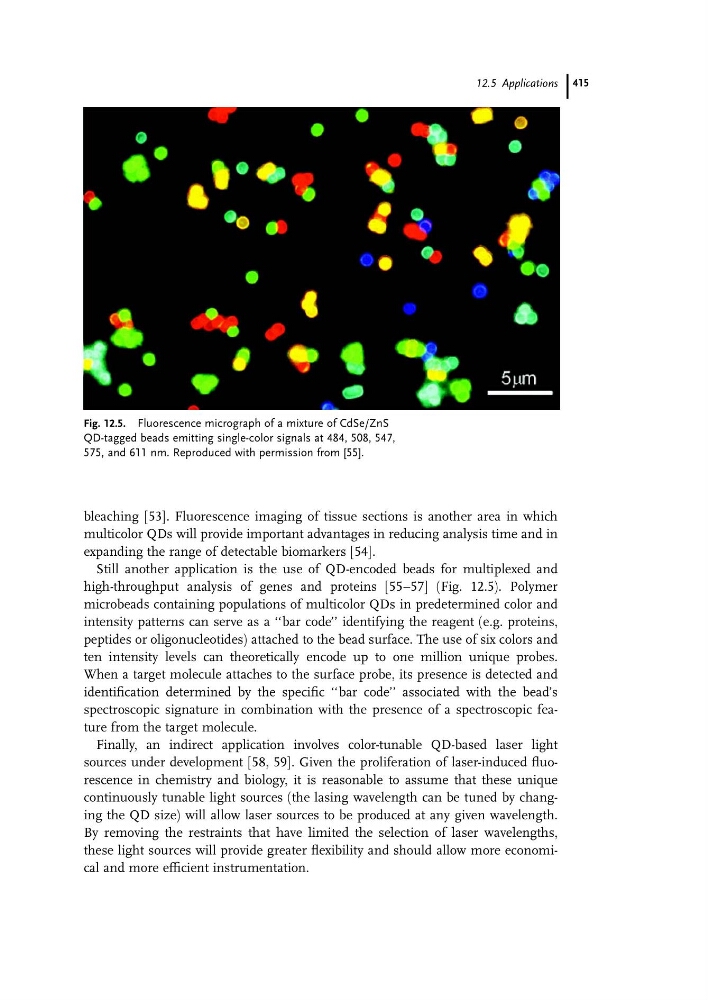
Still another application is the use of QD-encoded beads for multiplexed and
high-throughput analysis of genes and proteins [55–57] (Fig. 12.5). Polymer
microbeads containing populations of multicolor QDs in predetermined color and
intensity patterns can serve as a ‘‘bar code’’ identifying the reagent (e.g. proteins,
peptides or oligonucleotides) attached to the bead surface. The use of six colors and
ten intensity levels can theoretically encode up to one million unique probes.
When a target molecule attaches to the surface probe, its presence is detected and
identification determined by the specific ‘‘bar code’’ associated with the bead’s
spectroscopic signature in combination with the presence of a spectroscopic feature from the target molecule.
Finally, an indirect application involves color-tunable QD-based laser light
sources under development [58, 59]. Given the proliferation of laser-induced fluorescence in chemistry and biology, it is reasonable to assume that these unique
continuously tunable light sources (the lasing wavelength can be tuned by changing the QD size) will allow laser sources to be produced at any given wavelength.
By removing the restraints that have limited the selection of laser wavelengths,
these light sources will provide greater flexibility and should allow more economical and more efficient instrumentation.
Fig. 12.5. Fluorescence micrograph of a mixture of CdSe/ZnS
QD-tagged beads emitting single-color signals at 484, 508, 547,
575, and 611 nm. Reproduced with permission from [55].
12.5 Applications 415
multicolor QDs will provide important advantages in reducing analysis time and in
expanding the range of detectable biomarkers [54].
Still another application is the use of QD-encoded beads for multiplexed and
high-throughput analysis of genes and proteins [55–57] (Fig. 12.5). Polymer
microbeads containing populations of multicolor QDs in predetermined color and
intensity patterns can serve as a ‘‘bar code’’ identifying the reagent (e.g. proteins,
peptides or oligonucleotides) attached to the bead surface. The use of six colors and
ten intensity levels can theoretically encode up to one million unique probes.
When a target molecule attaches to the surface probe, its presence is detected and
identification determined by the specific ‘‘bar code’’ associated with the bead’s
spectroscopic signature in combination with the presence of a spectroscopic feature from the target molecule.
Finally, an indirect application involves color-tunable QD-based laser light
sources under development [58, 59]. Given the proliferation of laser-induced fluorescence in chemistry and biology, it is reasonable to assume that these unique
continuously tunable light sources (the lasing wavelength can be tuned by changing the QD size) will allow laser sources to be produced at any given wavelength.
By removing the restraints that have limited the selection of laser wavelengths,
these light sources will provide greater flexibility and should allow more economical and more efficient instrumentation.
Fig. 12.5. Fluorescence micrograph of a mixture of CdSe/ZnS
QD-tagged beads emitting single-color signals at 484, 508, 547,
575, and 611 nm. Reproduced with permission from [55].
12.5 Applications 415