

10.8
Modeling
10.8.1
High Reactivity of Silicon Suboxide Vapor
Silicon oxide is a critical source material in the oxide-assisted growth as described
above. It also plays important roles, as is well known, in many fields such as electronics, optical communications, and thin-film technology. Our recent finding of
silicon oxide in the synthesis of silicon nanowires, as we reviewed in the previous
part of this chapter, would extend further the important new application of silicon
oxide.
We have studied the silicon oxide-assisted formation of Si nanostructures based
on quantum-mechanical calculations of Si n O m (n; m ¼ 1–8) clusters [50, 51, 84].
We found that most of the structures contain planar or buckled ring units. Pendent
silicon atoms bonded only to a single oxygen atom are found in silicon-rich clusters. Oxygen-rich clusters have perpendicular planar rings, while silicon monoxidelike clusters usually form a large buckled ring. Structures made up of tetrahedrally
bonded units are found only in two clusters. Furthermore, the energy gap and net
charge distribution for clusters with different Si:O ratios have been calculated. We
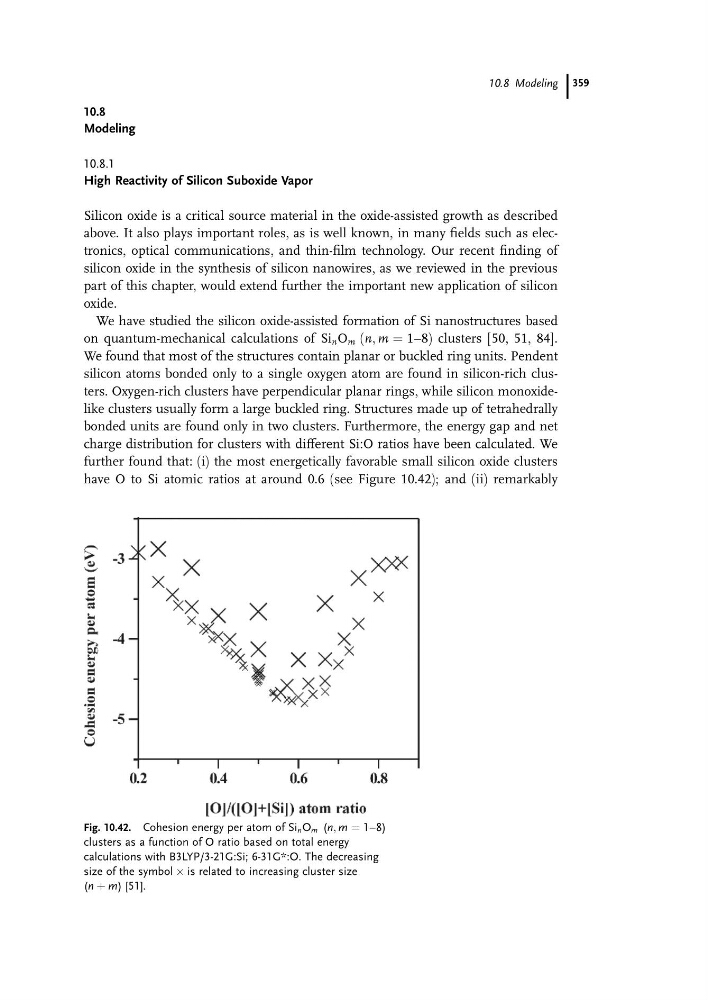
further found that: (i) the most energetically favorable small silicon oxide clusters
have O to Si atomic ratios at around 0.6 (see Figure 10.42); and (ii) remarkably
Fig. 10.42. Cohesion energy per atom of Si n O m (n; m ¼ 1–8)
clusters as a function of O ratio based on total energy
calculations with B3LYP/3-21G:Si; 6-31G*:O. The decreasing
size of the symbol  is related to increasing cluster size
(n þ m) [51].
10.8 Modeling 359
Modeling
10.8.1
High Reactivity of Silicon Suboxide Vapor
Silicon oxide is a critical source material in the oxide-assisted growth as described
above. It also plays important roles, as is well known, in many fields such as electronics, optical communications, and thin-film technology. Our recent finding of
silicon oxide in the synthesis of silicon nanowires, as we reviewed in the previous
part of this chapter, would extend further the important new application of silicon
oxide.
We have studied the silicon oxide-assisted formation of Si nanostructures based
on quantum-mechanical calculations of Si n O m (n; m ¼ 1–8) clusters [50, 51, 84].
We found that most of the structures contain planar or buckled ring units. Pendent
silicon atoms bonded only to a single oxygen atom are found in silicon-rich clusters. Oxygen-rich clusters have perpendicular planar rings, while silicon monoxidelike clusters usually form a large buckled ring. Structures made up of tetrahedrally
bonded units are found only in two clusters. Furthermore, the energy gap and net
charge distribution for clusters with different Si:O ratios have been calculated. We
further found that: (i) the most energetically favorable small silicon oxide clusters
have O to Si atomic ratios at around 0.6 (see Figure 10.42); and (ii) remarkably
Fig. 10.42. Cohesion energy per atom of Si n O m (n; m ¼ 1–8)
clusters as a function of O ratio based on total energy
calculations with B3LYP/3-21G:Si; 6-31G*:O. The decreasing
size of the symbol  is related to increasing cluster size
(n þ m) [51].
10.8 Modeling 359