

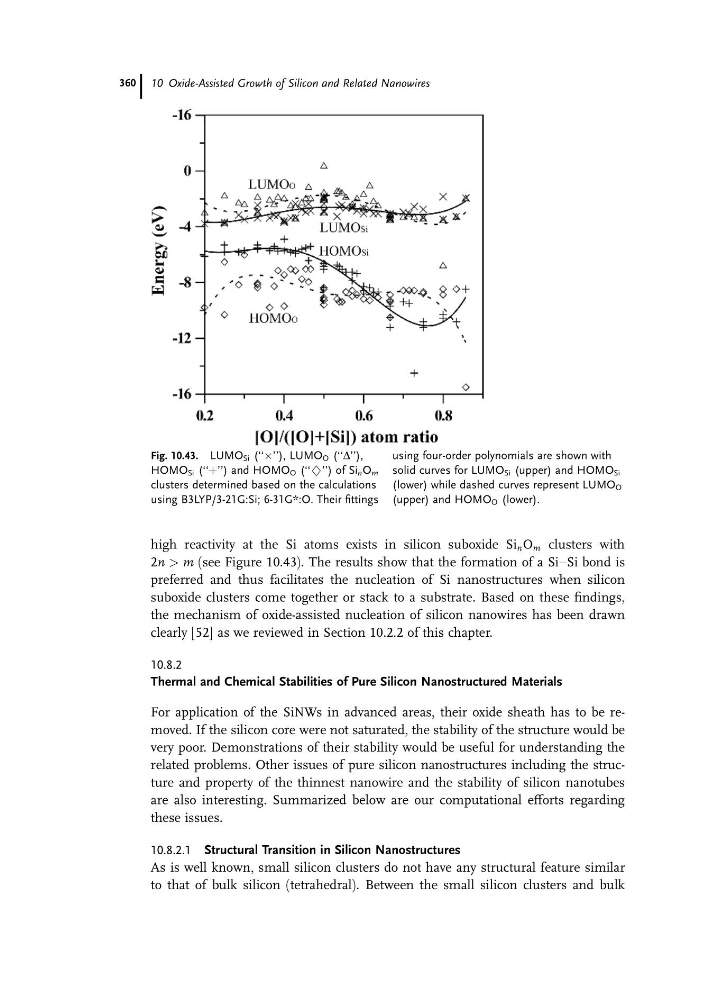
high reactivity at the Si atoms exists in silicon suboxide Si n O m clusters with
2n > m (see Figure 10.43). The results show that the formation of a SiaSi bond is
preferred and thus facilitates the nucleation of Si nanostructures when silicon
suboxide clusters come together or stack to a substrate. Based on these findings,
the mechanism of oxide-assisted nucleation of silicon nanowires has been drawn
clearly [52] as we reviewed in Section 10.2.2 of this chapter.
10.8.2
Thermal and Chemical Stabilities of Pure Silicon Nanostructured Materials
For application of the SiNWs in advanced areas, their oxide sheath has to be removed. If the silicon core were not saturated, the stability of the structure would be
very poor. Demonstrations of their stability would be useful for understanding the
related problems. Other issues of pure silicon nanostructures including the structure and property of the thinnest nanowire and the stability of silicon nanotubes
are also interesting. Summarized below are our computational efforts regarding
these issues.
10.8.2.1 Structural Transition in Silicon Nanostructures
As is well known, small silicon clusters do not have any structural feature similar
to that of bulk silicon (tetrahedral). Between the small silicon clusters and bulk
Fig. 10.43. LUMO Si (‘‘Â’’), LUMO O (‘‘D’’),
HOMO Si (‘‘þ’’) and HOMO O (‘‘U’’) of Si n O m
clusters determined based on the calculations
using B3LYP/3-21G:Si; 6-31G*:O. Their fittings
using four-order polynomials are shown with
solid curves for LUMO Si (upper) and HOMO Si
(lower) while dashed curves represent LUMO O
(upper) and HOMO O (lower).
10 Oxide-Assisted Growth of Silicon and Related Nanowires
360
2n > m (see Figure 10.43). The results show that the formation of a SiaSi bond is
preferred and thus facilitates the nucleation of Si nanostructures when silicon
suboxide clusters come together or stack to a substrate. Based on these findings,
the mechanism of oxide-assisted nucleation of silicon nanowires has been drawn
clearly [52] as we reviewed in Section 10.2.2 of this chapter.
10.8.2
Thermal and Chemical Stabilities of Pure Silicon Nanostructured Materials
For application of the SiNWs in advanced areas, their oxide sheath has to be removed. If the silicon core were not saturated, the stability of the structure would be
very poor. Demonstrations of their stability would be useful for understanding the
related problems. Other issues of pure silicon nanostructures including the structure and property of the thinnest nanowire and the stability of silicon nanotubes
are also interesting. Summarized below are our computational efforts regarding
these issues.
10.8.2.1 Structural Transition in Silicon Nanostructures
As is well known, small silicon clusters do not have any structural feature similar
to that of bulk silicon (tetrahedral). Between the small silicon clusters and bulk
Fig. 10.43. LUMO Si (‘‘Â’’), LUMO O (‘‘D’’),
HOMO Si (‘‘þ’’) and HOMO O (‘‘U’’) of Si n O m
clusters determined based on the calculations
using B3LYP/3-21G:Si; 6-31G*:O. Their fittings
using four-order polynomials are shown with
solid curves for LUMO Si (upper) and HOMO Si
(lower) while dashed curves represent LUMO O
(upper) and HOMO O (lower).
10 Oxide-Assisted Growth of Silicon and Related Nanowires
360