

spectively) for spheroidization, which is observed only at the lower temperature of
1130
C (Si nanowire diameter 50 nm), in spite of the higher diffusion rate at
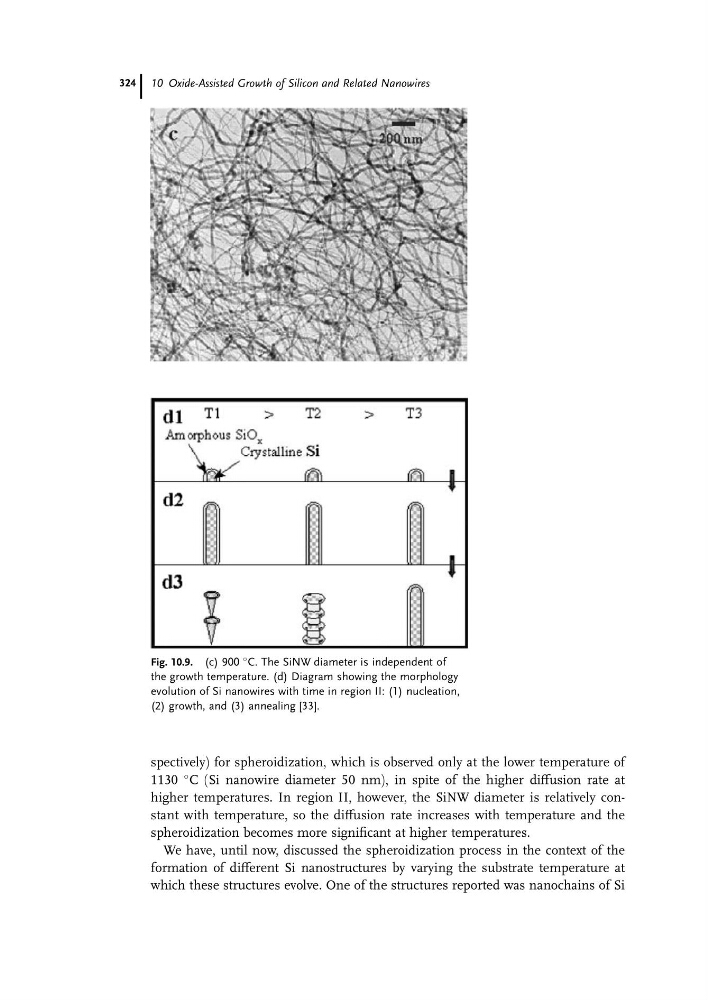
higher temperatures. In region II, however, the SiNW diameter is relatively constant with temperature, so the diffusion rate increases with temperature and the
spheroidization becomes more significant at higher temperatures.
We have, until now, discussed the spheroidization process in the context of the
formation of different Si nanostructures by varying the substrate temperature at
which these structures evolve. One of the structures reported was nanochains of Si
Fig. 10.9. (c) 900
C. The SiNW diameter is independent of
the growth temperature. (d) Diagram showing the morphology
evolution of Si nanowires with time in region II: (1) nucleation,
(2) growth, and (3) annealing [33].
10 Oxide-Assisted Growth of Silicon and Related Nanowires
324
1130
C (Si nanowire diameter 50 nm), in spite of the higher diffusion rate at
higher temperatures. In region II, however, the SiNW diameter is relatively constant with temperature, so the diffusion rate increases with temperature and the
spheroidization becomes more significant at higher temperatures.
We have, until now, discussed the spheroidization process in the context of the
formation of different Si nanostructures by varying the substrate temperature at
which these structures evolve. One of the structures reported was nanochains of Si
Fig. 10.9. (c) 900
C. The SiNW diameter is independent of
the growth temperature. (d) Diagram showing the morphology
evolution of Si nanowires with time in region II: (1) nucleation,
(2) growth, and (3) annealing [33].
10 Oxide-Assisted Growth of Silicon and Related Nanowires
324