

would break up and the spheroidization would become faster due to the larger
variations increasing the driving force. The amorphous SiO x nanorods connecting
the Si nanospheres then become thinner, and eventually break up. This is why the
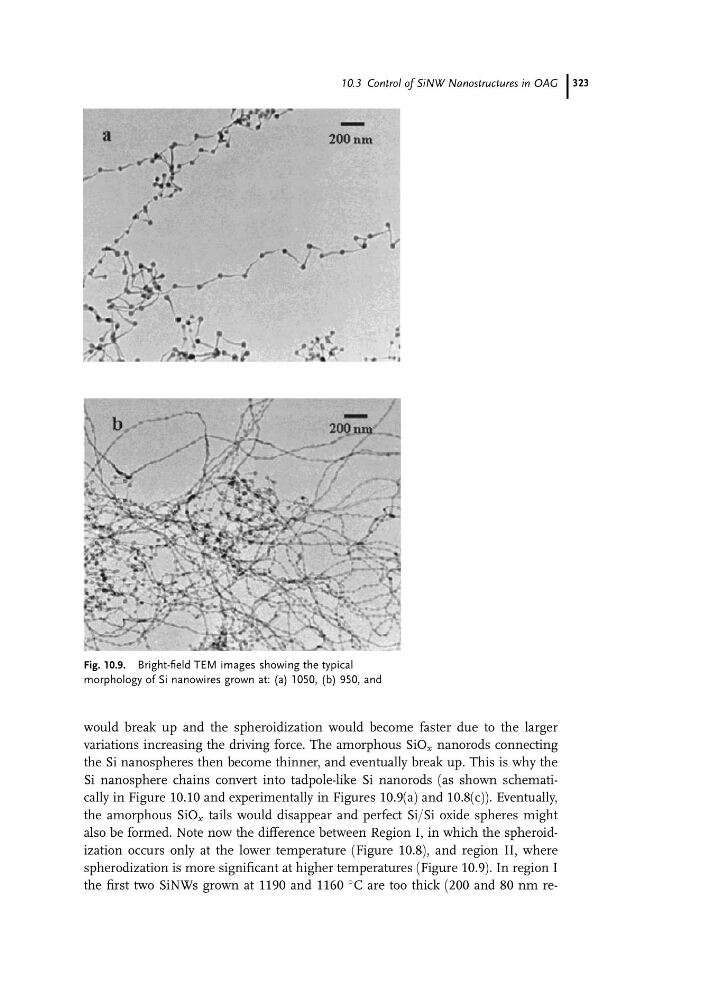
Si nanosphere chains convert into tadpole-like Si nanorods (as shown schematically in Figure 10.10 and experimentally in Figures 10.9(a) and 10.8(c)). Eventually,
the amorphous SiO x tails would disappear and perfect Si/Si oxide spheres might
also be formed. Note now the difference between Region I, in which the spheroidization occurs only at the lower temperature (Figure 10.8), and region II, where
spherodization is more significant at higher temperatures (Figure 10.9). In region I
the first two SiNWs grown at 1190 and 1160
C are too thick (200 and 80 nm reFig. 10.9. Bright-field TEM images showing the typical
morphology of Si nanowires grown at: (a) 1050, (b) 950, and
10.3 Control of SiNW Nanostructures in OAG 323
variations increasing the driving force. The amorphous SiO x nanorods connecting
the Si nanospheres then become thinner, and eventually break up. This is why the
Si nanosphere chains convert into tadpole-like Si nanorods (as shown schematically in Figure 10.10 and experimentally in Figures 10.9(a) and 10.8(c)). Eventually,
the amorphous SiO x tails would disappear and perfect Si/Si oxide spheres might
also be formed. Note now the difference between Region I, in which the spheroidization occurs only at the lower temperature (Figure 10.8), and region II, where
spherodization is more significant at higher temperatures (Figure 10.9). In region I
the first two SiNWs grown at 1190 and 1160
C are too thick (200 and 80 nm reFig. 10.9. Bright-field TEM images showing the typical
morphology of Si nanowires grown at: (a) 1050, (b) 950, and
10.3 Control of SiNW Nanostructures in OAG 323