

Fe-containing Si target. No nanowires could be obtained using a pure SiO 2 target.
We performed several experiments to further understand the nature of this OAG
of nanowires. SiNWs could not be formed by ablation of a pure Si target in the
absence of a pure metal catalyst. A two-stage experiment was carried out to explore
the role of SiO 2 in the nucleation and growth of SiNWs. First, a SiO 2 -containing Si
target was laser ablated to form SiNW nuclei. Second, ablation of a pure Si target
was attempted for further growth. SiNW growth could be observed only when a
SiO 2 -containing Si target was ablated in the second stage. The experiment showed
that in the OAG nucleation of a SiNW a pure Si target was not sufficient for the
further growth and the oxide was continuously needed throughout the entire
SiNW nucleation and growth process. This is in contrast to the metal catalyst VLS
mechanism in which the metal catalyst sustains the growth as long as the pure Si
supply is maintained.
10.2.2
Oxide-Assisted Nucleation Mechanism
We conducted experiments to reveal the nature of the Si core precipitation in the
SiO 2 sheath in this new growth process. In these experiments, the vapor phase
generated from the mixture of Si and SiO 2 at 1200
C mainly consisted of Si
monoxide [Si(s) þ SiO 2 (s) ! 2SiO(g), where (s) and (g) represent solid and gas,
respectively]. This was proven by the EDS observation that the material collected
on the water-cooled Cu finger was Si m O n ðm ¼ 0:51; n ¼ 0:49Þ. Si monoxide (SiO)
is an amorphous semiconductor of high electrical resistivity, which can be readily
generated from the powder mixture (especially in a 1:1 ratio) of Si and SiO 2 by
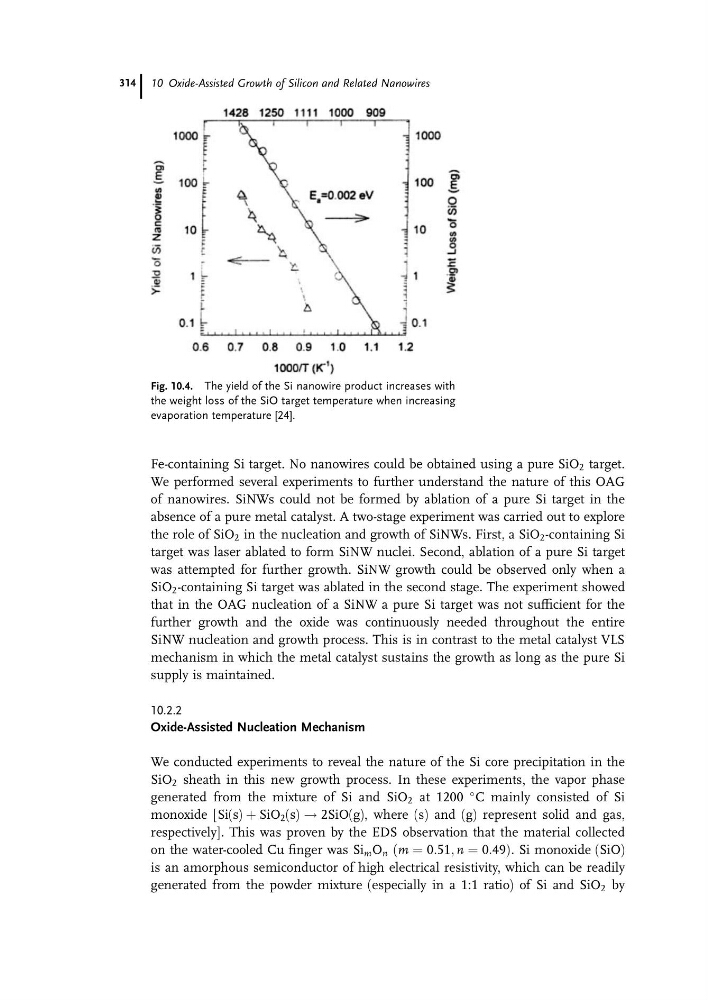
Fig. 10.4. The yield of the Si nanowire product increases with
the weight loss of the SiO target temperature when increasing
evaporation temperature [24].
10 Oxide-Assisted Growth of Silicon and Related Nanowires
314
We performed several experiments to further understand the nature of this OAG
of nanowires. SiNWs could not be formed by ablation of a pure Si target in the
absence of a pure metal catalyst. A two-stage experiment was carried out to explore
the role of SiO 2 in the nucleation and growth of SiNWs. First, a SiO 2 -containing Si
target was laser ablated to form SiNW nuclei. Second, ablation of a pure Si target
was attempted for further growth. SiNW growth could be observed only when a
SiO 2 -containing Si target was ablated in the second stage. The experiment showed
that in the OAG nucleation of a SiNW a pure Si target was not sufficient for the
further growth and the oxide was continuously needed throughout the entire
SiNW nucleation and growth process. This is in contrast to the metal catalyst VLS
mechanism in which the metal catalyst sustains the growth as long as the pure Si
supply is maintained.
10.2.2
Oxide-Assisted Nucleation Mechanism
We conducted experiments to reveal the nature of the Si core precipitation in the
SiO 2 sheath in this new growth process. In these experiments, the vapor phase
generated from the mixture of Si and SiO 2 at 1200
C mainly consisted of Si
monoxide [Si(s) þ SiO 2 (s) ! 2SiO(g), where (s) and (g) represent solid and gas,
respectively]. This was proven by the EDS observation that the material collected
on the water-cooled Cu finger was Si m O n ðm ¼ 0:51; n ¼ 0:49Þ. Si monoxide (SiO)
is an amorphous semiconductor of high electrical resistivity, which can be readily
generated from the powder mixture (especially in a 1:1 ratio) of Si and SiO 2 by
Fig. 10.4. The yield of the Si nanowire product increases with
the weight loss of the SiO target temperature when increasing
evaporation temperature [24].
10 Oxide-Assisted Growth of Silicon and Related Nanowires
314