

heating [22, 48]. By heating the SiO sample, Si precipitation was observed. Such
precipitation of Si nanoparticles from annealed SiO is quite well known [49]. The
precipitation, nucleation and growth of SiNWs always occurred at the area near the
cold finger, which suggests that the temperature gradient provided the external
driving force for nanowire formation and growth. The nucleation of nanoparticles
is assumed to occur on the substrate by decomposition of Si oxide as shown in Eqs.
(1) and (2).
Si x OðsÞ ! Si xÀ1 ðsÞ þ SiOðsÞ ðx > 1Þ
ð 1Þ
2SiOðsÞ ! SiðsÞ þ SiO 2 ðsÞ
ð 2Þ
Our TEM data suggested that this decomposition results in the precipitation of Si
nanoparticles, which are the nuclei of SiNWs, clothed with shells of silicon oxide.
We further initiated theoretical studies to explore the role of the oxide species in
the OAG process. The gas-phase composition of silicon oxide clusters evaporated
by laser ablation or thermal treatment should be considered to be important in the
SiNW synthesis. We first used density functional theory (DFT) calculations to study
the nature of the Si n O m (n; m ¼ 1–8) clusters formed in the gas phase during OAG
[50]. Our calculations show that silicon suboxide clusters are the most probable
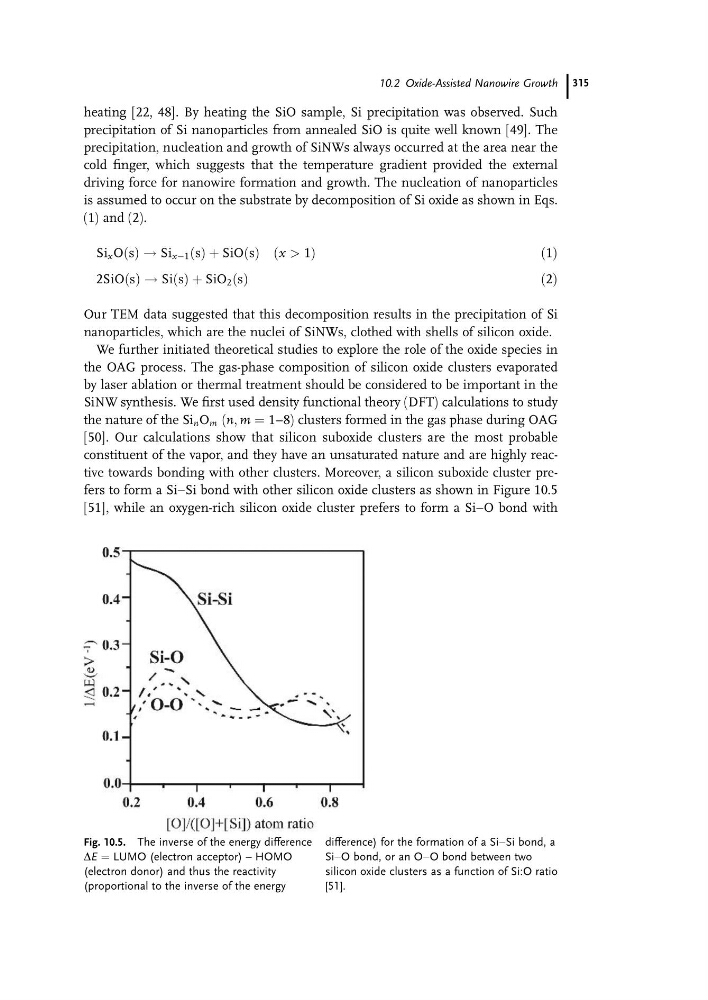
constituent of the vapor, and they have an unsaturated nature and are highly reactive towards bonding with other clusters. Moreover, a silicon suboxide cluster prefers to form a SiaSi bond with other silicon oxide clusters as shown in Figure 10.5
[51], while an oxygen-rich silicon oxide cluster prefers to form a SiaO bond with
Fig. 10.5. The inverse of the energy difference
DE ¼ LUMO (electron acceptor) – HOMO
(electron donor) and thus the reactivity
(proportional to the inverse of the energy
difference) for the formation of a SiaSi bond, a
SiaO bond, or an OaO bond between two
silicon oxide clusters as a function of Si:O ratio
[51].
10.2 Oxide-Assisted Nanowire Growth 315
precipitation of Si nanoparticles from annealed SiO is quite well known [49]. The
precipitation, nucleation and growth of SiNWs always occurred at the area near the
cold finger, which suggests that the temperature gradient provided the external
driving force for nanowire formation and growth. The nucleation of nanoparticles
is assumed to occur on the substrate by decomposition of Si oxide as shown in Eqs.
(1) and (2).
Si x OðsÞ ! Si xÀ1 ðsÞ þ SiOðsÞ ðx > 1Þ
ð 1Þ
2SiOðsÞ ! SiðsÞ þ SiO 2 ðsÞ
ð 2Þ
Our TEM data suggested that this decomposition results in the precipitation of Si
nanoparticles, which are the nuclei of SiNWs, clothed with shells of silicon oxide.
We further initiated theoretical studies to explore the role of the oxide species in
the OAG process. The gas-phase composition of silicon oxide clusters evaporated
by laser ablation or thermal treatment should be considered to be important in the
SiNW synthesis. We first used density functional theory (DFT) calculations to study
the nature of the Si n O m (n; m ¼ 1–8) clusters formed in the gas phase during OAG
[50]. Our calculations show that silicon suboxide clusters are the most probable
constituent of the vapor, and they have an unsaturated nature and are highly reactive towards bonding with other clusters. Moreover, a silicon suboxide cluster prefers to form a SiaSi bond with other silicon oxide clusters as shown in Figure 10.5
[51], while an oxygen-rich silicon oxide cluster prefers to form a SiaO bond with
Fig. 10.5. The inverse of the energy difference
DE ¼ LUMO (electron acceptor) – HOMO
(electron donor) and thus the reactivity
(proportional to the inverse of the energy
difference) for the formation of a SiaSi bond, a
SiaO bond, or an OaO bond between two
silicon oxide clusters as a function of Si:O ratio
[51].
10.2 Oxide-Assisted Nanowire Growth 315